Supreme Court Upholds Ruling on Diplomatic Mission Tenders
Source:The Hindu ↗
Why It Matters
Highlights the crucial role of the judiciary (via judicial review) in ensuring transparency, fairness, and accountability in public procurement and government contracting, which are essential principles of good governance.
Summary
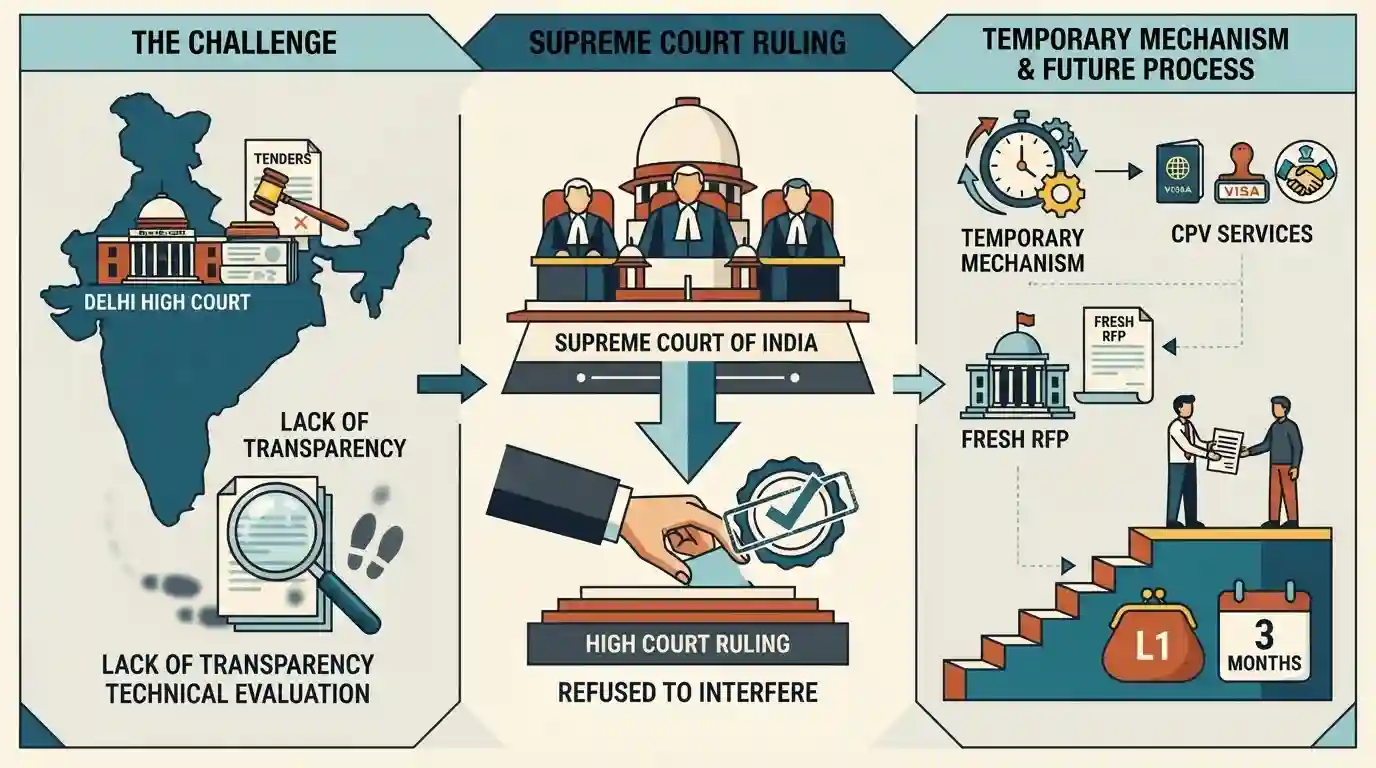
The Supreme Court of India refused to interfere with a Delhi High Court ruling that quashed the Ministry of External Affairs' (MEA) tenders for outsourcing Consular, Passport, and Visa (CPV) services at Indian missions in Abu Dhabi, Kuwait, Singapore, and Canberra. The High Court had struck down the tenders due to a lack of transparency and unfairness in the technical evaluation process. To prevent disruption of services, a three-judge Supreme Court bench headed by CJI Surya Kant permitted the MEA to use a temporary mechanism until a fresh Request for Proposal (RFP) is issued and the work is allocated to the lowest bidder (L1) within three months.
Key Points
- The Supreme Court upheld a Delhi High Court decision to quash MEA tenders for outsourcing Consular, Passport, and Visa (CPV) services at four Indian missions abroad.
- The High Court had nullified the tenders, citing that the technical evaluation of the bidders was unfair and lacked transparency.
- A Supreme Court Bench led by CJI Surya Kant allowed the MEA to make temporary arrangements to ensure uninterrupted CPV services for citizens.
- The MEA has been directed to issue fresh Requests for Proposal (RFPs) and complete the tender process to allocate work to the lowest bidder (L1) within three months.
Important Terms
Supreme Court of India

The highest judicial forum and final court of appeal under the Constitution of India, possessing original, appellate, and advisory jurisdictions to safeguard fundamental rights.
UPSC context
GS Paper II (Polity & Constitution). Tests structure, jurisdiction, and power of the apex court.
Delhi High Court
The premier state-level judicial body in India's National Capital Territory, exercising original, appellate, and constitutional writ jurisdiction under Article 226.
UPSC context
GS Paper II (Polity). Tests knowledge of high courts, their constitutional powers, and writ jurisdictions.
Ministry of External Affairs (MEA)
The Union Ministry responsible for conducting India's foreign relations, representing the nation globally, and administering passport, consular, and visa services.
UPSC context
GS Paper II (International Relations). Tests execution of foreign policy and administrative governance of overseas affairs.
Judicial Review
The constitutional power of the judiciary to examine and invalidate legislative, executive, or administrative actions that violate the Constitution.
UPSC context
GS Paper II (Polity). Tests judicial accountability, separation of powers, and basic structure doctrine.
General Financial Rules (GFR)
A comprehensive set of rules and guidelines issued by the Ministry of Finance to regulate financial management and public procurement across government departments.
UPSC context
GS Paper III (Economy/Governance). Tests mechanisms ensuring fiscal discipline and transparency in public procurement.
Prelims Trap
Courts can evaluate the technical merits and revise pricing of government tenders during judicial review.
Courts do not act as appellate bodies over tender conditions. They only review the decision-making process for arbitrariness, mala fides, or Article 14 violations.
Static Concepts Connected
What are the grounds for judicial review of government contracts?
- Article 14: State actions in contractual matters must not be arbitrary or discriminatory, ensuring equality before the law.
- Wednesbury Principle: Courts intervene if a decision is so unreasonable that no reasonable authority would ever make it.
- Process vs Merit: Judicial review applies to the decision-making process, not the substantive merits or technical scoring of the tender itself.
What is the L1 selection criteria in public procurement?
- L1 System: Under traditional General Financial Rules (GFR), contracts are awarded to the 'Lowest Bidder' (L1) among those who meet all technical qualifications.
- Objective: To ensure taxpayers' money is spent efficiently without compromising on the baseline quality stipulated in the Request for Proposal (RFP).
- QCBS Alternative: For complex consulting or tech services, the government is shifting toward Quality-cum-Cost Based Selection (QCBS) rather than strict L1.
Cross-Topic Patterns
GeM and Procurement Transparency
Judicial interventions in traditional RFPs highlight the governance shift towards platforms like Government e-Marketplace (GeM), which automate L1 selection to minimize arbitrary technical disqualifications and ensure Article 14 compliance.
Diaspora Services & Soft Power
Outsourcing CPV (Consular, Passport, Visa) services is critical for the Indian diaspora. Disruptions in these administrative processes directly impact India's diaspora outreach and soft power, especially in regions like the Gulf.

GS2 Mains 2026 could frame a question balancing judicial review of public procurement against the need to avoid administrative paralysis.
Linked PYQs · 4
Linked PYQs · 4
- 2020PrelimsGS1
Consider the following statements: 1. The Constitution of India defines its 'basic structure' in terms of federalism, secularism, fundamental rights and democracy. 2. The Constitution of India provides for 'judicial review' to safeguard the citizens' liberties and to preserve the ideals on which the Constitution is based. Which of the statements given above is/are correct?
- 2023MainsGS2
e-governance, as a critical tool of governance, has ushered in effectiveness, transparency and accountability in governments. What inadequacies hamper the enhancement of these features ?
- 2024MainsGS2
e-governance is not just about the routine application of digital technology in service delivery process. It is as much about multifarious interactions for ensuring transparency and accountability. In this context evaluate the role of the 'Interactive Service Model' of e-governance.
- 2024MainsGS4
“The 'Code of Conduct' and 'Code of Ethics' are the sources of guidance in public administration. There is code of conduct already in operation, whereas code of ethics is not yet put in place. Suggest a suitable model for code of ethics to maintain integrity, probity and transparency in governance.”
