Supreme Court Stance on Shared Sacred Spaces and Worship Rights
Source:The Hindu ↗
Why It Matters
The article highlights the interplay between the Supreme Court's Article 32 powers and ongoing proceedings in High Courts/Tribunals, a frequent theme in Polity. Additionally, disputes involving the Places of Worship Act, 1991 and shared religious spaces are highly relevant for questions on secularism, communal harmony, and India's composite culture in GS1 and GS2.
Summary
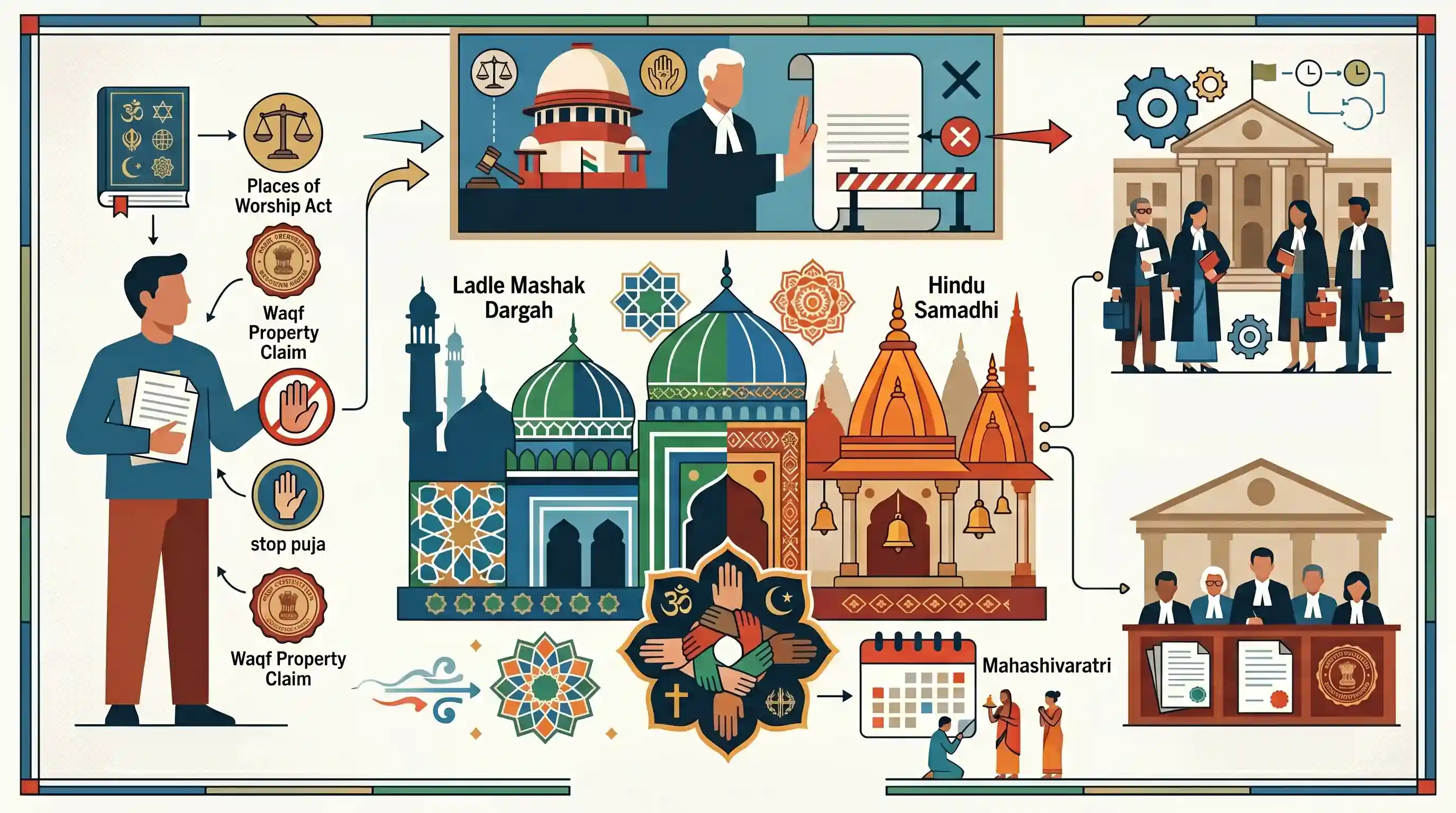
The Supreme Court of India refused to entertain a writ petition under Article 32 that sought to halt a scheduled puja at the Ladle Mashak Dargah in Karnataka on Mahashivaratri. The bench highlighted that a parallel dispute over the site's title and religious character is already under the consideration of the High Court and Waqf Tribunal. The petitioner invoked the Places of Worship Act, 1991, asserting the site's status as waqf property. Historically, the site is a shared sacred space embodying India's syncretic culture, containing both a Sufi saint's dargah and a Hindu saint's samadhi.
Key Points
- The Supreme Court declined to intervene via a writ petition under Article 32 concerning the performance of puja at Ladle Mashak Dargah on Mahashivaratri.
- The Court emphasized that it should not invoke extraordinary jurisdiction while parallel suits on the title and religious character of the site are pending before the High Court and the Waqf Tribunal.
- The petitioner argued that the site was registered as a waqf property in 1980 and alleged that the puja violated the Places of Worship (Special Provisions) Act, 1991.
- The Ladle Mashak Dargah stands as a historical symbol of syncretic culture, simultaneously housing the tomb of 14th-century Sufi saint Hazrat Ladle Mashak and the samadhi of 15th-century Hindu saint Raghava Chaitanya.
Important Terms
Places of Worship (Special Provisions) Act, 1991

A law prohibiting the conversion of any place of worship and mandating the maintenance of its religious character as it existed on August 15, 1947.
UPSC context
GS II: Key for secularism and communal harmony; tests judicial interpretation of historical religious status.
Article 32
A Fundamental Right empowering citizens to approach the Supreme Court directly for the enforcement of Part III rights via writs like Mandamus or Habeas Corpus.
UPSC context
GS II: Fundamental for constitutional remedies; tests the role of the judiciary as the "guarantor" of rights.
Waqf Tribunal
A state-constituted quasi-judicial body under the Waqf Act, 1995, with exclusive jurisdiction to adjudicate disputes regarding the title and character of Waqf properties.
UPSC context
GS II: Relates to statutory bodies and the administration of religious endowments and minority rights.
Syncretic Culture
The harmonious blending of diverse religious and cultural traditions, exemplified by shared sacred spaces like Dargahs that house both Sufi and Hindu shrines.
UPSC context
GS I: Tests understanding of Indian heritage, "Unity in Diversity," and the evolution of composite culture.
Writ Jurisdiction
The constitutional authority of the Supreme Court and High Courts to issue commands to authorities for enforcing rights or correcting legal wrongs.
UPSC context
GS II: Central to judicial review and the protection of fundamental rights against state excesses.
Waqf
A permanent dedication of property for pious, religious, or charitable purposes under Muslim law, managed by state-level boards and overseen by mutawallis.
UPSC context
GS II: Relevant to minority affairs, personal laws, and recent legislative controversies regarding property management.
Prelims Trap
The Supreme Court cannot refuse to entertain a writ petition under Article 32 because moving the Court is a guaranteed Fundamental Right.
While Article 32 is a Fundamental Right, the Supreme Court exercises self-restraint and can refuse petitions if alternative efficacious remedies (like High Courts or Tribunals) are available or parallel proceedings exist.
Static Concepts Connected
What are the key provisions and exemptions of the Places of Worship Act, 1991?
- Cut-off date: Freezes the religious character of a place of worship as it existed on August 15, 1947.
- Strict prohibition: Bars the conversion of any place of worship of any religious denomination into one of a different denomination.
- Statutory exemptions: Exempts the Ram Janmabhoomi-Babri Masjid site and ancient historical monuments covered by the Ancient Monuments and Archaeological Sites and Remains (AMASR) Act, 1958.
What is the role and jurisdiction of a Waqf Tribunal?
- Statutory bodies: They are statutory quasi-judicial bodies constituted under the Waqf Act, 1995, by State Governments.
- Civil jurisdiction: They adjudicate civil disputes relating to waqf properties, functioning as substitutes for ordinary civil courts in such matters.
Cross-Topic Patterns
Syncretism meets the Places of Worship Act
Historical shared spaces (Sufi/Bhakti) are increasingly subjects of legal disputes, creating a tension between lived syncretic traditions (GS1) and strict statutory interpretations of religious character (GS2).
Article 32 limits and alternative remedies
The SC's refusal to intervene highlights the doctrine of alternative remedies, often tested by UPSC when comparing the discretionary nature of Article 226 with the fundamental right of Article 32.

Expect a prelims statement mixing Waqf Tribunal jurisdiction, AMASR Act exemptions, and the Places of Worship Act 1991 cut-off date.
Linked PYQs · 4
Linked PYQs · 4
- 2014PrelimsGS1
The power of the Supreme Court of India to decide disputes between the Centre and the States falls under its
- 2024PrelimsGS1
A Writ of Prohibition is an order issued by the Supreme Court or High Courts to :
- 2017MainsGS2
Examine the scope of Fundamental Rights in the light of the latest judgement of the Supreme Court on Right to Privacy.
- 2025MainsGS1
Examine the main aspects of Akbar's religious syncretism.
