Supreme Court Ruling on Retrospective Environmental Clearances
Source:The Hindu ↗
Why It Matters
This issue is highly relevant for the UPSC syllabus as it touches upon the Environmental Impact Assessment (EIA) process under GS3, and the judiciary's role in interpreting environmental laws (Environmental Jurisprudence) under GS2. The conflict between stalling economically crucial infrastructure and adhering to strict prior environmental safeguards is a classic sustainable development dilemma.
Summary
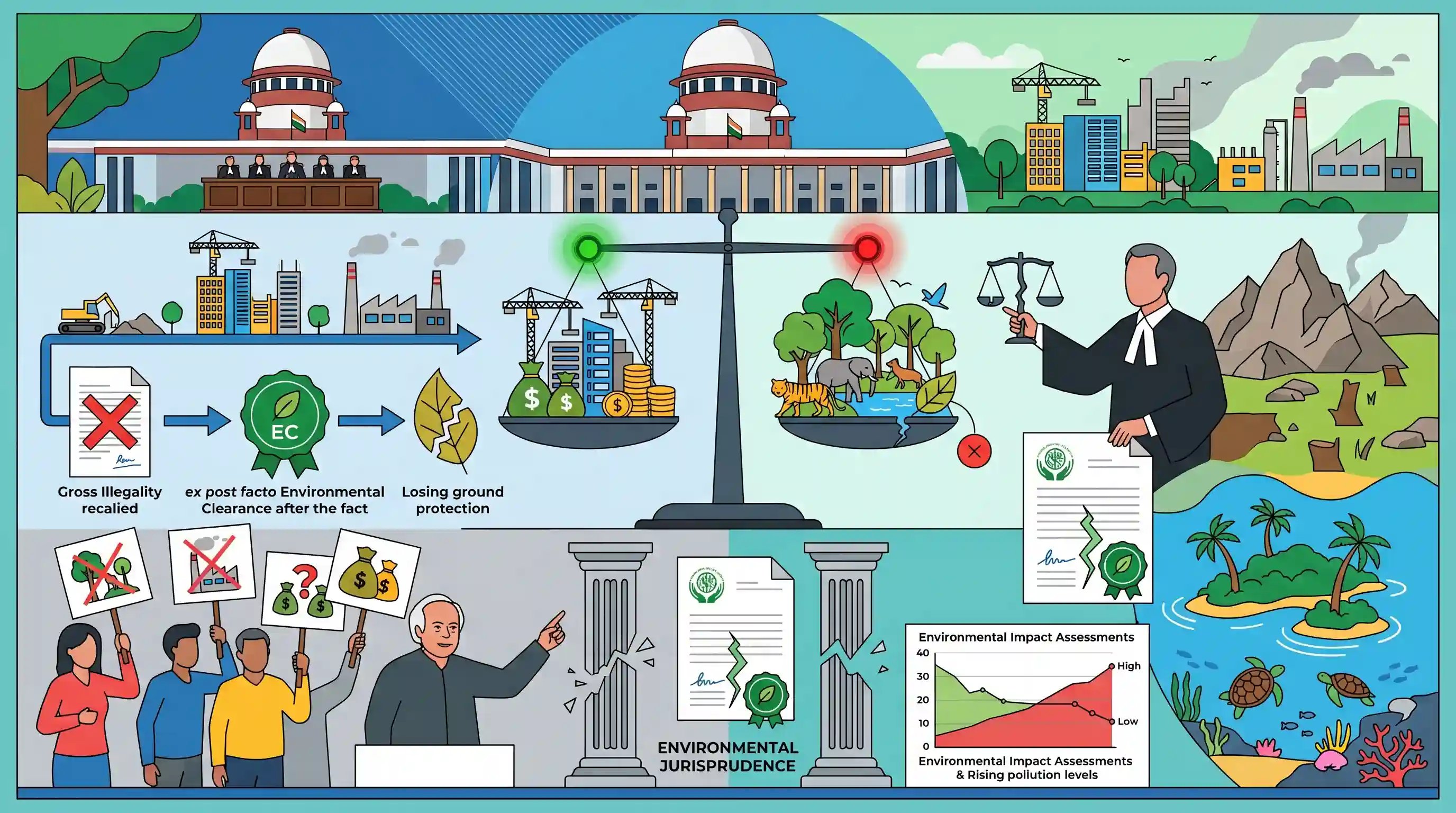
The Supreme Court has refused to entertain a writ petition filed by Congress MP Jairam Ramesh challenging the practice of granting ex post facto (retrospective) environmental clearances (ECs). The Chief Justice of India questioned the use of a writ petition to review a November 2025 majority judgment by a three-judge Bench, which had recalled a previous ruling that deemed retrospective clearances a "gross illegality." The November 2025 majority argued that strictly forbidding ex post facto ECs would waste vast amounts of public money on stalled infrastructure projects. However, a dissenting judge and petitioners argued that retrospective clearances violate the Environment (Protection) Act and undermine the fundamental principles of environmental jurisprudence, threatening sensitive ecosystems like the Aravallis and Great Nicobar.
Key Points
- The Supreme Court declined to entertain Congress MP Jairam Ramesh's writ petition challenging the legality of granting retrospective (ex post facto) environmental clearances to projects.
- Chief Justice Surya Kant noted that a writ petition cannot be used to effectively seek a review of a coordinate Supreme Court bench's judgment, prompting the withdrawal of the plea.
- In November 2025, a three-judge Bench recalled a May 2025 verdict, with the majority ruling that halting projects lacking prior clearance would waste thousands of crores, thereby allowing ex post facto clearances.
- Justice Ujjal Bhuyan dissented in the November 2025 verdict, arguing that the Environment (Protection) Act does not permit retrospective clearances and warning of the detrimental impact on environmental jurisprudence.
- The debate reflects a critical tension between environmental conservation (e.g., in the Aravalli hills and Great Nicobar) and the economic cost of stalling large-scale public infrastructure projects.
Important Terms
Ex Post Facto Environmental Clearance

Retrospective approval granted to projects that commenced without mandatory prior environmental clearance. It essentially regularizes violations, often involving penalties, to prevent the demolition of significant infrastructure investments.
UPSC context
GS Paper 3: Environment. Tests the balance between the Precautionary Principle and economic pragmatism in sustainable development.
Environmental Impact Assessment (EIA)
A prior, systematic process to identify and evaluate the likely environmental and social impacts of a proposed project. It ensures that ecological risks are mitigated before a project begins.
UPSC context
GS Paper 3: Environmental Governance. A vital tool for ensuring that development projects align with ecological safeguards.
Review Petition
Under Article 137, a petition requesting the Supreme Court to reconsider its own judgment. It is typically entertained only on narrow grounds of "apparent error" or miscarriage of justice.
UPSC context
GS Paper 2: Judiciary. Important for understanding judicial procedures, appellate jurisdiction, and the finality of Supreme Court rulings.
Environment (Protection) Act, 1986
India's comprehensive "umbrella" environmental law enacted in 1986. It empowers the Union government to coordinate authorities and frame rules to protect environmental quality and control pollution.
UPSC context
GS Paper 3: Environment. The primary statutory framework for environmental regulation, EIA notifications, and pollution control standards.
Precautionary Principle
A legal tenet holding that if an action has a suspected risk of causing harm to the environment, the burden of proof that it is not harmful falls on those taking the action.
UPSC context
GS Paper 3: Environmental Jurisprudence. A core principle used by the judiciary to strike down potentially harmful projects.
Judicial Review
The power of the Supreme Court and High Courts to examine the legality and constitutionality of legislative or executive actions, including government orders regarding environmental clearances.
UPSC context
GS Paper 2: Polity. A basic structure feature ensuring executive accountability and upholding constitutional mandates like the right to life.
Sustainable Development
Development that meets the needs of the present without compromising the ability of future generations to meet theirs, balancing environmental health with economic and social growth.
UPSC context
GS Paper 3: Environment/Economics. The central theme of the debates over environmental clearances and national infrastructure growth.
Prelims Trap
"A writ petition can be filed to strike down an earlier Supreme Court judgment if it violates constitutional principles."
Judicial orders of the Supreme Court cannot be challenged via Article 32 writ petitions. They can only be challenged through a Review Petition (Art 137) or a Curative Petition.
Static Concepts Connected
What is the statutory and judicial framework for EIA in India?
- EPA 1986: EIA does not have its own standalone Act; it draws statutory backing from the Environment (Protection) Act, 1986 via delegated executive notifications.
- Prior Clearance: The EIA Notification 2006 traditionally mandates 'prior' clearance, which is why ex-post facto (retrospective) regularization remains highly contentious.
- Precautionary Principle: Recognized in the Vellore Citizens Case (1996), it dictates that environmental harm must be anticipated and prevented beforehand, undermining the logic of post-facto approvals.
How does the Supreme Court review its own judgments?
- Article 137: Grants the Supreme Court the inherent power to review any of its judgments or orders to correct apparent errors.
- No Writ Option: A writ petition (Article 32) cannot be entertained as an alternative mechanism to review a final judgment passed by a coordinate bench.
- Curative Petition: Evolved in the Rupa Hurra case (2002), it serves as the final judicial resort to prevent abuse of process after a review petition is dismissed.
Cross-Topic Patterns
Ex-post facto ECs vs Precautionary Principle
The shift towards allowing retrospective clearances to save "sunk public investments" clashes directly with the Precautionary Principle, fueling a classic GS3 Mains debate on sustainable development.
Great Nicobar: Strategic Infrastructure vs PVTGs
Mega-projects receiving expedited or post-facto ECs increasingly pit maritime security and port infrastructure against fragile island ecosystems and PVTG (Shompen) rights.

Expect a Prelims question combining the statutory basis of EIA (EPA 1986), the Precautionary Principle, and Article 137 review powers.
Linked PYQs · 5
Linked PYQs · 5
- 2024MainsGS3
What role do environmental NGOs and activists play in influencing Environmental Impact Assessment (EIA) outcomes for major projects in India? Cite four examples with all important details.
- 2020MainsGS3
How does the draft Environment Impact Assessment (EIA) Notification, 2020 differ from the existing EIA Notification, 2006?
- 2022MainsGS2
“The most significant achievement of modern law in India is the constitutionalization of environmental problems by the Supreme Court.” Discuss this statement with the help of relevant case laws.
- 2021PrelimsGS1
With reference to Indian judiciary, consider the following statements : 1. Any retired judge of the Supreme Court of India can be called back to sit and act as a Supreme Court judge by the Chief Justice of India with prior permission of the President of India. 2. A High Court in India has the power to review its own judgement as the Supreme Court does. Which of the statements given above is/are correct?
- 2017PrelimsGS1
In India, Judicial Review implies
