Supreme Court Rejects Plea for Computer Based Test Mode in NEET Retest
Source:The Hindu ↗
Why It Matters
This incident highlights critical challenges in conducting transparent, large-scale public examinations in India and brings up the debate on judicial restraint versus intervention in administrative matters. It also underscores the importance of technological solutions (like CBTs) and legislative measures to prevent unfair practices, which is directly relevant to GS2 topics on governance, transparency, and institutional accountability.
Summary
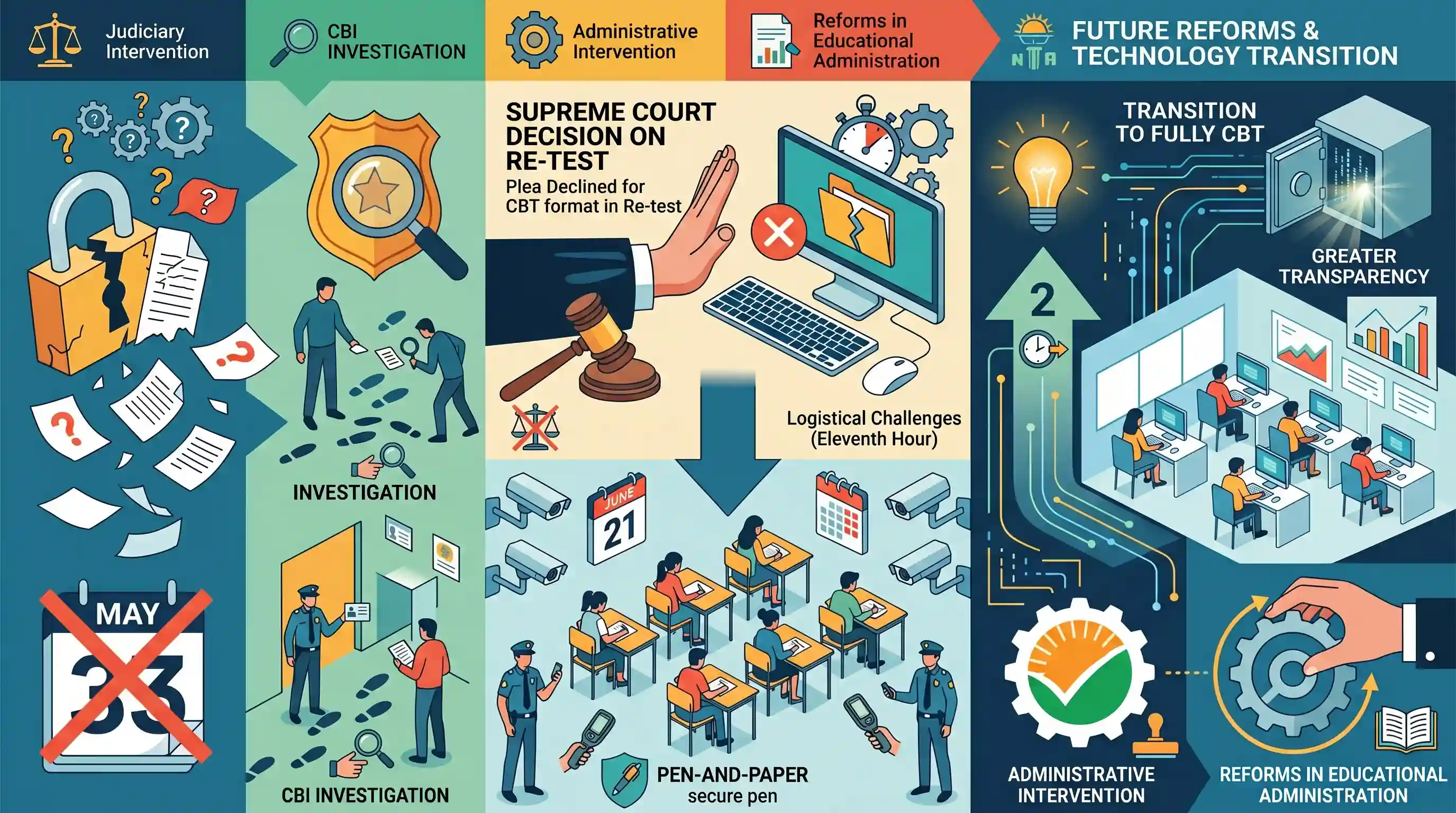
The Supreme Court of India declined a plea to mandate a Computer-Based Test (CBT) format for the June 21 NEET-UG 2026 re-examination, acknowledging the logistical challenges of implementing such a shift at the eleventh hour. The re-test follows the cancellation of the original May 3 exam due to widespread paper leak allegations, currently under CBI investigation. Highlighting the need for accountability in large-scale public examinations, the court deferred the matter to July. Meanwhile, the National Testing Agency (NTA) informed the court that it will implement strengthened anti-cheating protocols for the pen-and-paper re-test and will fully transition the NEET-UG to a CBT mode from the next examination cycle to ensure greater transparency.
Key Points
- The Supreme Court refused a petition to order the National Testing Agency (NTA) to conduct the June 21 NEET-UG 2026 re-examination in a Computer-Based Test (CBT) mode instead of pen-and-paper.
- The bench cited severe practical constraints and logistical difficulties in changing the exam mode on such short notice and deferred the matter to July.
- The original May 3 exam was cancelled nationwide due to paper leak allegations, which are currently under a CBI probe.
- The NTA, acting on the recommendations of a High-Level Committee of Experts, confirmed in its affidavit that NEET-UG will transition to a CBT format starting from the next examination cycle.
- For the upcoming June 21 re-test, the NTA announced a strengthened Standard Operating Procedure (SOP) featuring multi-layer authentication and enhanced surveillance to prevent further lapses.
Important Terms
National Testing Agency (NTA)

An autonomous body under the Ministry of Education established in 2017 to conduct standardized national-level entrance examinations (e.g., NEET, JEE) for higher education admissions.
UPSC context
GS Paper 2: Governance; relevant for institutional reforms in education and the challenges of administrative transparency and accountability.
High-Level Committee of Experts (HLCE)
A 2024 committee chaired by Dr. K. Radhakrishnan tasked with recommending systemic reforms for the NTA, focusing on examination security, data protocols, and institutional restructuring.
UPSC context
GS Paper 2: Administrative Reforms; tests awareness of government measures to restore public trust in competitive examination systems.
Central Bureau of Investigation (CBI)
India’s premier investigative agency under the DSPE Act, 1946, responsible for probing high-profile corruption and complex crimes of national importance, including examination paper leaks.
UPSC context
GS Paper 2: Statutory/Non-statutory bodies; tests understanding of federal investigative jurisdiction and the agency's role in maintaining administrative integrity.
Supreme Court of India
The apex judicial authority in India (Articles 124-147) that ensures the rule of law and protects fundamental rights through judicial review and Article 142 powers.
UPSC context
GS Paper 2: Judiciary; tests knowledge of judicial intervention in executive failures and the principle of 'complete justice' in public interest.
Ministry of Education
The nodal Union Ministry (specifically the Department of Higher Education) responsible for educational policy-making and the administrative oversight of the National Testing Agency.
UPSC context
GS Paper 2: Government Policies; relevant for understanding the executive's responsibility in managing large-scale public services and human resource development.
Prelims Trap
The National Testing Agency (NTA) is a statutory body established by an Act of Parliament.
NTA is an autonomous testing organization registered as a society under the Societies Registration Act, 1860. It is not a statutory body.
Static Concepts Connected
What is the administrative status and mandate of the National Testing Agency (NTA)?
- Legal Status: Registered as a society under the Societies Registration Act, 1860; it is an autonomous, non-statutory body.
- Key Function: Conducts premier entrance examinations like NEET, JEE, CUET, and UGC-NET for higher education institutions.
- Governance: Chaired by an eminent educationist appointed by the Ministry of Education.
What are the core provisions of the Public Examination Act, 2024?
- Coverage: Applies to central exam-conducting bodies like NTA, UPSC, SSC, and Railway Recruitment Boards.
- Penalties: Imposes strict deterrence: up to 10 years in jail and ₹1 crore fine for organized syndicates compromising exams.
- Nature of Offences: All offences under the Act are classified as cognizable, non-bailable, and non-compoundable.
Cross-Topic Patterns
E-governance & Legal Deterrence
The transition to CBT represents an e-governance reform that complements the legal deterrence of the 2024 Public Examination Act to secure public institutions against organized syndicates.
Judicial Restraint in Administration
The SC’s refusal to order a last-minute CBT shift exemplifies judicial restraint, respecting the separation of powers and acknowledging the executive's practical logistical constraints.

Expect a Prelims question pairing the NTA's non-statutory society status with the penal provisions of the 2024 Public Examination Act.
Linked PYQs · 3
Linked PYQs · 3
- 2024MainsGS2
What are the aims and objects of recently passed and enforced, The Public Examination (Prevention of Unfair Means) Act, 2024? Whether University/State Education Board examinations, too, are covered under the Act ?
- 2020MainsGS2
Judicial Legislation is antithetical to the doctrine of separation of powers as envisaged in the Indian Constitution. In this context justify the filing of large number of public interest petitions praying for issuing guidelines to executive authorities.
- 2023MainsGS2
e-governance, as a critical tool of governance, has ushered in effectiveness, transparency and accountability in governments. What inadequacies hamper the enhancement of these features ?
