Judicial Intervention and National Medical Entrance Examinations
Source:The Hindu ↗
Why It Matters
This article highlights the limits of judicial intervention in academic and technical matters. It brings attention to the administrative challenges and transparency issues in conducting large-scale national examinations (like NEET), and the necessity of balancing individual grievances against the broader public interest and stability of the educational system.
Summary
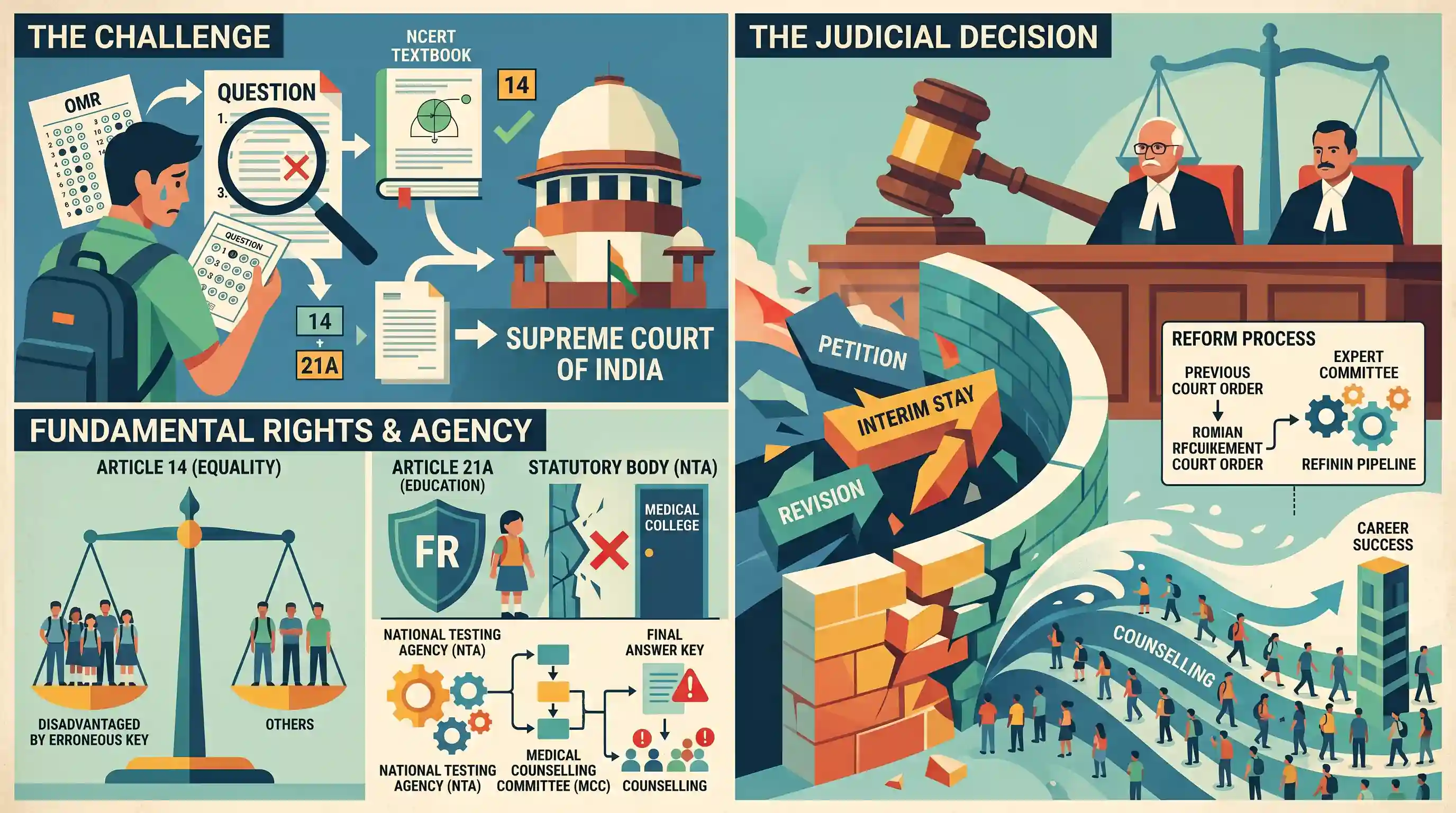
The Supreme Court of India refused to entertain a petition challenging the final answer key of the NEET-UG 2025 examination. The petitioners alleged that the National Testing Agency (NTA) and Medical Counselling Committee (MCC) published an erroneous answer key inconsistent with NCERT textbooks, thereby violating fundamental rights to equality (Article 14) and education (Article 21A). The Court, presided over by Justices P.S. Narasimha and R. Mahadevan, dismissed the plea for an interim stay on counselling. The Bench emphasized that judicial intervention at this stage would endanger the careers of thousands of students, noting that previous court directions had already initiated systemic reforms through an expert committee.
Key Points
- The Supreme Court dismissed a plea seeking a stay on NEET-UG 2025 counselling and a reassessment of results based on alleged errors in the final answer key.
- Petitioners argued that the NTA and MCC's failure to align the answer key with NCERT textbooks violated the fundamental rights to equality (Article 14) and education (Article 21A).
- The Court emphasized that staying a national-level examination at this advanced stage would unjustly jeopardize the careers of thousands of other students.
- The Bench observed that previous judicial orders have already directed the formation of an expert body to recommend systemic reforms in the examination process.
Important Terms
Article 14 of the Constitution

Guarantees equality before the law and equal protection of laws within India. It prohibits arbitrary state action and mandates reasonable classification for any differential treatment by the government.
UPSC context
GS Paper II - Polity. Tests understanding of Fundamental Rights, Rule of Law, and the doctrine of non-arbitrariness in governance.
Article 21A of the Constitution
Mandates the State to provide free and compulsory education to children aged 6 to 14. Inserted by the 86th Amendment Act (2002), it made elementary education a Fundamental Right.
UPSC context
GS Paper II - Social Justice. Tests knowledge of educational rights, the 86th Amendment, and universal elementary education.
National Testing Agency (NTA)
An autonomous testing organization under the Ministry of Education that conducts entrance examinations like NEET and JEE. It aims to provide standardized, transparent, and efficient testing for higher education.
UPSC context
GS Paper II - Governance/Statutory Bodies. Tests knowledge of executive agencies, examination integrity, and administrative reforms in education.
Medical Counselling Committee (MCC)
A body under the Directorate General of Health Services (DGHS) that conducts online seat allotment for undergraduate and postgraduate medical/dental courses based on NEET scores.
UPSC context
GS Paper II - Social Justice/Governance. Tests understanding of centralized admission mechanisms and health education resource distribution.
Supreme Court of India
The highest judicial authority in India and the final interpreter of the Constitution. It possesses original, appellate, and advisory jurisdictions and acts as the guardian of fundamental rights.
UPSC context
GS Paper II - Judiciary. Tests knowledge of judicial review, constitutional interpretation, and the court’s role in public policy disputes.
National Council of Educational Research and Training (NCERT)
An autonomous organization that assists the government in school education policies and prepares standardized textbooks, which serve as the primary curriculum for national competitive exams.
UPSC context
GS Paper II - Social Justice/Education. Tests understanding of curriculum standards and the role of apex academic bodies.
Prelims Trap
"The National Testing Agency (NTA) is a statutory body established under an Act of Parliament."
The NTA is not a statutory body. It is an autonomous testing organization registered as a society under the Indian Societies Registration Act, 1860.
Static Concepts Connected
How is the National Testing Agency (NTA) constituted?
- Legal Status: It is registered as a society under the Indian Societies Registration Act, 1860, not created by a specific statute.
- Administrative Control: It operates as an autonomous, self-sustained testing organization under the Ministry of Education.
- Recent Safeguards: Covered under the Public Examinations (Prevention of Unfair Means) Act, 2024, which prescribes heavy penalties for organized paper leaks.
What is the doctrine of Judicial Restraint?
- Core Principle: A theory of judicial interpretation that encourages judges to limit the exercise of their own power and avoid encroaching on executive/legislative domains.
- Application in Academics: Courts defer to specialized expert bodies (like NTA or medical boards) in technical and academic matters, refusing to act as subject-matter experts.
Cross-Topic Patterns
Article 14 vs. Academic Autonomy
The tension between 'arbitrary state action' (violating Article 14) and courts' reluctance to act as 'super-evaluators' over expert bodies like NTA or UPSC is a recurring constitutional law theme.
Evolving scope of Article 21A
While strictly guaranteeing elementary education (ages 6-14), litigants increasingly invoke Article 21A in higher-education exam disputes, arguing that flawed testing processes deny equitable educational opportunities.

Expect a Prelims question pairing NTA's non-statutory status with the recent Public Examinations (Prevention of Unfair Means) Act 2024.
Linked PYQs · 3
Linked PYQs · 3
- 2024MainsGS2
What are the aims and objects of recently passed and enforced, The Public Examination (Prevention of Unfair Means) Act, 2024? Whether University/State Education Board examinations, too, are covered under the Act ?
- 2021MainsGS2
Analyze the distinguishing features of the notion of Right to Equality in the Constitutions of the USA and India.
- 2022MainsGS2
The Right of Children to Free and Compulsory Education Act, 2009 remains inadequate in promoting incentive-based system for children's education without generating awareness about the importance of schooling. Analyse.
