Supreme Court Recalls Liquidation Order for Bhushan Steel
Source:The Hindu ↗
Why It Matters
This article is important for UPSC aspirants as it touches upon the core philosophy of the Insolvency and Bankruptcy Code (IBC) — prioritizing corporate resolution over liquidation. It also provides a practical example of the Supreme Court's power to recall and review its own judgments when an apparent error in interpreting statutory law is identified, which is highly relevant for GS2 Polity and GS3 Economy.
Summary
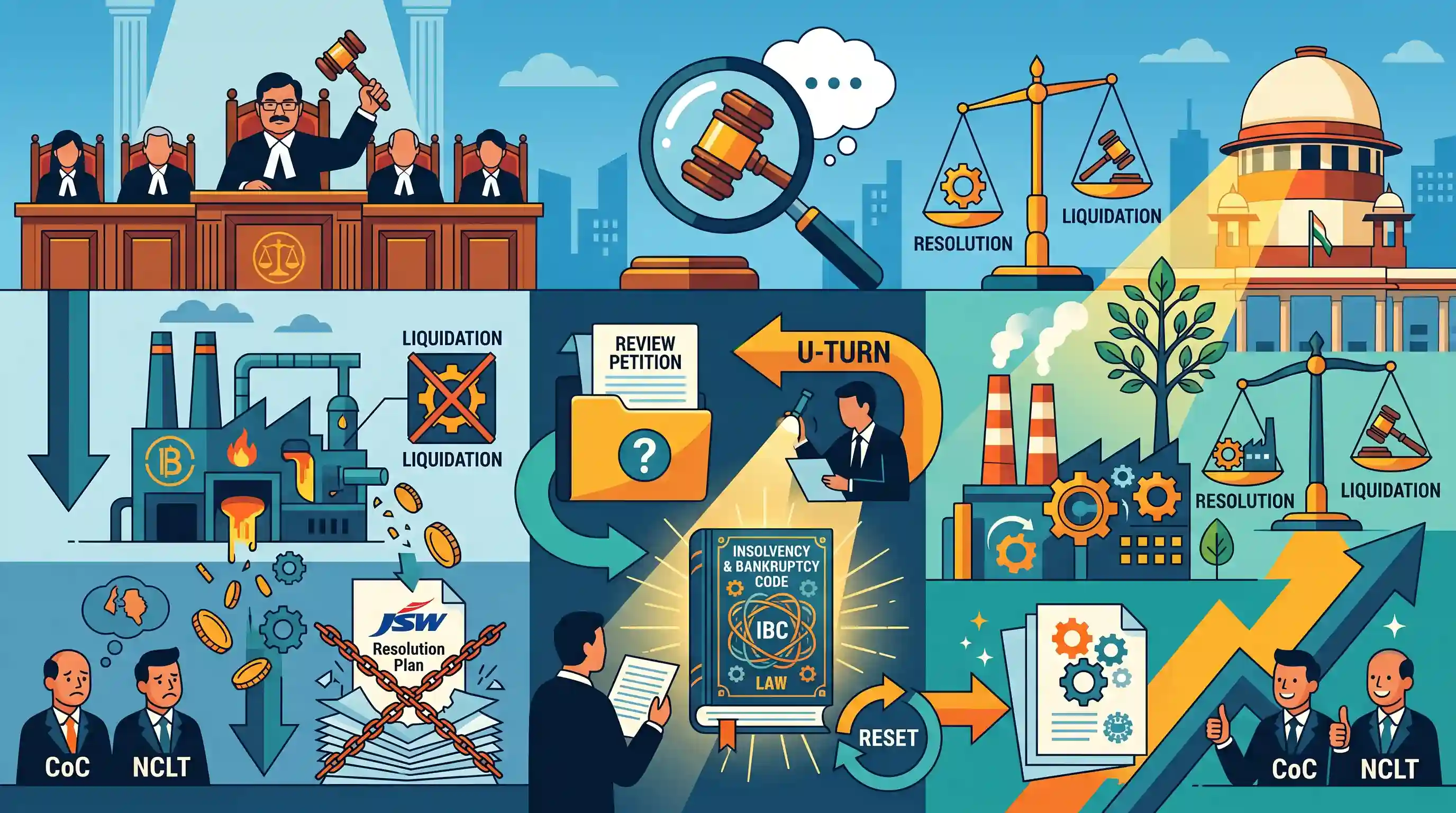
The Supreme Court recalled its May 2 verdict that had ordered the liquidation of Bhushan Steel and Power Limited (BSPL) and quashed the resolution plan proposed by JSW Steel Limited. A bench headed by Chief Justice of India B.R. Gavai noted that the earlier judgment, which had criticized the Committee of Creditors (CoC) and the National Company Law Tribunal (NCLT), failed to consider key legal aspects of the Insolvency and Bankruptcy Code (IBC) correctly. Consequently, the top court will hear the review petitions afresh. The decision underscores the importance of correctly interpreting the IBC's framework, which generally prioritizes the resolution of stressed assets over outright liquidation, and demonstrates the self-correcting mechanisms within the higher judiciary.
Key Points
- The Supreme Court recalled its May 2, 2024 verdict that had ordered the liquidation of Bhushan Steel and Power Limited (BSPL).
- A new bench led by CJI B.R. Gavai set aside the earlier order, stating it failed to correctly interpret the legal position under the Insolvency and Bankruptcy Code (IBC).
- The previous May 2 verdict had quashed the resolution plan by JSW Steel Limited and heavily criticized the National Company Law Tribunal (NCLT) and the Committee of Creditors (CoC) for flagrant violations of the IBC.
- The Supreme Court will now hear the review petitions filed by the CoC, JSW Steel, and others afresh, highlighting the tension between prioritizing asset resolution over liquidation.
Important Terms
Insolvency and Bankruptcy Code (IBC)

A comprehensive 2016 law providing a time-bound framework for resolving insolvency of companies, individuals, and partnerships. It aims to maximize asset value and balance stakeholder interests.
UPSC context
GS Paper III (Economy); tests knowledge of NPA resolution, credit market reforms, and ease of doing business.
National Company Law Tribunal (NCLT)
A quasi-judicial body established under the Companies Act, 2013. It acts as the primary Adjudicating Authority for corporate insolvency, restructuring, and winding-up proceedings under the IBC.
UPSC context
GS Paper II/III; tests understanding of statutory/quasi-judicial bodies and corporate governance legal frameworks.
Committee of Creditors (CoC)
A decision-making body under the IBC, primarily composed of financial creditors. It assesses resolution plans and holds the 'commercial wisdom' to decide a debtor's revival or liquidation.
UPSC context
GS Paper III (Economy); evaluates the creditor-in-control model and the primacy of financial creditors in insolvency.
Review Petition
A legal remedy under Article 137 of the Constitution allowing the Supreme Court to revisit its own judgment to correct a 'patent error' or prevent miscarriage of justice.
UPSC context
GS Paper II (Judiciary); tests knowledge of judicial remedies and the self-correcting mechanisms of the higher judiciary.
Resolution Plan
A proposal submitted by a resolution applicant for the revival and reorganization of a corporate debtor, requiring approval by 66% of the CoC and the NCLT.
UPSC context
GS Paper III (Economy); focuses on the 'revival-oriented' philosophy of the IBC over outright liquidation.
Liquidation
The final process of winding up a company and distributing its assets to creditors, occurring if no viable resolution plan is approved within the IBC's statutory timelines.
UPSC context
GS Paper III (Economy); tests understanding of the exit mechanism for failed firms and the 'waterfall' priority of claims.
Prelims Trap
Liquidation of assets is the primary objective of the Insolvency and Bankruptcy Code (IBC) to ensure quick recovery for creditors.
The IBC structurally prioritizes corporate resolution and revival over liquidation. Liquidation is strictly the last resort if resolution fails.
Static Concepts Connected
What are the grounds for a Supreme Court Review Petition?
- Constitutional Basis: Under Article 137, the Supreme Court can review its own judgments to correct patent errors or misinterpretations.
- Limited Scope: Permitted only for errors apparent on the face of the record or discovery of new evidence, not as an appeal.
- Functus Officio: It acts as a vital exception to the rule that a case cannot be reopened once a final judgment is pronounced.
How does the Committee of Creditors (CoC) function under the IBC?
- Composition: Consists primarily of financial creditors. Operational creditors have limited or no voting rights in the CoC.
- Commercial Wisdom: The CoC is the supreme decision-making body; its commercial decisions regarding resolution plans are generally non-justiciable.
- Voting Threshold: A resolution plan requires a 66% majority vote from the Committee of Creditors for approval.
Cross-Topic Patterns
IBC vs Judicial Intervention
The friction between NCLT/Supreme Court oversight and the CoC's 'commercial wisdom' is a recurring theme bridging GS2 Judiciary and GS3 Economy.
Hierarchy of Judicial Correction
This links directly to the constitutional progression of judicial remedies: from standard appeals to Review Petitions (Article 137) and finally Curative Petitions.

Expect a 2026 Prelims statement testing if NCLT can overrule the 'commercial wisdom' of the CoC on a resolution plan's viability.
Linked PYQs · 3
Linked PYQs · 3
- 2021PrelimsGS1
With reference to Indian judiciary, consider the following statements : 1. Any retired judge of the Supreme Court of India can be called back to sit and act as a Supreme Court judge by the Chief Justice of India with prior permission of the President of India. 2. A High Court in India has the power to review its own judgement as the Supreme Court does. Which of the statements given above is/are correct?
- 2017PrelimsGS1
In India, Judicial Review implies
- 2016MainsGS2
What was held in the Coelho case? In this context, can you say that judicial review is of key importance amongst the basic features of the Constitution?
