CBSE digital evaluation glitches and administrative accountability
Source:The Hindu ↗
Why It Matters
This development illustrates the real-world administrative and technical bottlenecks in transitioning public systems to digital formats (e-governance) without adequate institutional capacity building (evaluator training). It represents a classic study of how technological policy design must prioritize user-centric requirements (students and evaluators) to avoid systemic failures, while showcasing how the judiciary steps in to protect public interest without overstepping into policy formulation.
Summary
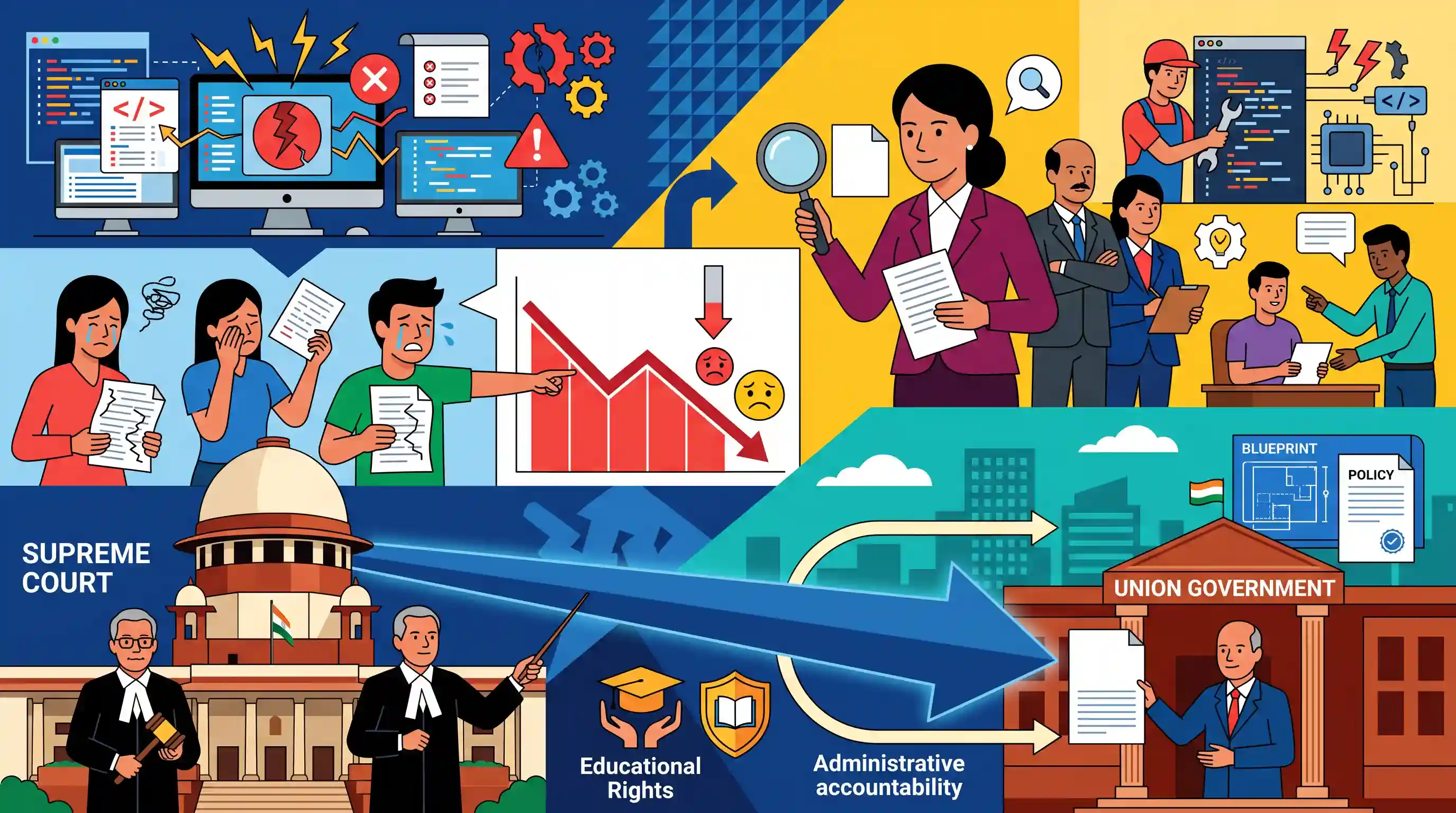
The Supreme Court of India has sought a status report from the Union government regarding systemic failures in the Central Board of Secondary Education's (CBSE) On-Screen Marking (OSM) system for the 2026 Class 12 board examinations. Highlighting the extreme frustration of students, the court has focused on a one-member inquiry panel led by S. Radha Chauhan to address technical defects and lack of examiner training. The glitches led to a 7-year low pass percentage of 85.2%. While acknowledging the government's right to policy formulation, the court emphasized judicial review to guarantee administrative accountability and protect students' educational rights.
Key Points
- The Supreme Court of India directed the Union government to address the frustration of Class 12 students caused by systemic failures and irregularities in the CBSE's On-Screen Marking (OSM) system in 2026.
- The OSM technical glitches and implementation gaps reportedly contributed to a sharp drop in the Class 12 pass percentage to 85.2%, a 3.19 percentage point decrease and the lowest level in seven years.
- The Union government has constituted a one-member probe committee led by S. Radha Chauhan (retired IAS officer and Capacity Building Commission chairperson) to investigate the technological defects and evaluation lapses.
- The petitioner, Rakesh Binjola, highlighted that the OSM system was rolled out without formal training for evaluators, leading to issues like unchecked answers, illegible scanning of pages, and a breach of the board's duty of care.
- The Supreme Court clarified that while the government has the right to formulate policies like OSM, the judiciary's intervention aims to ensure seamless, non-adversarial improvements to avoid student harassment.
- Technology vendor Coempt attributed the answer sheet mix-ups to manual oversight rather than fundamental system design errors.
Important Terms
On-Screen Marking (OSM) system

A digital evaluation system where examiners assess scanned copies of physical answer scripts on computer screens rather than grading paper copies manually, aimed at standardising the assessment process.
UPSC context
GS Paper II (e-Governance applications and limitations), testing digital reforms in administrative processes and their implementation challenges.
Capacity Building Commission
An independent body under Mission Karmayogi tasked with standardising civil services training, coordinating capacity-building initiatives, and auditing training institutions in India.
UPSC context
GS Paper II (Governance and civil services reforms), examining institutional frameworks designed to modernise public service state capacity.
Central Board of Secondary Education (CBSE)
India's premier national board of education under the Ministry of Education, responsible for curriculum development and conducting secondary and senior secondary board examinations.
UPSC context
GS Paper II (Issues relating to development and management of Education), testing national-level educational administration and public accountability.
Supreme Court of India
The apex judicial authority in India under the Constitution, serving as the ultimate interpreter of laws and guardian of fundamental rights with powers of judicial review.
UPSC context
GS Paper II (Structure, organisation, and functioning of the Judiciary), assessing judicial intervention in public administration and policy failure.
Coempt
A private educational technology firm contracted by CBSE to design, scan, and manage the digital portal hosting the On-Screen Marking evaluation process.
UPSC context
GS Paper II (Governance and Public-Private Partnerships), assessing data security, digital vendor accountability, and procurement standards.
Prelims Trap
The Capacity Building Commission (CBC) is a statutory body established by an Act of Parliament to oversee civil service reforms.
CBC was set up in 2021 through an executive resolution (gazette notification) under the DoPT, making it an executive body, not a statutory one.
Static Concepts Connected
What is the status and role of the Capacity Building Commission (CBC)?
- Executive Origin: Established in 2021 via an executive gazette notification under DoPT, not through a legislative statute.
- Training Custodian: Acts as the central supervisor for standardizing civil services training and formulating the Annual State of Civil Services Report.
- Reform Driver: Serves as the functional engine of NPCSCB to shift public administration from rule-based to role-based competency frameworks.
When can courts judicially review executive policy decisions?
- Substantive illegality: Courts intervene if a policy violates constitutional provisions, fundamental rights (Articles 14, 21), or is patently arbitrary and unreasonable.
- Procedural impropriety: Review is permitted if the decision-making process lacks fair play, violates natural justice, or fails the test of proportionality.
- Policy non-interference: The judiciary generally avoids substituting its own wisdom for that of the executive in technical or purely administrative policy design.
Cross-Topic Patterns
Digital governance vs. educational equity
Automated grading errors expose how rapid digital rollouts without user-centric design can jeopardize the fundamental educational rights of disadvantaged students under Article 21.
Technology adoption + Capacity building
Systemic evaluation lapses underscore that e-governance transitions fail without matching human-resource training, justifying Mission Karmayogi's focus on administrative skill development.

2026 GS2 could analyze judicial intervention limits in policy implementation through the lens of e-governance and administrative lapses.
Linked PYQs · 3
Linked PYQs · 3
- 2023MainsGS2
e-governance, as a critical tool of governance, has ushered in effectiveness, transparency and accountability in governments. What inadequacies hamper the enhancement of these features ?
- 2025MainsGS2
e-governance projects have a built-in bias towards technology and back-end integration than user-centric designs. Examine.
- 2020MainsGS2
Judicial Legislation is antithetical to the doctrine of separation of powers as envisaged in the Indian Constitution. In this context justify the filing of large number of public interest petitions praying for issuing guidelines to executive authorities.
