Supreme Court Scrutiny on Cancer Drug Pricing and Regulation
Source:The Hindu ↗
हे का महत्त्वाचे आहे
It directly relates to public health governance, the affordability of life-saving drugs, and the regulatory effectiveness of state mechanisms like the NPPA in curbing exploitative pricing in the pharmaceutical sector.
सारांश
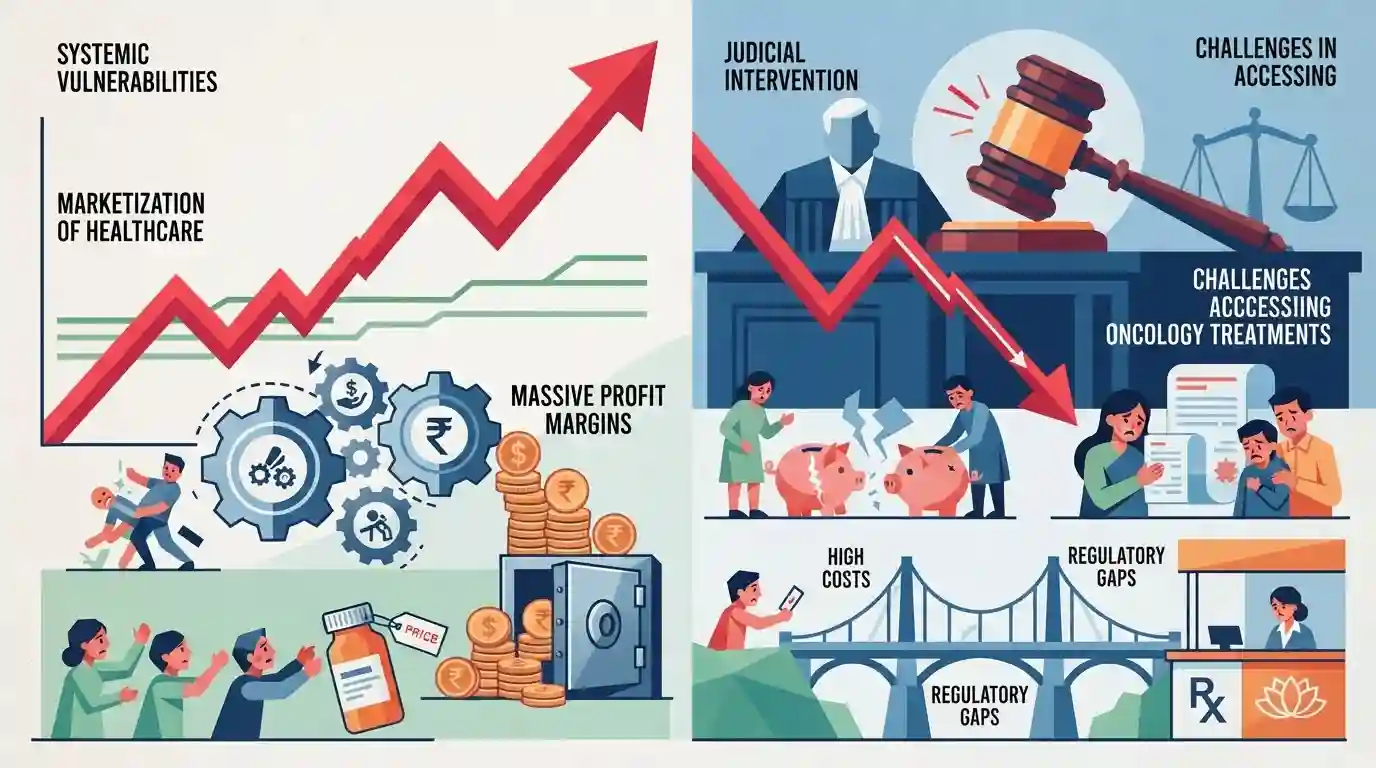
The Supreme Court of India strongly criticized the exorbitant mark-ups on cancer drugs, terming the pricing disparity and massive profit margins a 'carnage' for patients. The judicial observation sheds light on systemic vulnerabilities in drug pricing, marketization of healthcare, and the challenges faced by citizens in accessing affordable oncology treatments.
मुख्य मुद्दे
- The Supreme Court criticized the steep mark-ups on cancer medicines, describing the pricing disparity and profit margins as a form of 'carnage' affecting patients.
- The court raised concerns regarding the role of pharmaceutical companies, hospitals, and distributors in driving up the costs of critical life-saving oncology drugs.
- The discussions highlight systemic issues in drug price regulation, affordability, and access to essential healthcare in India under frameworks like the National Pharmaceutical Pricing Authority (NPPA).
महत्त्वाच्या संज्ञा
Drugs (Prices Control) Order (DPCO)

An order issued by the Central Government under Section 3 of the Essential Commodities Act, 1955, enabling it to fix the prices of essential medicines and regulate their availability.
UPSC context
GS Paper II (Health/Social Sector): Evaluates government policies, regulatory mechanisms, and interventions for making essential healthcare affordable.
National Pharmaceutical Pricing Authority (NPPA)
An apex regulatory agency established under the Department of Pharmaceuticals, Ministry of Chemicals and Fertilizers, tasked with fixing/revising prices of pharmaceutical products and enforcing DPCO provisions.
UPSC context
GS Paper II (Statutory Bodies/Health): Tests knowledge of regulatory institutions, market oversight, and mechanisms to check profiteering in drug pricing.
Supreme Court of India
The highest constitutional court of India, which interprets laws, protects fundamental rights, and exercises judicial review over legislative and executive actions regarding healthcare access.
UPSC context
GS Paper II (Polity/Judiciary): Examines judicial activism, protection of the right to health under Article 21, and checks on policy execution.
पूर्वपरीक्षा सापळा
NPPA regulates the pricing of all medicines sold in India without exception.
The NPPA only regulates scheduled formulations under the NLEM and exercises price control on non-scheduled drugs up to a 10% annual increase, not every drug automatically.
संबंधित स्थिर संकल्पना
What are the statutory functions and powers of the National Pharmaceutical Pricing Authority (NPPA)?
- Price Ceiling: Mandated by DPCO 2013, it fixes ceiling prices for scheduled formulations listed in the National List of Essential Medicines (NLEM).
- Parent Ministry: Functions under the administrative control of the Department of Pharmaceuticals, Ministry of Chemicals and Fertilizers.
- Extraordinary Powers: Empowered under Paragraph 19 of DPCO 2013 to fix or revise prices under extraordinary circumstances in public interest.
आंतर-विषय नमुने
Right to Health vs. Commercialized Healthcare
Exorbitant mark-ups in private healthcare connect the right to health (Article 21) directly with federal fiscal devolution and state-level regulatory enforcement of clinical establishment acts.
Drug Price Control and TRIPS Flexibility
Disparities between manufacturer costs and MRP highlight regulatory friction within the DPCO framework, intersecting with intellectual property rights and TRIPS flexibilities.

NPPA's emergency powers under Para 19 DPCO 2013 and NLEM inclusion criteria are prime targets for match-the-following Prelims items.
संबंधित PYQ · 1
संबंधित PYQ · 1
- 2024MainsGS2
In a crucial domain like the public healthcare system the Indian State should play a vital role to contain the adverse impact of marketisation of the system. Suggest some measures through which the State can enhance the reach of public healthcare at the grassroots level.
