Supreme Court Protects Judicial Discretion for Bail in Rajasthan
Source:supremetoday-ai ↗
Why It Matters
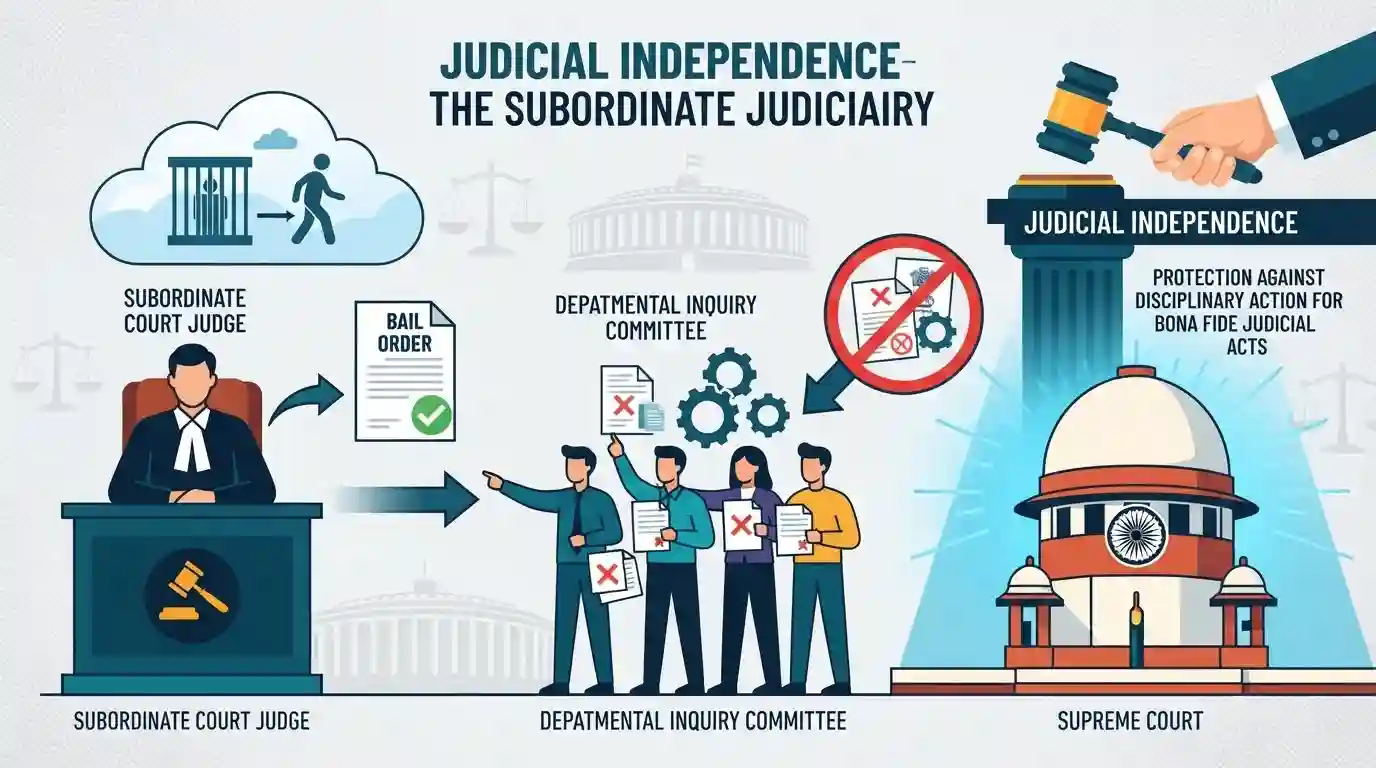
This ruling is vital for understanding the boundaries of judicial accountability versus judicial independence, ensuring that subordinate court judges can exercise bonafide discretion in granting bail without fear of unwarranted disciplinary action.
Summary
The Supreme Court quashed a disciplinary inquiry against a retired Rajasthan judge, ruling that departmental proceedings cannot be initiated simply for granting a bail order unless mala fides or corruption are proven, safeguarding judicial independence in the subordinate judiciary.
Key Points
- The Supreme Court of India quashed a disciplinary inquiry initiated against a retired Rajasthan judicial officer over a bail order passed by them.
- The apex court emphasized that judicial officers cannot be subjected to departmental proceedings merely because a judicial order or grant of bail is perceived to be erroneous, unless there is clear evidence of extraneous considerations, corruption, or mala fides.
- This judgment reinforces the principle of judicial independence and protects subordinate judiciary members from malicious or routine disciplinary harassment for exercising bonafide judicial discretion.
Important Terms
Supreme Court of India

The apex court of India established under Article 124 of the Constitution, possessing ultimate appellate, original, and advisory jurisdiction, and entrusted with safeguarding fundamental rights and judicial independence across the nation.
UPSC context
Important for RPSC Paper II (Indian Polity and Governance) under structure, organization, and functioning of the Supreme Court and judicial review.
Rajasthan High Court
The highest constitutional court of the state of Rajasthan established under Article 214 of the Constitution, exercising original and appellate jurisdiction over civil and criminal matters and supervisory control over subordinate courts.
UPSC context
Crucial for Rajasthan Polity (RPSC Papers II & III) covering state judiciary organization, writs, and administrative control over judicial officers.
Prelims Trap
departmental proceedings can be initiated against judicial officers for passing erroneous judicial orders without proving corruption.
Aspirants may think that any erroneous judicial order can attract departmental disciplinary proceedings under the CCA rules, whereas the Supreme Court requires proof of mala fides or corruption.
Static Concepts Connected
What are the constitutional and statutory safeguards for the independence of the subordinate judiciary in India?
- Article 235: Article 235 vests the control over district courts and subordinate courts in the hands of the High Court, including posting and promotion.
- Protection Act: Judicial officers acting in their judicial capacity are protected from civil suits and criminal liability under the Judicial Officers Protection Act, 1850.
- Disciplinary Threshold: Departmental proceedings against judicial officers cannot be initiated merely for erroneous judicial decisions in the absence of mala fides, corruption, or extraneous motives.
Cross-Topic Patterns
Judicial Accountability vs. Administrative Remedies
While disciplinary action requires proof of mala fides, administrative remedies for perceived judicial errors include counselling, warnings, or adverse entries in Annual Confidential Reports (ACR).
CCA Rules and Subordinate Judiciary Safeguards
The Rajasthan Civil Services (Classification, Control and Appeal) Rules, 1958 govern disciplinary proceedings for state service officers, including members of the Rajasthan Judicial Service.

Expect a statement-based RPSC question on the threshold for initiating departmental inquiries against judicial officers for judicial orders.
Linked PYQs · 2
Linked PYQs · 2
- 2025RPSC_PRELIMSGS1
Which of the following statements regarding subordinate legislation in the Rajasthan Legislative Assembly is not correct?
- 2025RPSC_PRELIMSGS1
Under which article of the Constitution is there a mandatory consultation provision with the Rajasthan Public Service Commission in disciplinary cases affecting serving personnel under the Government of Rajasthan?
