Supreme Court sets three-month deadline for President on State Bills
Source:The Hindu ↗
Why It Matters
It establishes crucial judicial precedent on the constitutional deadlock between elected state governments and appointed Governors over legislative assent, clarifying the operational boundaries of Article 200, Article 201, and Article 143.
Summary
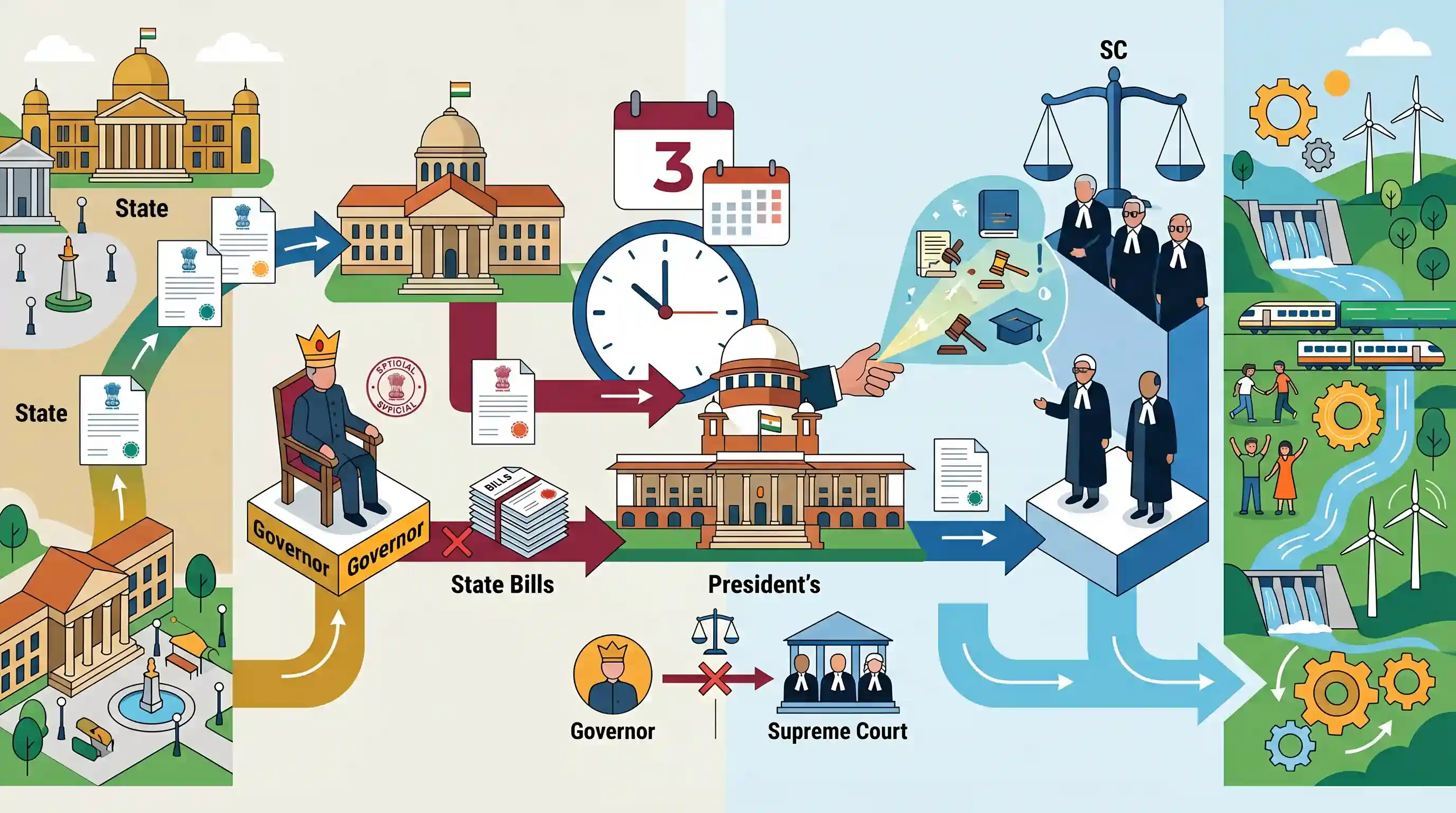
In a significant constitutional ruling, the Supreme Court has imposed a three-month deadline for the President to decide on State Bills reserved by a Governor for consideration. Furthermore, Justices J.B. Pardiwala and R. Mahadevan advised the President to utilize Article 143 to consult the apex court on Bills reserved due to alleged constitutional invalidity, since Governors lack the mechanism to directly refer Bills to constitutional courts. The decision stems from Tamil Nadu's writ petition against Governor R.N. Ravi over withheld legislation, providing a legal remedy to federal friction and preventing legislative gridlock caused by prolonged inaction on state laws.
Key Points
- The Supreme Court imposed a three-month deadline on the President to decide on State Bills reserved by a Governor.
- The bench suggested the President invoke Article 143 to consult the Supreme Court on Bills reserved due to perceived unconstitutionality.
- This mechanism was recommended because Governors do not have the constitutional power to refer Bills directly to constitutional courts.
- The judgment was delivered in response to Tamil Nadu's writ petition against Governor R.N. Ravi for withholding assent to 10 passed Bills.
- The ruling addresses increasing federal friction, acting as a safeguard against prolonged legislative paralysis caused by Governors in opposition-ruled states.
Important Terms
Article 200

Article 200 outlines the Governor's powers when a Bill is presented for assent. The Governor can grant assent, withhold it, return the Bill for reconsideration, or reserve it for the President's consideration.
UPSC context
GS Paper II (Polity); essential for questions on the discretionary powers of the Governor and legislative procedures in states.
Article 201
Article 201 governs the procedure for Bills reserved by the Governor for Presidential consideration. The President can grant assent, withhold it, or direct the Governor to return non-Money Bills for legislative reconsideration.
UPSC context
GS Paper II; key to understanding the President's veto powers over state legislation and Centre-State legislative relations.
Article 143
Article 143 establishes the Supreme Court's advisory jurisdiction. It empowers the President to seek the Court's opinion on questions of law or fact that are of significant public importance.
UPSC context
GS Paper II; tests knowledge of the consultative mechanism between the Executive and Judiciary and the Supreme Court's jurisdiction.
Federalism
A constitutional system of governance where power is divided between a central authority and various regional units (States). In India, it emphasizes cooperative functioning between the Union and the States.
UPSC context
GS Paper II; a "basic structure" concept central to issues involving state autonomy and Centre-State friction.
Writ of Mandamus
A judicial writ issued as a command to an inferior court, public official, or constitutional authority to perform a legal duty that they have failed to carry out.
UPSC context
GS Paper II; fundamental rights and remedies; tests the judiciary's ability to compel constitutional authorities to act.
Prelims Trap
The Constitution mandates a three-month deadline for the President to decide on State Bills reserved by the Governor.
The Constitution (Article 201) sets no explicit time limit. The three-month deadline is a new judicial innovation by the Supreme Court.
Static Concepts Connected
What are the President's powers regarding reserved State Bills (Article 201)?
- Three Options: The President can grant assent, withhold assent, or direct the Governor to return the Bill (if it is not a Money Bill) to the state legislature.
- No Veto Override: Unlike Parliamentary bills, if the State Legislature re-passes the returned bill with or without amendments, the President is still not constitutionally bound to give assent.
What are the key features of the Supreme Court's Advisory Jurisdiction (Article 143)?
- Presidential Privilege: Only the President can refer questions of law or public importance to the Supreme Court. Governors lack the constitutional mechanism to directly consult the apex court.
- Non-binding Nature: The opinion delivered by the Supreme Court is strictly advisory and is not legally binding on the President or the Union Government.
- Canadian Origin: This feature is borrowed from the Canadian Constitution, distinguishing it from the US Supreme Court which does not exercise advisory jurisdiction.
Cross-Topic Patterns
Punchhi Commission vs. Judicial Mandates
The Punchhi Commission previously recommended a six-month time limit for the President on reserved bills. The Supreme Court has now judicially enforced a stricter three-month deadline to resolve federal deadlocks.
Federalism and Constitutional Silences
The Supreme Court is increasingly interpreting constitutional silences—such as the lack of explicit timelines in Articles 200 and 201—to actively safeguard federalism, an essential feature of the Basic Structure.

Expect a 2026 Prelims question testing if the 3-month deadline for reserved State Bills is a Constitutional mandate or a judicial ruling.
Linked PYQs · 3
Linked PYQs · 3
- 2022MainsGS2
Discuss the essential conditions for exercise of the legislative powers by the Governor. Discuss the legality of re-promulgation of ordinances by the Governor without placing them before the Legislature.
- 2025PrelimsGS1
Consider the following statements : I. The Constitution of India explicitly mentions that in certain spheres the Governor of a State acts in his/her own discretion. II. The President of India can, of his/her own, reserve a bill passed by a State Legislature for his/her consideration without it being forwarded by the Governor of the State concerned. Which of the statements given above is/are correct?
- 2014PrelimsGS1
The power of the Supreme Court of India to decide disputes between the Centre and the States falls under its
