Supreme Court Proposes Higher Retirement Age to Clear Judicial Backlog
Source:The Hindu ↗
Why It Matters
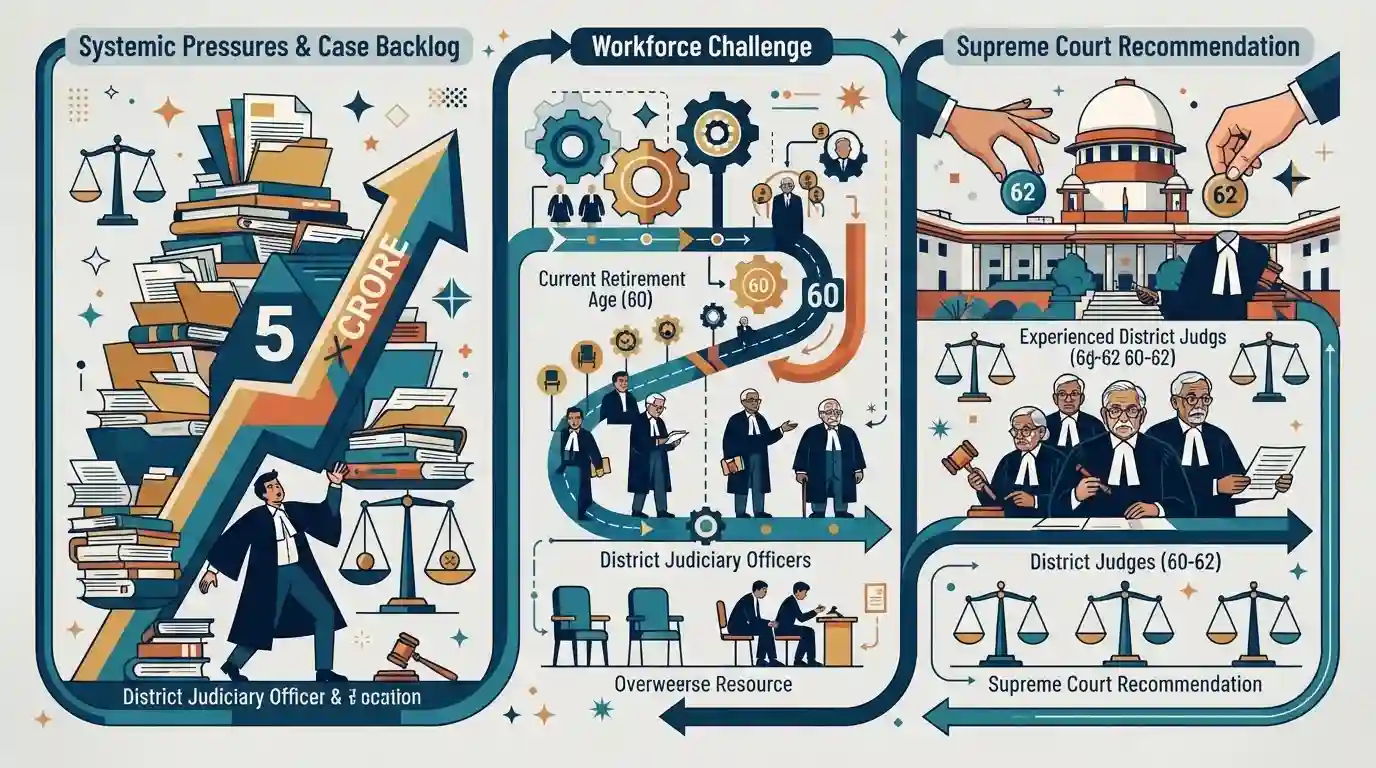
The district judiciary serves as the foundational tier of India's legal delivery system; addressing its structural vulnerabilities like workforce shortages and retirement age discrepancies is vital for access to justice and clearing backlogs exceeding five crore cases.
Summary
The Supreme Court of India has strongly pushed for increasing the retirement age of district judiciary officers to 62 years. This recommendation comes in the backdrop of mounting systemic pressures, with India's total case backlog crossing the five-crore mark, highlighting critical structural and workforce challenges in the lower judiciary.
Key Points
- The Supreme Court advocated for raising the retirement age of judicial officers in the district judiciary to 62 years to mitigate severe judicial workforce shortages.
- The total case backlog across Indian courts has crossed the grim milestone of five crore (50 million) pending cases.
- Enhancing the retirement age aims to retain experienced manpower, combat high pendency, and improve the overall efficiency of trial and district courts.
Important Terms
Supreme Court

The apex judicial body of India established under Article 124 of the Constitution, functioning as the final court of appeal and guardian of the Constitution.
UPSC context
UPSC GS Paper II (Polity & Governance) — Structure, organization, and functioning of the judiciary.
District Judiciary
The subordinate judicial tier comprising district and lower courts in India, governed by Articles 233–237 of the Constitution, handling the primary burden of litigation.
UPSC context
UPSC GS Paper II (Polity & Governance) — Subordinate judiciary, judicial reforms, and issues relating to case pendency and vacancies.
Static Concepts Connected
What is the constitutional and administrative framework governing the district judiciary in India?
- Article 233: Article 233 deals with the appointment of district judges, made by the Governor in consultation with the High Court exercising jurisdiction over the state.
- Article 235: Article 235 vests the control over district courts and subordinate courts, including posting, promotion, and discipline, exclusively in the respective High Court.
- Recruitment Base: District judges are recruited either through direct recruitment from advocates or through promotion from the judicial service by the High Court.
Cross-Topic Patterns
District Judiciary Pendency & Article 21 Rights
Chronic understaffing in the district judiciary directly compromises the constitutional right to speedy trial under Article 21, linking judicial administration directly to fundamental rights enforcement.

District judiciary retirement age conditions (performance review by High Court) + 5 crore pendency data likely in a prelims statement.
Linked PYQs · 3
Linked PYQs · 3
- 2025MainsGS2
Comment on the need of administrative tribunals as compared to the court system. Assess the impact of the recent tribunal reforms through rationalization of tribunals made in 2021.
- 2021MainsGS2
Discuss the desirability of greater representation to women in the higher judiciary to ensure diversity, equity and inclusiveness.
- 2021PrelimsGS1
With reference to Indian judiciary, consider the following statements : 1. Any retired judge of the Supreme Court of India can be called back to sit and act as a Supreme Court judge by the Chief Justice of India with prior permission of the President of India. 2. A High Court in India has the power to review its own judgement as the Supreme Court does. Which of the statements given above is/are correct?
