Supreme Court Directs Protection of Saranda Sal Forest in Jharkhand
Source:The Hindu ↗
Why It Matters
This ruling serves as an excellent case study for the persistent conflict between economic development (mining) and ecological conservation. It directly addresses GS3 themes of environmental degradation due to mining, GS1 themes regarding the location of the iron and steel industry, and Prelims themes concerning Wildlife Sanctuaries, buffer zones, and the Forest Rights Act.
Summary
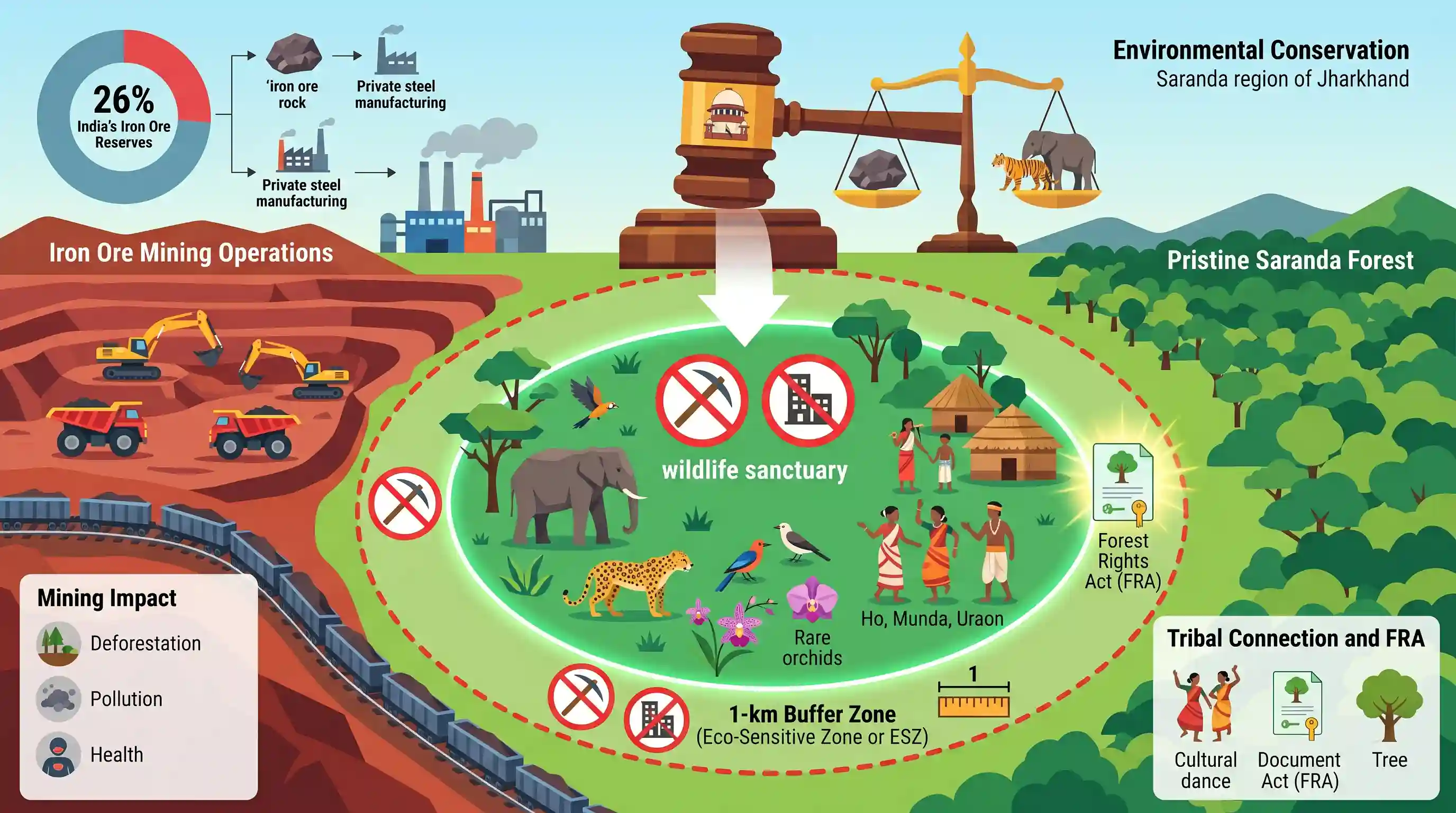
The Supreme Court of India has directed the Jharkhand government to declare 314 sqkm of the pristine Saranda forest as a wildlife sanctuary. This landmark decision aims to balance critical biodiversity conservation with the region's massive iron ore mining operations. Saranda holds 26% of India's iron ore reserves, essential for public and private steel manufacturers, while also hosting endangered wildlife and indigenous tribes like the Ho, Munda, and Uraon. The ruling enforces a strict no-mining policy within the sanctuary and a 1-km buffer zone while upholding the rights of forest-dwelling communities under the Forest Rights Act.
Key Points
- The Supreme Court directed the Jharkhand government to officially declare 314 sqkm of the Saranda forest as a wildlife sanctuary to protect its rich biodiversity.
- The Saranda forest division is economically vital, accounting for 26% of India’s iron ore reserves and sustaining major steel operations by SAIL and Tata Steel.
- The pristine sal forest ecosystem supports endangered species such as the endemic sal forest tortoise, four-horned antelope, and Asian palm civet.
- The Court reiterated that mining is strictly prohibited within the sanctuary and its 1-km buffer zone, reinforcing jurisprudence on Eco-Sensitive Zones.
- The judgment explicitly protects the traditional rights of local tribal communities (Ho, Munda, Uraon) under the Forest Rights Act, ensuring their livelihoods are not disrupted.
Important Terms
Forest Rights Act (FRA), 2006

A 2006 law recognizing the land and resource rights of forest-dwelling Scheduled Tribes and other traditional forest dwellers who were historically deprived of legal titles.
UPSC context
GS Paper II/III: Social Justice and Environment. Tests understanding of tribal rights versus state-led conservation models.
Wildlife (Protection) Act, 1972
India's primary legal framework for protecting plant and animal species. It provides for the declaration of National Parks and Wildlife Sanctuaries and regulates trade in wildlife.
UPSC context
GS Paper III: Ecology. Core legislation for protected area management and biodiversity conservation questions.
Eco-Sensitive Zones (ESZ)
Fragile areas surrounding Protected Areas notified by MoEFCC to act as "shock absorbers," where high-impact activities like commercial mining are prohibited within a minimum 1-km radius.
UPSC context
GS Paper III: Environment. Tests knowledge of buffer zone regulations and Supreme Court mandates on industrial proximity to sanctuaries.
Saranda Forest
Located in Jharkhand's West Singhbhum, it is Asia's largest Sal (Shorea robusta) forest. Known as the "land of seven hundred hills," it is a critical elephant corridor.
UPSC context
GS Paper I/III: Geography and Environment. A recurring "Place in News" representing the conflict between mineral wealth and biodiversity.
Steel Authority of India Limited (SAIL)
A Maharatna Public Sector Undertaking and India's largest steel producer. It operates major iron ore mines in Saranda, including the massive Chiria and Kiriburu mines.
UPSC context
GS Paper III: Economic Development. Relevant for the distribution of key natural resources and the role of PSUs in industrial growth.
Fifth Schedule
A constitutional provision (Article 244) for the administration of "Scheduled Areas" where tribal populations predominate, ensuring their protection from land alienation and cultural erosion.
UPSC context
GS Paper II: Polity. Crucial for understanding tribal governance and the legal requirements for land use in Saranda.
Prelims Trap
"Declaring a forest as a Wildlife Sanctuary automatically extinguishes the traditional and customary rights of local tribal communities."
Under the Forest Rights Act (FRA) 2006, the customary and livelihood rights of forest-dwelling tribes are legally protected and cannot be arbitrarily extinguished by a Wildlife Sanctuary declaration.
Static Concepts Connected
What are Eco-Sensitive Zones (ESZ) and their regulatory framework?
- Statutory backing: ESZs are not explicitly mentioned in any act but are notified under the Environment (Protection) Act, 1986 (Section 3) to restrict industries near protected areas.
- Minimum buffer: The Supreme Court mandates a minimum 1-km ESZ buffer around National Parks and Wildlife Sanctuaries where commercial mining is strictly prohibited.
- Primary purpose: To act as a 'shock absorber' transitioning from highly protected ecosystems to zones with lesser protection.
What are the ethnolinguistic characteristics of the Ho, Munda, and Uraon tribes?
- Austroasiatic speakers: The Ho and Munda tribes speak Austroasiatic languages and traditionally follow the Manki-Munda local governance system.
- Dravidian speakers: The Uraon (or Oraon) tribe speaks Kurukh, which is classified under the Dravidian language family.
- Regional concentration: They primarily inhabit the Chhotanagpur plateau region, particularly Jharkhand, relying heavily on local forest ecosystems for their livelihood.
Cross-Topic Patterns
Mining vs Biodiversity in Chhotanagpur
Saranda exemplifies the 'resource curse'. While holding 26% of India's iron ore, the region faces intense conflict between heavy steel-industry extraction and statutory protection of endemic species and tribal rights.
Judicial enforcement of ESZ buffers
The Supreme Court’s direct intervention to notify a sanctuary and enforce a 1-km no-mining zone overrides state inertia, echoing past Godavarman rulings on mandatory eco-sensitive buffers.

Expect a paired-matching question in 2026 linking specific tribes (Ho, Uraon), their language families, and regions (Saranda/Singhbhum).
Linked PYQs · 5
Linked PYQs · 5
- 2025MainsGS3
Mineral resources are fundamental to the country's economy and these are exploited by mining. Why is mining considered an environmental hazard? Explain the remedial measures required to reduce the environmental hazard due to mining.
- 2014PrelimsGS1
With reference to 'Eco-Sensitive Zones', which of the following statements is/are correct? 1. Eco-Sensitive Zones are the areas that are declared under the Wildlife (Protection) Act, 1972. 2. The purpose of the declaration of Eco-Sensitive Zones is to prohibit all kinds of human activities in those zones except agriculture. Select the correct answer using the code given below.
- 2020MainsGS1
Account for the present location of iron and steel industries away from the source of raw material, by giving examples.
- 2013PrelimsGS1
Under the Scheduled Tribes and Other Traditional Forest Dwellers (Recognition of Forest Rights) Act, 2006, who shall be the authority to initiate the process for determining the nature and extent of individual or community forest rights or both?
- 2021PrelimsGS1
At the national level, which ministry is the nodal agency to ensure effective implementation of the Scheduled Tribes and Other Traditional Forest Dwellers (Recognition of Forest Rights) Act, 2006?
