Supreme Court Proposes Interim Committee for Bankey Bihari Temple
Source:The Hindu ↗
Why It Matters
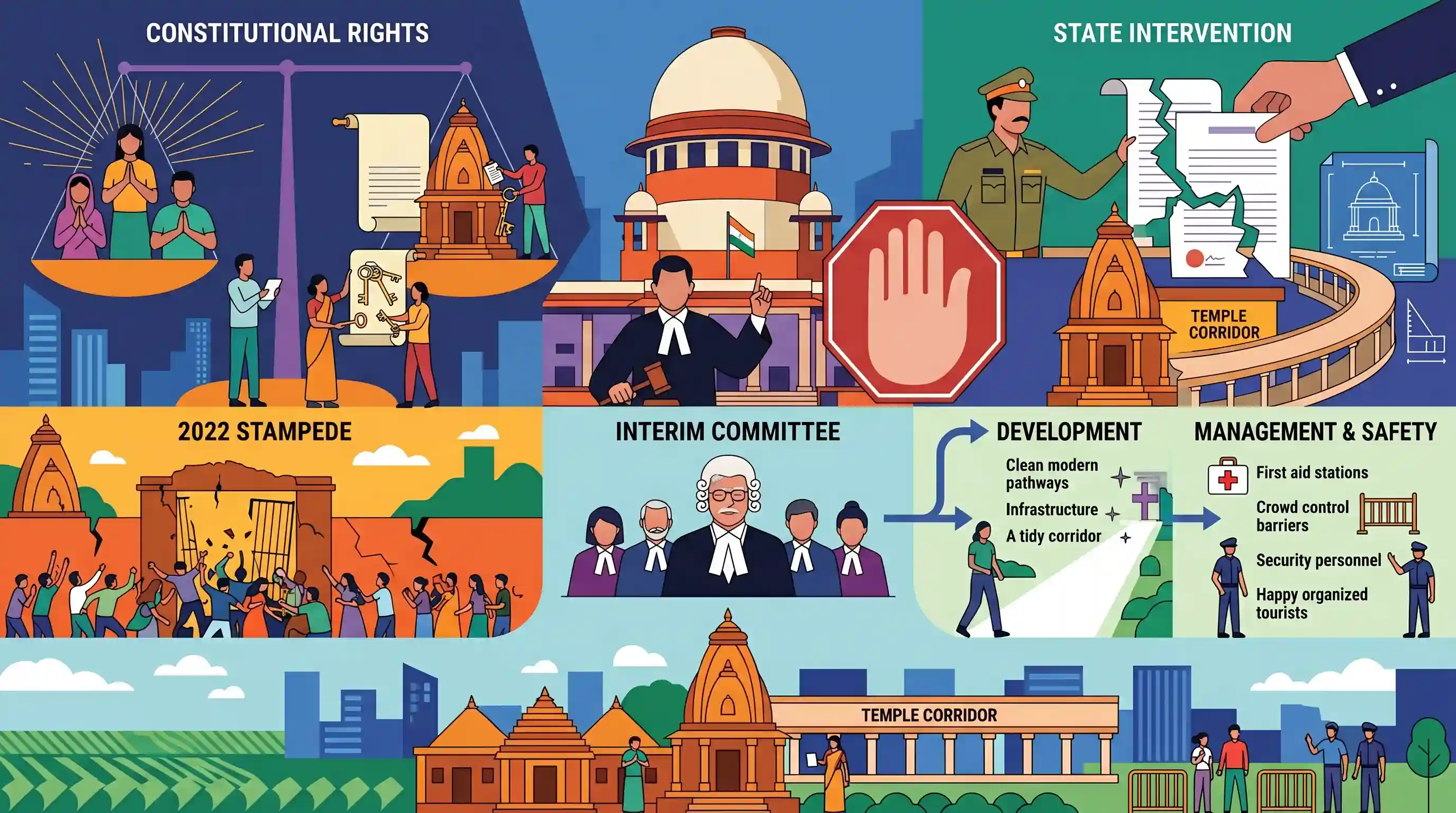
This issue underscores the delicate balance between the constitutional right to religious freedom (managing religious affairs) and the state's responsibility to ensure public order, manage religious tourism, and prevent disasters like stampedes at major shrines.
Summary
The Supreme Court stayed the Uttar Pradesh government's Shri Bankey Bihari Ji Temple Trust Ordinance, 2025, which aimed to take over the management of the historic temple in Vrindavan for a corridor development project. Proposing an interim committee headed by a retired High Court judge to oversee both development and law and order, the Court sought to balance the traditional rights of the temple's management with the need to improve facilities and prevent tragedies like the 2022 stampede. The case highlights the broader constitutional debate over state control of religious institutions, secularism, and the management of religious tourism.
Key Points
- The Supreme Court proposed an interim committee headed by a retired High Court judge to manage the Bankey Bihari temple in Vrindavan.
- The UP government had promulgated an ordinance in 2025 to take over the temple's management and use its funds for a corridor development project.
- The Supreme Court stayed the ordinance to protect the rights of the traditional temple management (Goswamis) and allowed them to challenge it in the High Court.
- The interim committee will include local officials and Goswamis to oversee temple development and prevent law and order issues, such as the 2022 stampede tragedy.
- The State argued for government intervention citing the need for better facilities for lakhs of devotees, the revenue potential of religious tourism, and alleged mismanagement of funds.
Important Terms
Shri Bankey Bihari Ji Temple Trust Ordinance, 2025

A 2025 Uttar Pradesh legislative instrument aimed at creating a state-led trust to manage the Bankey Bihari temple; the Supreme Court stayed its management takeover provisions to protect traditional rights.
UPSC context
GS Paper II: Government Policies/Interventions. Relates to the debate over state control of religious institutions and the limits of executive power.
Article 26 of the Constitution
Fundamental Right guaranteeing religious denominations the authority to establish and maintain institutions, manage their own religious affairs, and administer property in accordance with law.
UPSC context
GS Paper II: Indian Constitution. Core provision for cases involving temple management, denomination rights, and state interference in religion.
Indian Secularism
A "positive" model (Sarva Dharma Samabhava) where the state maintains a principled distance but can intervene in secular, financial, or administrative aspects of religious institutions for public order.
UPSC context
GS Paper I (Social Issues) & II (Polity). Contrasts the Western "separation" model with India's "engagement" model regarding religious management.
Goswamis (Haridasi Sampraday)
Hereditary priests and traditional managers of the Bankey Bihari temple (Haridasi Sampraday) who claim private ownership and management rights against state intervention.
UPSC context
GS Paper II/Social Justice. Represents the "stakeholder" perspective in constitutional disputes over hereditary rights versus administrative reforms.
Interim Management Committee
A temporary judicial governance mechanism—typically headed by a retired judge—appointed to oversee institution management when state legislation is stayed or under legal challenge.
UPSC context
GS Paper II: Judiciary. Example of judicial activism/oversight used to balance public safety (crowd management) with fundamental rights during litigation.
Religious Corridor Development
Large-scale infrastructure projects aimed at improving pilgrim facilities and crowd management around major shrines, often balancing heritage preservation with modern safety needs.
UPSC context
GS Paper I (Culture) & GS Paper III (Infrastructure). Concerns urban planning, disaster management (stampedes), and the promotion of religious tourism.
Prelims Trap
Article 26 grants religious denominations absolute immunity from State intervention in administering their institutional property.
Article 26(d) explicitly states property administration must be 'in accordance with law'. The State can regulate secular, financial, and administrative aspects, as established in the Shirur Mutt case.
Static Concepts Connected
How does the Constitution balance religious freedom with State regulation of temples?
- Matters of religion: Article 26 protects a denomination's right to manage core religious affairs (Essential Religious Practices) without State interference.
- Secular regulation: Article 25(2)(a) empowers the State to regulate economic, financial, or political activities associated with religious practices.
- Property administration: Under Article 26(d), denominations can administer property, but strictly 'in accordance with law', permitting statutory oversight.
What are the core NDMA guidelines for crowd management at religious sites?
- Capacity Planning: Assessing safe holding capacity and continuous flow dynamics to prevent critical bottlenecks and stampedes.
- Risk Assessment: Mandating tools like Failure Mode and Effect Analysis (FMEA) to preemptively identify potential crowd crush zones.
- Infrastructure Control: Creating distinct, segregated entry and exit routes, alongside systematic barricading for structured crowd flow.
Cross-Topic Patterns
Indian Secularism & Temple Economics
Unlike Western strict separation, Indian 'principled distance' allows state management of temple finances to fund infrastructure, testing the boundary between public administration and religious autonomy.
Heritage Urbanism vs. Carrying Capacity
State-led 'corridor' developments in ancient temple towns highlight the tension between maximizing religious tourism revenue and breaching the infrastructural carrying capacity of fragile heritage zones.

Expect a Prelims question differentiating 'matters of religion' (Art 26) from 'secular activities' (Art 25) regarding temple management.
Linked PYQs · 4
Linked PYQs · 4
- 2024MainsGS2
Discuss India as a secular state and compare with the secular principles of the US constitution.
- 2019MainsGS2
What can France learn from the Indian Constitution's approach to secularism?
- 2020MainsGS3
Discuss the recent measures initiated in disaster management by the Government of India departing from the earlier reactive approach.
- 2024MainsGS2
Public charitable trusts have the potential to make India's development more inclusive as they relate to certain vital public issues. Comment.
