Supreme Court petition seeks removal of invasive plants from sanctuary
Source:lawbeat ↗
Why It Matters
The issue highlights the ecological hazards of invasive alien species (like Prosopis juliflora) and the legal obligations of conservation authorities under the Wildlife (Protection) Act to protect fragile wetland ecosystems and Ramsar sites in Uttar Pradesh.
Summary
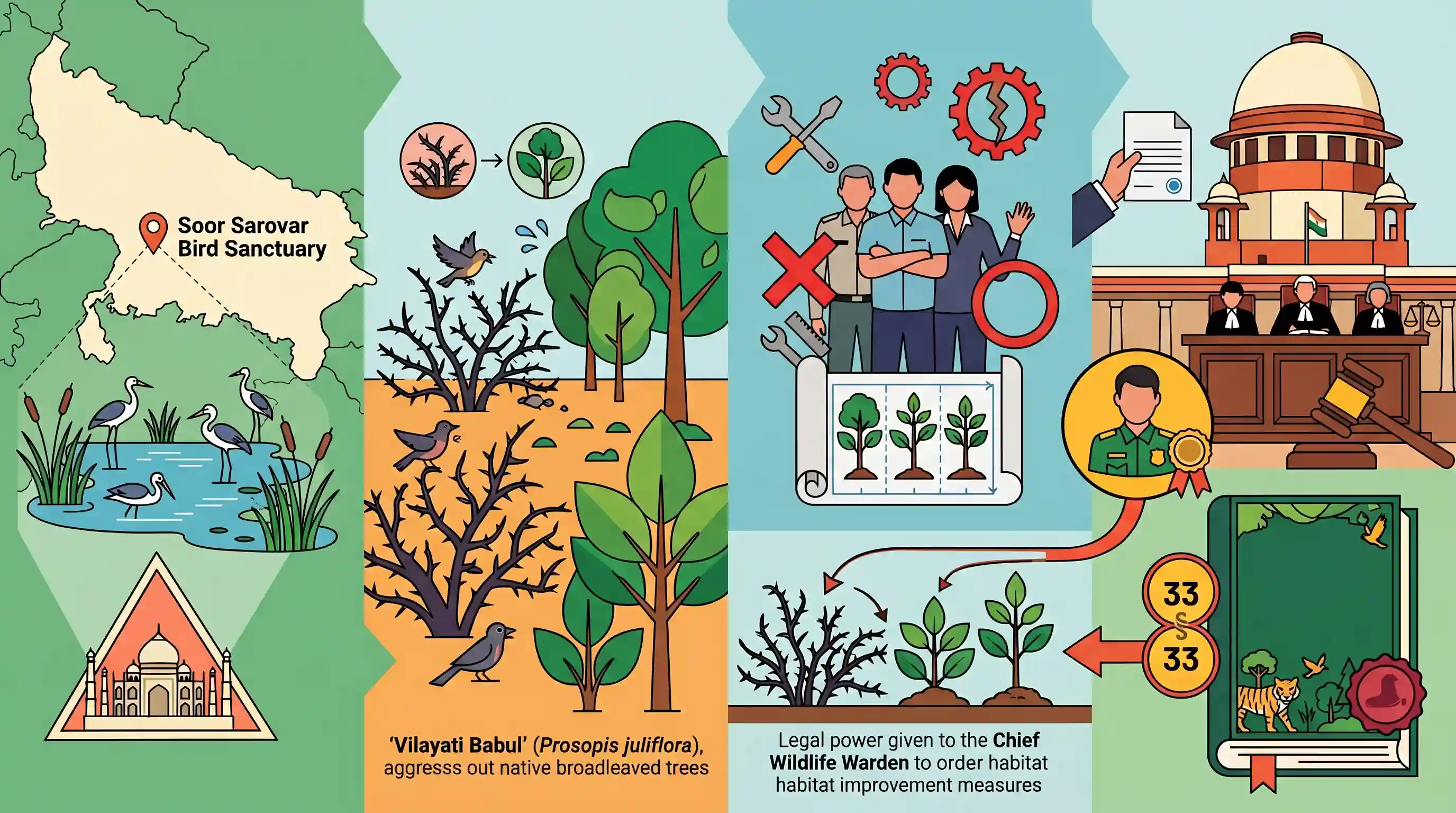
A plea in the Supreme Court highlights the failure of Uttar Pradesh state authorities to replace the highly invasive plant 'Vilayati Babul' (Prosopis juliflora) with native broad-leaved tree species within Agra's Soor Sarovar Bird Sanctuary (Ramsar site), situated in the Taj Trapezium Zone. The petition relies on Section 33 of the Wildlife (Protection) Act, 1972, which empowers the Chief Wildlife Warden to execute habitat improvement measures.
Key Points
- The Supreme Court issued a notice on a plea seeking the phased removal and replacement of the invasive plant 'Vilayati Babul' (Prosopis juliflora) with native broad-leaved tree species inside the Soor Sarovar Bird Sanctuary in Agra, Uttar Pradesh.
- Prosopis juliflora, native to Mexico and Central America, was introduced by the British in the 19th century in Rajasthan as a firewood source. It has since become a major ecological threat in India.
- Ecology of Vilayati Babul: It is a phreatophyte (a deep-rooted plant that draws heavily from the phreatic zone below the water table, causing hydrological drought) and is allelopathic (releases chemical compounds that inhibit the germination and growth of surrounding native plants).
- Soor Sarovar Bird Sanctuary, a Ramsar site containing Keetham Lake, is located within the Taj Trapezium Zone (TTZ) in Agra. The sanctuary's Site Management Plan (2020–2030) explicitly recognizes Prosopis juliflora as a threat to native biodiversity and avian habitats.
- Statutory Provisions: Section 33 and Section 33(c) of the Wildlife (Protection) Act, 1972 authorize and oblige the Chief Wildlife Warden (CWW) to manage sanctuaries and take active measures for habitat improvement, which includes removing invasive alien species.
Important Terms
Ramsar Convention

An international treaty signed in 1971 in Ramsar, Iran, providing a framework for the conservation and 'wise use' of wetlands and their resources globally.
UPSC context
GS Paper III (Environment & Ecology); tests international conservation treaties, wetland management, and India's biodiversity commitments.
Wildlife (Protection) Act, 1972
A landmark Indian law providing a legal framework for protecting wild animals, birds, and plants, managing their habitats, and regulating trade in wildlife products.
UPSC context
GS Paper III (Biodiversity & Environment); tests conservation laws, protected area networks, and wildlife governance in India.
Supreme Court of India
The highest judicial court and final constitutional authority in India, exercising original, appellate, and advisory jurisdictions, and acting as the custodian of fundamental rights.
UPSC context
GS Paper II (Polity & Governance); tests structure of judiciary, constitutional interpretation, judicial activism, and public interest litigation.
Uttar Pradesh Forest Department
The state-level agency in Uttar Pradesh responsible for managing forests, wildlife sanctuaries, implementing national afforestation targets, and protecting local biodiversity.
UPSC context
GS Paper III (Environment & Ecology); tests state-level governance, ecological management of sanctuaries, and local conservation initiatives.
Tamil Nadu Planning Commission
A state advisory body in Tamil Nadu responsible for formulating development policies, socio-economic plans, and ecological restoration guidelines, including invasive species management.
UPSC context
GS Paper II (Polity & Governance); tests decentralized state-level advisory bodies, cooperative federalism, and policy-making for environmental challenges.
Prelims Trap
Prosopis juliflora (Vilayati Babul) and Acacia nilotica (Desi Babul) are both invasive exotic species introduced by the British.
Only Prosopis juliflora is an exotic invasive from the Americas. Acacia nilotica (Desi Babul) is indigenous to the Indian subcontinent and ecologically integrated.
Static Concepts Connected
What are the ecological definitions and mechanisms of Allelopathy and Phreatophytes?
- Allelopathy definition: Chemical warfare where plants release biochemicals (allelochemicals) that suppress germination and growth of neighboring native species, rapidly reducing local biodiversity.
- Phreatophyte mechanism: Plants with exceptionally deep root systems (often extending tens of meters) that tap directly into the groundwater table, causing localized hydrological drought.
What is the statutory role of the Chief Wildlife Warden (CWW) under the Wildlife Protection Act?
- Section 33 Authority: Vests complete administrative control, management, and maintenance of wildlife sanctuaries within a State in the designated Chief Wildlife Warden.
- Habitat Measures: Explicitly authorizes the CWW to take necessary steps for sanctuary habitat improvement, including water conservation and active removal of invasive alien species.
Cross-Topic Patterns
Ramsar wise-use vs. Alien Invasive Species
Under Ramsar guidelines, parties must maintain the ecological character of wetlands. Invasive species eradication directly fulfills Article 3 commitments via domestic acts like WPA.
TTZ judicial legacy & wetland conservation
The 1996 TTZ ruling (M.C. Mehta) has expanded from air pollution control to holistic ecosystem preservation, regulating biological degradation inside TTZ-affected wetlands.

WPA 1972 Section 33 sanctuary management powers of CWW combined with ecological traits of invasives is highly probable for Prelims 2026.
Linked PYQs · 3
Linked PYQs · 3
- 2021UPPSC_PRELIMSGS1
Which of the following Ramsar site is NOT situated in Uttar Pradesh ?
- 2022UPPSC_PRELIMSGS1
Which of the following trees is dangerous for environment ?
- 2015UPPSC_PRELIMSGS1
The Wildlife Protection Act was passed in the year
