Supreme Court sets deadline for Ganga encroachment removal in Patna
Source:indian-masterminds ↗
Why It Matters
The issue of floodplain encroachment along the Ganga in Patna is highly relevant for BPSC Prelims, overlapping with Bihar's geography (Ganga's course and districts) and environmental governance (NGT, River Ganga Authorities Order). Previous BPSC exams have tested knowledge on the length and course of the Ganga through Bihar districts, making regional geographical changes and conservation efforts significant for aspirants.
Summary
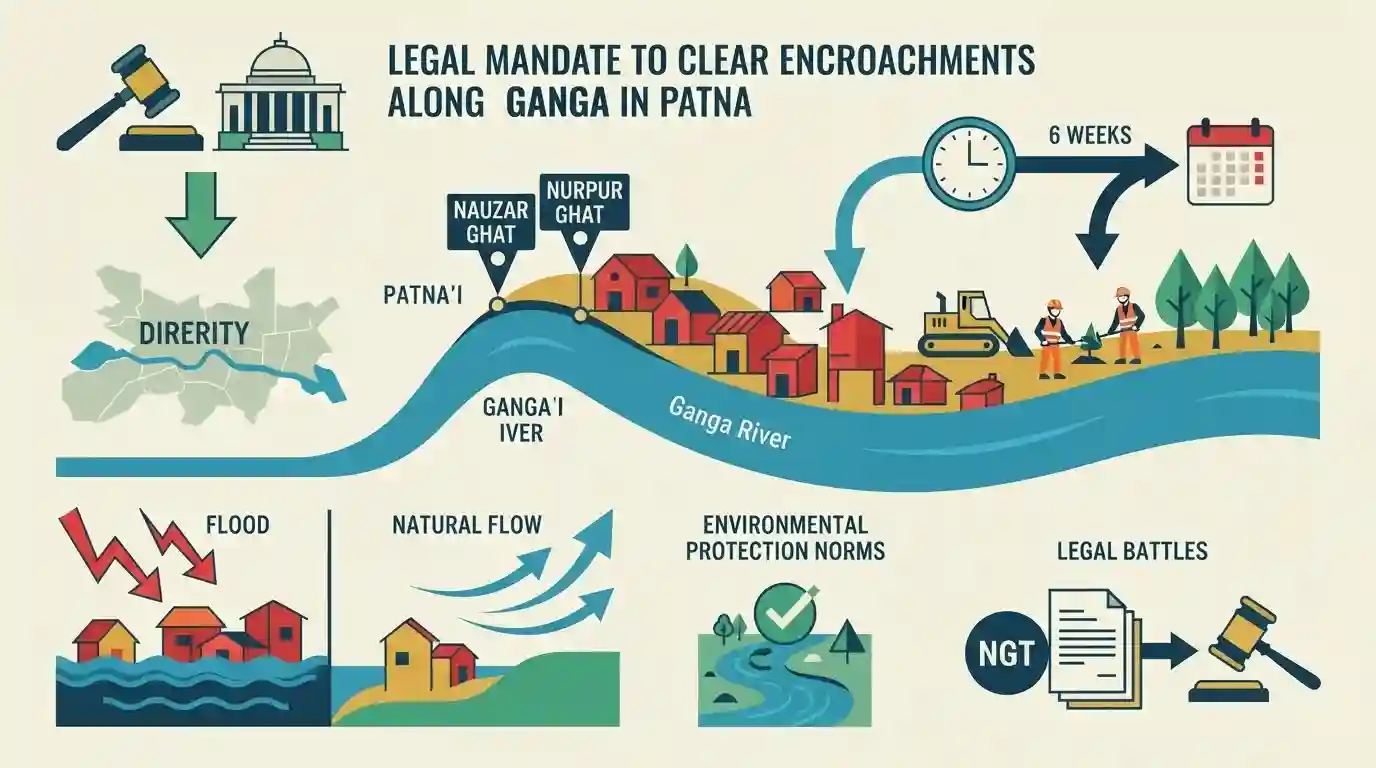
The Supreme Court has directed the Bihar government to clear all unauthorized encroachments along the Ganga river in Patna, specifically between Nauzar Ghat and Nurpur Ghat, within six weeks. This enforcement is part of broader efforts to protect river floodplains from illegal constructions which disrupt the natural flow, heighten flood risks, and violate environmental protection norms such as the River Ganga Authorities Order, 2016. The directive underscores the ongoing legal battles, originally passing through the National Green Tribunal, to preserve the ecological integrity of the Ganga in Bihar.
Key Points
- The Supreme Court has issued a strict six-week deadline to the Bihar government to remove unauthorized structures and encroachments along the Ganga river in Patna.
- The specific stretch targeted in this recent directive is between Nauzar Ghat and Nurpur Ghat, following an earlier NGT and SC mandate concerning the Digha Ghat to Nauzar Ghat stretch.
- Illegal constructions in the floodplains violate the River Ganga Authorities Order, 2016, leading to the shrinkage of river channels and increased risk of flooding.
- This development highlights ongoing judicial intervention in environmental conservation and riverbank protection in Bihar.
Important Terms
River Ganga (Rejuvenation, Protection and Management) Authorities Order, 2016

A 2016 notification under the Environment Protection Act establishing an institutional structure to prevent pollution, regulate floodplains, and clear encroachments, thereby empowering authorities to sustainably manage and rejuvenate the Ganga river basin.
UPSC context
GS-3 (Environment). Highly relevant for questions on environmental laws, river ecosystem protection, and floodplain zoning regulations.
National Green Tribunal (NGT)
A specialized statutory body established in 2010 to expedite the disposal of cases relating to environmental protection, forest conservation, and the enforcement of legal rights linked to the environment.
UPSC context
GS-2 (Statutory Bodies) and GS-3 (Environment). Often tested regarding its jurisdiction, composition, and role in delivering environmental justice.
Supreme Court
India's apex judicial body. In environmental governance, it frequently uses its appellate and writ jurisdiction to enforce ecological protection, mandating the removal of illegal encroachments when lower authorities or tribunals delay action.
UPSC context
GS-2 (Judiciary) and GS-3 (Environment). Relevant for studying judicial activism and the overarching enforcement of constitutional environmental mandates.
Prelims Trap
Floodplain zoning across India is mandated and directly executed by the National Ganga Council or Central Water Commission.
Floodplain zoning falls under 'land' and 'water' which are State subjects (Entries 17 and 18, State List). The Centre and NDMA only issue guidelines; states must legislate and execute.
Static Concepts Connected
What is the institutional structure under the River Ganga Authorities Order, 2016?
- National Ganga Council: Replaced NGRBA; acts as the apex body and is chaired by the Prime Minister of India, not the Environment Minister.
- NMCG: Acts as the implementation arm, uniquely functioning as a regulatory authority under the Environment (Protection) Act, 1986.
- State Ganga Committees: Headed by the Chief Secretary of the respective state to monitor local compliance and river rejuvenation efforts.
What are the jurisdictional and appeal mechanisms of the NGT?
- Civil Jurisdiction: Enforces 7 specific environmental laws (e.g., Water, Air, EPA, Forest Acts). It notably excludes the Wildlife Protection Act and the Indian Forest Act, 1927.
- Direct SC Appeal: Appeals against NGT decisions do not go to High Courts; they lie directly with the Supreme Court, to be filed within 90 days.
Cross-Topic Patterns
Floodplain Zoning + Disaster Management
Links GS3 Environment with Disaster Management. Despite NDMA guidelines prohibiting concrete structures in 10-year flood zones, state compliance is poor due to land being a state subject and urban pressure.
Environmental Judiciary + State Subjects
Reflects the GS2 theme of judicial activism where the Supreme Court and NGT bypass standard executive delays to enforce ecological mandates on state-list subjects like land and drainage.

Expect a multi-statement Prelims question mixing NGT's appellate structure with the PM-led National Ganga Council's statutory backing.
Linked PYQs · 2
Linked PYQs · 2
- 2019BPSC_PRELIMSGS1
The district of Bihar which has a longer length of Ganga river is
- 2019BPSC_PRELIMSGS1
The number of districts situated on the bank of Ganga river in Bihar State is
