Supreme Court panel suggests carrying capacity study for Himachal hubs
Source:Indian Express ↗
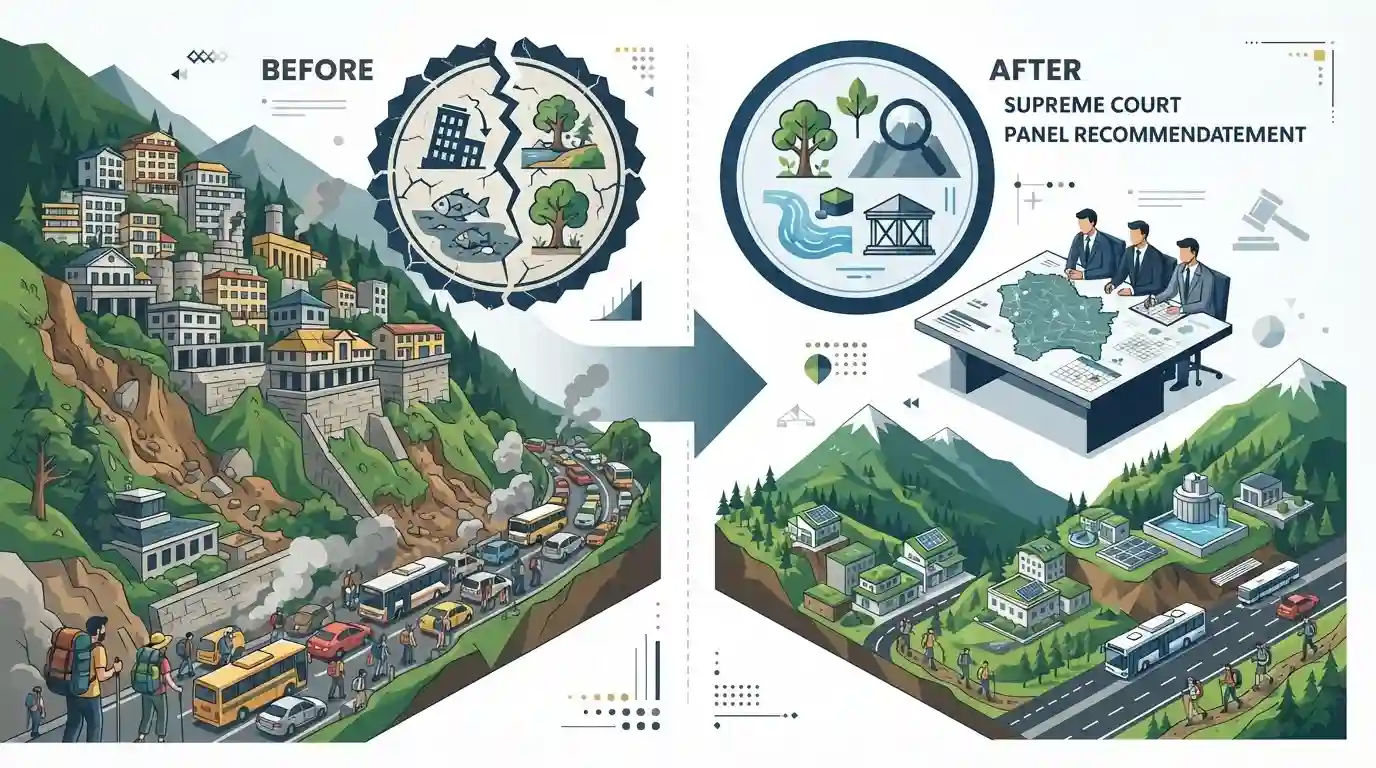
Why It Matters
Crucial for HPAS aspirants as it deals with environmental sustainability, tourist carrying capacity, and ecological vulnerability of Himalayan hill stations.
Summary
A Supreme Court panel recommended carrying capacity studies for major tourism hubs in Himachal Pradesh to prevent ecological degradation and infrastructure collapse caused by unchecked tourist influx and construction in fragile Himalayan regions.
Key Points
- A Supreme Court-appointed panel has suggested conducting a comprehensive carrying capacity study for tourism hubs in Himachal Pradesh to address ecological concerns and infrastructure strain.
- The recommendation aims to balance tourism growth with environmental preservation, particularly in fragile Himalayan ecosystems prone to landslides and waste management issues.
- Highlights the urgent need for sustainable tourism policies, regulatory checks on unchecked construction, and managing tourist inflows in major hubs of the state.
Important Terms
Carrying Capacity

The highest number of visitors or level of development a destination can support without permanent ecological damage, resource depletion, or infrastructure collapse.
UPSC context
Crucial for HPAS Mains (GS Paper III: Environment & Disaster Management), testing sustainable tourism and ecological governance in hill states.
Central Empowered Committee (CEC)
An expert body established by the Supreme Court to advise on environmental and forest matters, monitor compliance with forest laws, and investigate ecological violations.
UPSC context
Important for HPAS Prelims and Polity/Environment sections, testing judicial activism and environmental regulatory bodies in India.
Supreme Court
The apex judicial authority in India, which takes suo motu cognizance of systemic ecological degradation and issues binding directives to protect fragile ecosystems like the Himalayas.
UPSC context
Important for HPAS GS Paper II (Indian Polity and Judicial Review) and environmental jurisprudence in fragile Himalayan states.
Prelims Trap
The Supreme Court has automatically enforced mandatory carrying capacity limits across all Indian hill stations without state legislative action.
Aspirants often assume carrying capacity studies are legally binding nationwide automatically upon SC observation, whereas they are typically directed as expert committee recommendations for state-level policy formulation.
Static Concepts Connected
What is carrying capacity in environmental management and why is it critical for the Himalayas?
- Definition: Maximum population or tourist load an ecosystem can support without permanent environmental degradation.
- Himalayan Vulnerability: Fragile geology, seismic sensitivity (Zone IV/V), and poor waste assimilation make Himalayan ecosystems highly susceptible to over-construction.
- Impact of Overtourism: Unregulated tourist inflows lead to groundwater depletion, severe traffic congestion, slope destabilization, and solid waste crises.
Cross-Topic Patterns
Himalayan Tourism vs Disaster Resilience
Unchecked tourism in fragile Himalayan ecosystems directly triggers urban solid waste crises and flash-floods, connecting state town planning acts with national disaster management frameworks.
Eco-Tourism Regulation & State Economy
Carrying capacity assessments balance state revenue from tourism with ecological vulnerability under the HP Town and Country Planning Act.

SC panel recommendations on carrying capacity will likely feature in HPAS Mains GS3 (Environment/Disaster Management) or prelims statements.
Linked PYQs · 2
Linked PYQs · 2
- 2020HPAS_PRELIMSGS1
Consider the given four statements and choose the correct answer from the given options. Select the true statements from the following: 1. Chamba, Kullu and Kinnaur are considered the most susceptible of landslide threat. 2. Una, Bilaspur, Sirmaur, Shimla and Solan are considered as low vulnerable of disaster threats. 3. Hum valley of Una district has hardly any natural drinking water source. 4. As per the study of central water board, Kala Amb valley in Sirmaur district has exploited the least underground water.
- 2024HPAS_PRELIMSGS1
Arrange the following years based on the number of foreign tourist arrivals in Himachal Pradesh in descending order : (1) 2020 (2) 2021 (3) 2022 (4) 2023 (up to December 2023) Choose the correct option :
