Supreme Court Committee Review on Aravalli Hills Ecological Definition
Source:Indian Express ↗
Why It Matters
The Aravalli range acts as a crucial barrier against desertification and regulates the climate in North-West India. Understanding the ongoing legal and regulatory battles over its definition is important for UPSC aspirants studying environmental impact assessments, the ecological hazards of mining, and the role of the Supreme Court in shaping environmental jurisprudence.
Summary
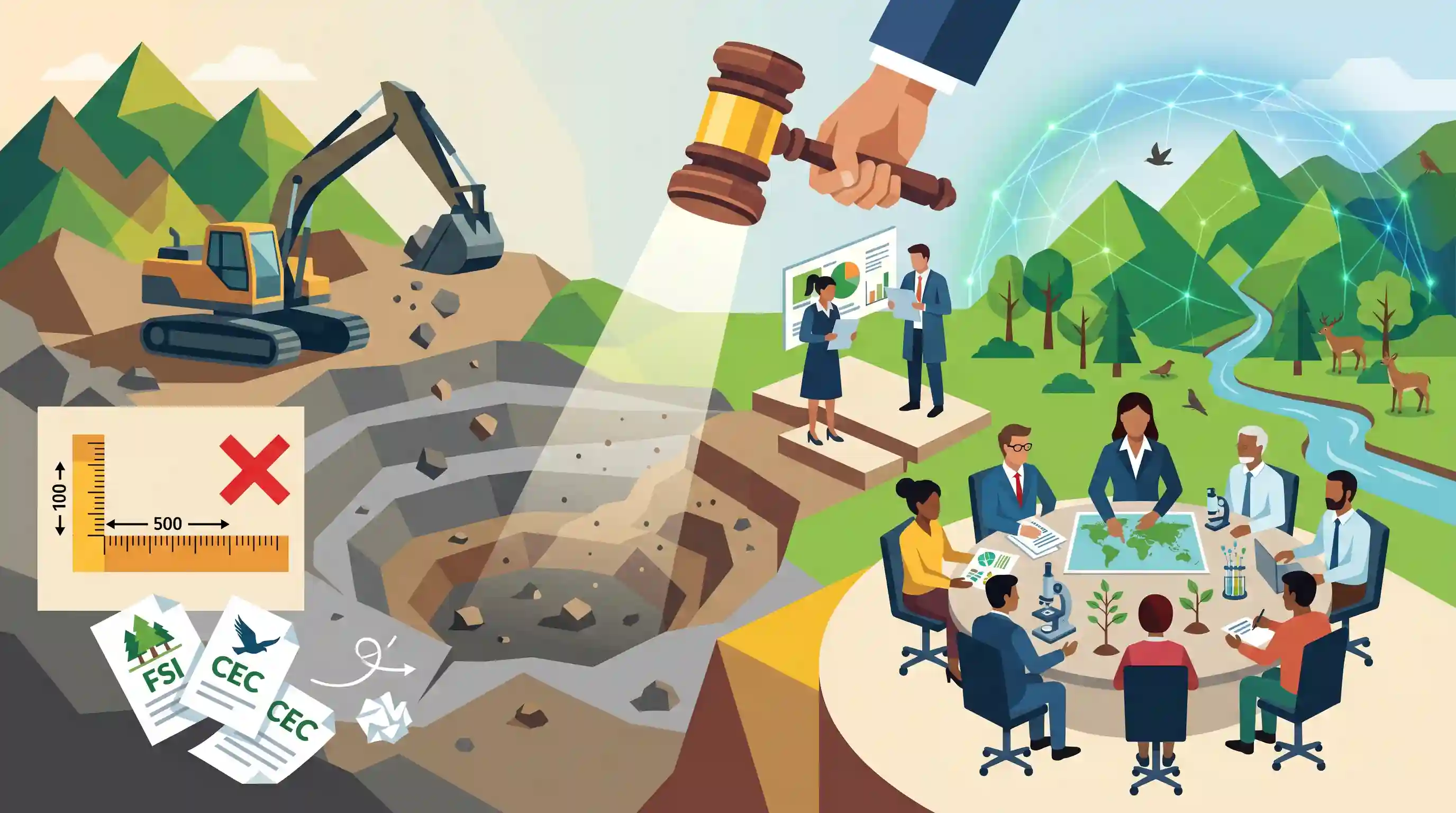
The Supreme Court has constituted a new High-Powered Committee (HPC) led by ICFRE Director General Kanchan Devi to establish a scientific and ecologically sound definition for the Aravalli hills. The move comes after widespread criticism of an earlier panel's report, which proposed that hills must be at least 100 meters high and have a gap of no more than 500 meters to be considered contiguous. These criteria would effectively exclude nearly 90% of the Aravallis in Rajasthan from environmental protection, potentially leading to unchecked mining activities. Recognizing that previous assessments ignored warnings from the Forest Survey of India (FSI) and the Central Empowered Committee (CEC), the apex court mandated a fresh, independent expert review to address regulatory loopholes and protect the fragile ecosystem.
Key Points
- The Supreme Court formed a new High-Powered Committee (HPC) headed by ICFRE Director General Kanchan Devi to define the Aravalli hills.
- The previous definition proposed a 100-metre height requirement and a 500-metre gap limit for contiguous hills, which would have excluded 90% of Rajasthan's Aravallis from protection.
- Critics and earlier bodies like the Forest Survey of India (FSI) warned that the restrictive definition would facilitate unregulated mining.
- The Supreme Court sought an independent review to resolve ambiguities and ensure the ecological integrity of the Aravalli range is protected.
Important Terms
Aravalli Range

One of the world's oldest fold mountain systems, stretching nearly 700km from Gujarat to Delhi. It serves as a vital ecological barrier against desertification and a primary watershed for north-western India.
UPSC context
GS-I Geography and GS-III Environment; focuses on landform evolution, water security, and the prevention of desert encroachment in the Indo-Gangetic plains.
Indian Council of Forestry Research and Education (ICFRE)
An autonomous apex body under the Ministry of Environment, Forest and Climate Change (MoEFCC). It leads India’s national forestry research system, providing scientific backing for forest-related policy decisions and ecological conservation.
UPSC context
GS-III Environment and Institutions; tests understanding of specialized bodies tasked with scientific governance and ecological rehabilitation of fragile ecosystems.
Forest Survey of India (FSI)
A national organization under MoEFCC responsible for the biennial assessment of India’s forest resources. It publishes the "India State of Forest Report" (ISFR) using satellite remote sensing and ground-truth verification.
UPSC context
GS-III Environment; essential for data-driven questions on forest cover, conservation status, and the application of technology in resource monitoring.
Central Empowered Committee (CEC)
A body established by the Supreme Court in 2002 to monitor compliance with its environmental orders. It was granted statutory status in 2023 to assist the judiciary in forest and wildlife conservation.
UPSC context
GS-II Governance and GS-III Environment; examines the role of judicial watchdogs and specialized bodies in environmental oversight and legal compliance.
High-Powered Committee (HPC)
A specialized panel of domain experts appointed by the Supreme Court to resolve "critical ambiguities" in environmental definitions. It ensures that regulatory decisions are based on independent, scientific, and impartial assessments.
UPSC context
GS-II Judiciary and GS-III Environment; highlights the role of expert committees in advising the court on complex ecological and regulatory matters.
Prelims Trap
The Central Empowered Committee (CEC) is a purely judicial body permanently operating under the Supreme Court.
Originally set up by the SC in the Godavarman case, the MoEFCC reconstituted the CEC in 2023 as a statutory body under the Environment (Protection) Act.
Static Concepts Connected
What is the geographical and ecological significance of the Aravalli Range?
- Relict mountains: They are highly denuded, oldest fold mountains in India, stretching from Gujarat to Delhi, formed during the Precambrian era.
- Desert barrier: The range acts as a critical climatic and physical shield preventing the eastward expansion of the Thar Desert into the fertile Indo-Gangetic plains.
- Water divide: It separates the drainage of the Bay of Bengal and Arabian Sea, acting as the source for key rivers like Luni, Banas, and Sabarmati.
What is the Central Empowered Committee (CEC)?
- Judicial origin: Initially established in 2002 by the Supreme Court in the T.N. Godavarman case to monitor compliance with its forest conservation orders.
- Statutory status: In 2023, the Centre notified it as a permanent statutory body under the Environment (Protection) Act, 1986, moving it under executive administration.
Cross-Topic Patterns
FCA 2023 and geographic definitions
The judicial tussle over defining 'Aravalli hills' mirrors the Forest (Conservation) Amendment Act 2023 controversy, where narrowing the dictionary definition of a 'forest' exposed unclassed woods to commercial diversion.
Combating Desertification (UNCCD)
The Aravalli's role as a desert barrier links directly to India's land degradation neutrality targets under UNCCD and the MoEFCC's Aravalli Green Wall Project (inspired by Africa's Great Green Wall).

Expect a multi-statement question in 2026 mixing Aravalli's drainage features, the Green Wall project, and the CEC's new statutory status.
Linked PYQs · 2
Linked PYQs · 2
- 2025MainsGS3
Mineral resources are fundamental to the country's economy and these are exploited by mining. Why is mining considered an environmental hazard? Explain the remedial measures required to reduce the environmental hazard due to mining.
- 2022MainsGS2
“The most significant achievement of modern law in India is the constitutionalization of environmental problems by the Supreme Court.” Discuss this statement with the help of relevant case laws.
