CEC Criticises Assam Government over Mining near Kaziranga
Source:The Hindu ↗
কেন এটি গুরুত্বপূর্ণ
This development is highly relevant for UPSC because it illustrates the real-world friction between economic development (mining) and environmental conservation in fragile ecologies. It highlights the ecological significance of animal corridors and high-ground refuges (Karbi Anglong) during natural disasters (floods). Additionally, it showcases the role of Supreme Court-appointed monitoring bodies (CEC) in environmental governance, local self-governance issues under the Sixth Schedule (KAAC), and the impact of citizen activism via RTI.
সারসংক্ষেপ
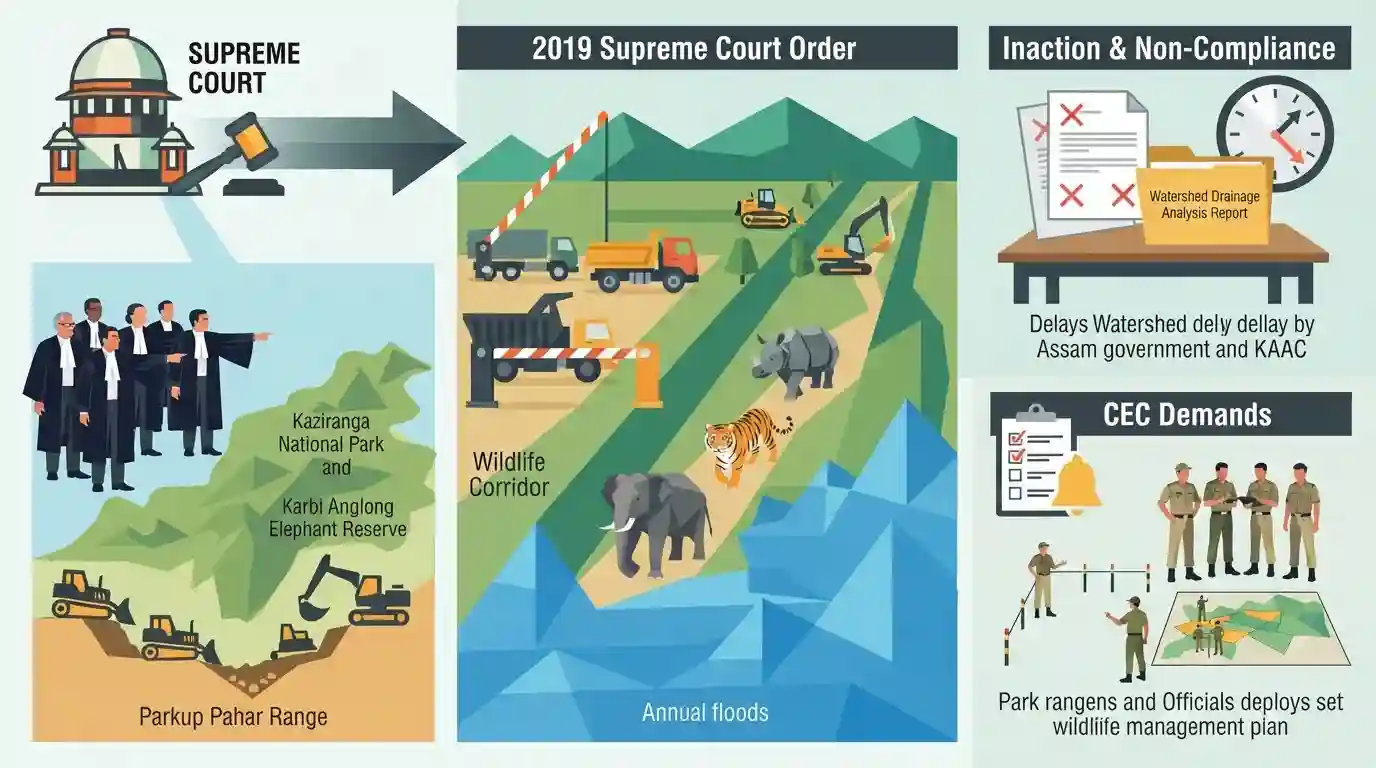
The Supreme Court-constituted Central Empowered Committee (CEC) has reprimanded the Assam government and the Karbi Anglong Autonomous Council (KAAC) for severe inaction against mining activities on the southern boundary of Kaziranga National Park, specifically in the Parkup Pahar Range and Karbi Anglong Elephant Reserve. Despite a landmark 2019 Supreme Court order banning mining in the catchments flowing into Kaziranga and halting construction in nine identified animal corridors, enforcement has been weak. The Assam government has also failed to submit a mandated Watershed Drainage Analysis Report and notify the animal corridors, which serve as crucial high-ground retreats for animals during annual floods. The CEC has demanded immediate compliance, notification of the corridors, and the deployment of a robust wildlife management plan.
মূল বিষয়
- The Supreme Court-appointed Central Empowered Committee (CEC) pulled up the Assam Government and the Karbi Anglong Autonomous Council (KAAC) for failure to stop mining along the southern boundary of Kaziranga National Park.
- The continuing mining violates a 2019 Supreme Court order that banned all mining along Kaziranga's southern boundary and in the river catchments originating in Karbi Anglong hills, and restricted construction on nine critical animal corridors.
- The Karbi Anglong hills are vital high-ground refuges where wildlife (including one-horned rhinos and elephants) flees when Kaziranga experiences annual monsoon flooding.
- The Assam Government failed to submit a comprehensive Watershed Drainage Analysis Report (which had an October 2025 deadline) and has not notified the nine animal corridors despite repeated reminders from the CEC.
- Large-scale mining inside the Karbi Anglong Elephant Reserve, including the Borjuri area, has degraded the ecology and escalated human-elephant conflict, while the KAAC has failed to put a wildlife management plan in place.
গুরুত্বপূর্ণ শব্দ
Central Empowered Committee (CEC)

A statutory body, initially formed by the Supreme Court in 2002 and institutionalized in 2023, tasked with monitoring compliance of court directives on forests, wildlife, and environmental protection.
UPSC context
GS Papers 2 & 3 (Environmental Governance, Judicial Activism). Tests knowledge of institutional bodies mediating between the judiciary and environmental enforcement.
Karbi Anglong Autonomous Council (KAAC)
An autonomous administrative body established under the Sixth Schedule of the Indian Constitution to govern the Karbi Anglong districts in Assam, empowered with legislative and executive control over local resources.
UPSC context
GS Paper 2 (Polity - Schedule VI). Tests the balance of power between autonomous tribal councils, state governments, and environmental enforcement.
Wildlife (Protection) Act, 1972
India's primary legal framework for the conservation of flora and fauna. It establishes protected areas like national parks and elephant reserves, outlaws hunting, and regulates the protection of animal corridors.
UPSC context
GS Paper 3 (Environment). Tests statutory mechanisms used to declare and protect vital habitats, animal corridors, and eco-sensitive zones.
Environment (Protection) Act, 1986
A comprehensive umbrella legislation empowering the central government to protect environmental quality, restrict industrial operations in sensitive areas, and constitute expert bodies (like the CEC) for regulatory oversight.
UPSC context
GS Paper 3 (EIA & Conservation). Tests knowledge of the legal backing for eco-sensitive zones, pollution control, and mining bans.
Karbi Anglong Elephant Reserve
A protected landscape of over 3,200 sq. km in Assam. Its elevated hills provide vital high-ground shelter for elephants, rhinos, and other wildlife fleeing Kaziranga National Park during seasonal floods.
UPSC context
GS Paper 3 (Biodiversity). Tests landscape-level conservation models, animal migration corridors, and man-animal conflict dynamics in Northeast India.
প্রিলিমস ফাঁদ
"The CEC is a statutory body constituted under the Wildlife (Protection) Act, 1972."
The CEC was originally formed by the Supreme Court in 2002 but draws its statutory authority from Section 3(3) of the Environment (Protection) Act, 1986.
সংযুক্ত স্থির ধারণা
What is the mandate and origin of the Central Empowered Committee (CEC)?
- Judicial origin: Initially formed by the Supreme Court in 2002 to monitor and ensure compliance with its judicial orders regarding forests and wildlife conservation.
- Statutory backing: It operates as a statutory authority notified by the Central Government under Section 3(3) of the Environment (Protection) Act, 1986.
- Core mandate: Evaluates grievances regarding forest clearances, illegal mining, and encroachments in protected areas, making recommendations directly to the Supreme Court or Government.
How is the Karbi Anglong region governed under the Indian Constitution?
- Sixth Schedule: Administered under Article 244(2), applying specifically to tribal areas in the states of Assam, Meghalaya, Tripura, and Mizoram (AMTM).
- Council autonomy: The Karbi Anglong Autonomous Council (KAAC) operates as an Autonomous District Council (ADC) with legislative and executive powers over local land, unclassed forests, and tribal customs.
আন্তঃবিষয় প্যাটার্ন
Sixth Schedule vs. Conservation
Environmental enforcement in Northeast India frequently stalls due to overlapping jurisdictions between State forest departments and Sixth Schedule Autonomous District Councils (like KAAC), which control local land and forest rights.
Flood Ecology & Migration
Kaziranga’s survival depends on Brahmaputra floods flushing its wetlands. This makes connected high-ground escapes like Karbi Anglong an ecological necessity during monsoons, heightening the critical need for unblocked animal corridors.

Expect a multi-statement question combining Sixth Schedule administrative powers (KAAC) with the statutory backing of the CEC under EPA.
সংযুক্ত PYQ · 3
সংযুক্ত PYQ · 3
- 2014PrelimsGS1
With reference to 'Eco-Sensitive Zones', which of the following statements is/are correct? 1. Eco-Sensitive Zones are the areas that are declared under the Wildlife (Protection) Act, 1972. 2. The purpose of the declaration of Eco-Sensitive Zones is to prohibit all kinds of human activities in those zones except agriculture. Select the correct answer using the code given below.
- 2025MainsGS3
Mineral resources are fundamental to the country's economy and these are exploited by mining. Why is mining considered an environmental hazard? Explain the remedial measures required to reduce the environmental hazard due to mining.
- 2024MainsGS3
What role do environmental NGOs and activists play in influencing Environmental Impact Assessment (EIA) outcomes for major projects in India? Cite four examples with all important details.
