Supreme Court Task Force on Student Mental Health and Nodal Officers
Source:The Hindu ↗
Why It Matters
The issue of student suicides and mental health in higher education represents a critical intersection of Indian society, education policy, and social justice. Understanding the Supreme Court's intervention via the National Task Force is important for GS2 (Polity and Social Justice) and GS1 (Indian Society), especially concerning systemic discrimination against vulnerable communities.
Summary
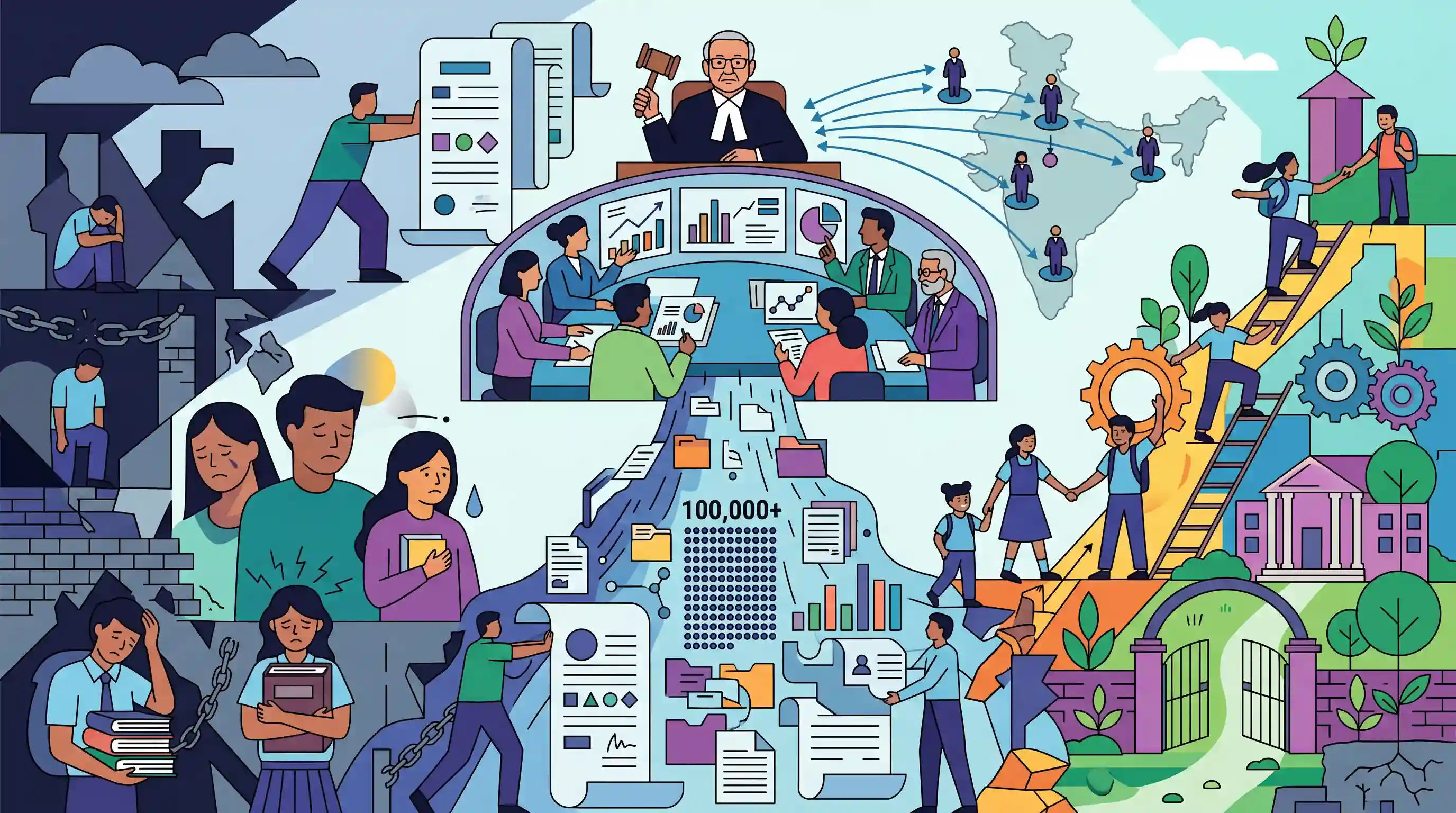
A Supreme Court-appointed National Task Force (NTF) examining student suicides and mental health in higher education institutions has begun coordinating with newly appointed nodal officers across States and Union Territories. Headed by former Justice S. Ravindra Bhat, the panel was formed in response to PILs highlighting systemic discrimination, including the tragic cases of Rohith Vemula and Payal Tadvi. The NTF aims to analyze institutional failures, academic pressure, and caste-based discrimination, having already collected over 1 lakh survey responses to recommend systemic reforms.
Key Points
- The Supreme Court has set up a National Task Force (NTF) to investigate the rising cases of student suicides and mental health challenges in higher education institutions.
- States and Union Territories are appointing nodal officers to assist the NTF in state-specific consultations and data collection.
- The NTF, led by former Supreme Court judge Justice S. Ravindra Bhat, has already gathered over 1 lakh survey responses from students, faculty, and parents.
- Regulatory bodies such as AICTE, PCI, and BCI have been directed to provide necessary institutional data to support the committee's mandate.
- The task force aims to address systemic issues, including caste-based discrimination, ragging, academic pressure, and mental health stigma, which were highlighted by PILs following the suicides of Rohith Vemula and Payal Tadvi.
Important Terms
National Task Force (NTF)

A Supreme Court-constituted panel (2025) chaired by Justice S. Ravindra Bhat to examine student suicides, academic pressure, and discrimination in higher education institutions.
UPSC context
GS Paper II: Statutory/Regulatory/Quasi-judicial bodies and judicial activism; tests understanding of institutional mechanisms for vulnerable sections.
All India Council for Technical Education (AICTE)
A statutory body under the Ministry of Education responsible for planning and coordinating technical and management education in India.
UPSC context
GS Paper II: Issues relating to development and management of Social Sector/Services relating to Education.
Bar Council of India (BCI)
A statutory body established under the Advocates Act, 1961, that regulates legal education and professional standards for lawyers in India.
UPSC context
GS Paper II: Regulatory bodies; significant for legal reforms and judicial oversight of professional education.
Pharmacy Council of India (PCI)
A statutory body under the Ministry of Health and Family Welfare that regulates pharmacy education and the profession of pharmacy in India.
UPSC context
GS Paper II: Government policies and interventions for development in various sectors; health and education regulation.
All India Survey on Higher Education (AISHE)
An annual web-based survey by the Ministry of Education that collects comprehensive data on all higher education institutions in India.
UPSC context
GS Paper II: Issues relating to Education and Human Resources; critical for tracking GER and gender parity.
Supreme Court of India
The highest judicial court under the Constitution of India, possessing powers of original, appellate, and advisory jurisdiction.
UPSC context
GS Paper II: Indian Constitution—historical underpinnings, evolution, features, and significant provisions.
Prelims Trap
The National Task Force on student mental health in higher education was constituted by the University Grants Commission (UGC).
The NTF was directly constituted by the Supreme Court of India in response to PILs, not by an executive ministry or statutory body.
Static Concepts Connected
Which constitutional articles protect marginalized students from campus discrimination?
- Article 15(4) & (5): Allows the State to make special provisions for the advancement of socially and educationally backward classes, including SCs and STs, in educational institutions.
- Article 17: Abolishes untouchability and forbids its practice in any form, preventing caste-based exclusion or segregation in campus hostels, messes, and academic spaces.
- Article 46: A DPSP directing the State to promote the educational and economic interests of weaker sections (especially SCs/STs) and protect them from social injustice.
How does the Mental Healthcare Act, 2017 address the issue of student suicides?
- Decriminalization of Suicide: Section 115 presumes severe stress in suicide attempts, effectively decriminalizing it and exempting survivors from prosecution under Section 309 of the IPC.
- Right to Healthcare: The Act guarantees every person the right to access mental healthcare and treatment from services operated or funded by the appropriate government.
Cross-Topic Patterns
Judicial Activism vs. Executive Inaction
The Supreme Court forming a National Task Force reflects judicial activism stepping in where statutory regulators like the UGC and AICTE have failed to curb the student suicide crisis.
Social Justice intersecting with Mental Health
Mental health policies now intersect directly with caste dynamics, acknowledging that structural discrimination (as seen in the Vemula and Tadvi cases) is a primary driver of the campus suicide epidemic.

Mains GS2 may test the intersection of judicial activism, caste-based discrimination, and the mental health crisis in higher education.
Linked PYQs · 3
Linked PYQs · 3
- 2024MainsGS2
Explain the reasons for the growth of public interest litigation in India. As a result of it, has the Indian Supreme Court emerged as the world's most powerful judiciary ?
- 2023MainsGS1
Explain why suicide among young women is increasing in Indian society.
- 2023MainsGS2
“Development and welfare schemes for the vulnerable, by its nature, are discriminatory in approach.” Do you agree? Give reasons for your answer.
