Supreme Court Orders Status Quo on CAG Audit of Delhi Discoms
Source:The Hindu ↗
Why It Matters
This case highlights critical constitutional and administrative issues regarding the jurisdiction of the CAG over private utility companies under Section 20(3) of the CAG Act, 1971. It also raises questions about the suo motu powers of specialized statutory tribunals (APTEL) vis-a-vis independent sector regulators (DERC) and the Supreme Court's oversight of regulatory capture in the infrastructure sector.
Summary
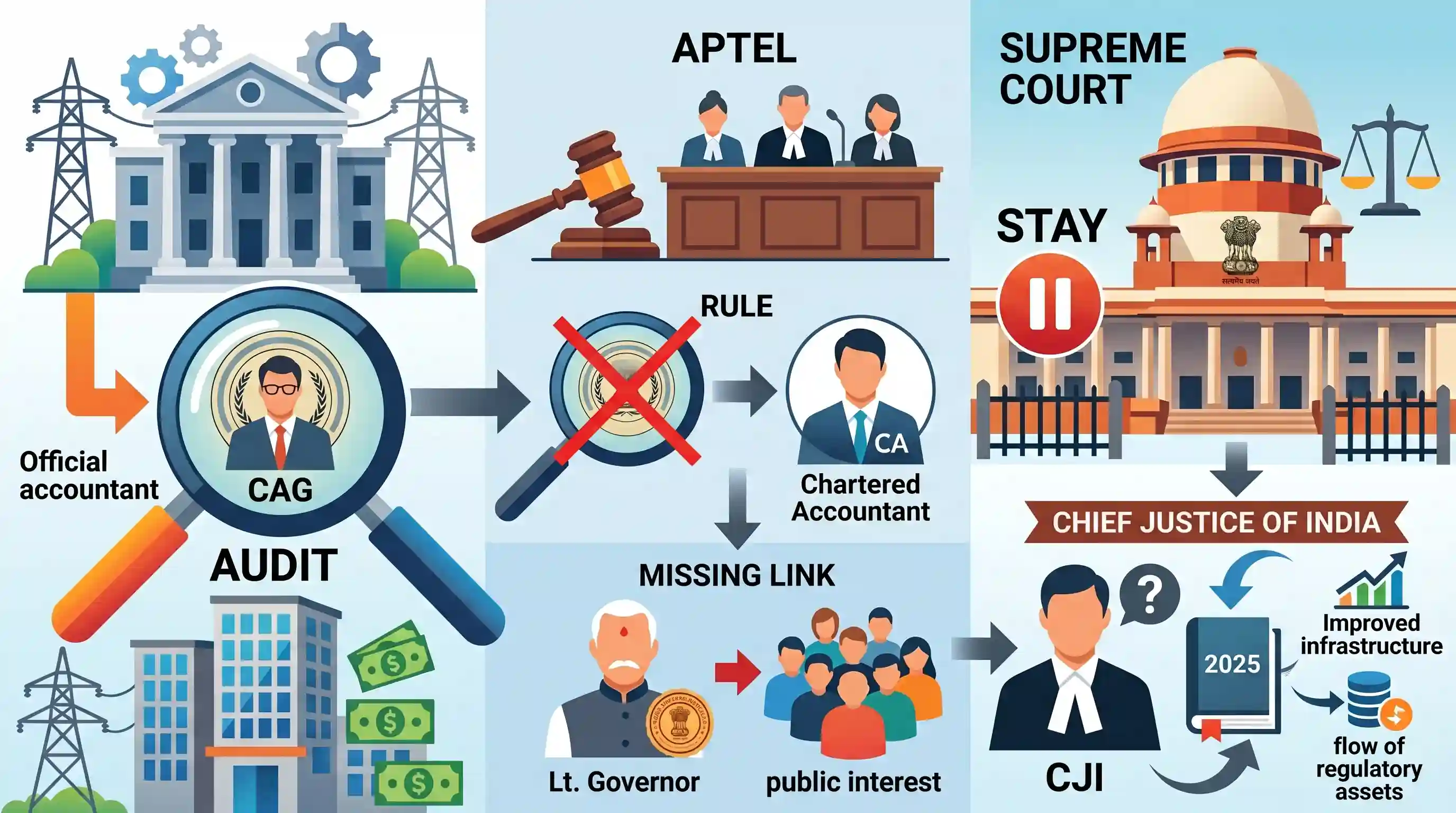
The Supreme Court has stayed an Appellate Tribunal for Electricity (APTEL) order that had quashed the Delhi Electricity Regulatory Commission's (DERC) directive to have the Comptroller and Auditor General (CAG) audit Delhi's private discoms. APTEL had ruled that a CAG audit of private discoms without the Lt. Governor's recorded satisfaction of 'public interest' violated Section 20(3) of the CAG Act of 1971, and that any chartered accountant could perform the audit instead. The Supreme Court ordered a status quo on the audit and referred the matter to the Chief Justice of India to clarify the scope of a previous 2025 judgment on electricity sector reforms.
Key Points
- The Supreme Court stayed an order of the Appellate Tribunal for Electricity (APTEL) which had quashed a Delhi Electricity Regulatory Commission (DERC) order directing a CAG audit of Delhi's private power distribution companies (discoms).
- The controversy is rooted in an August 6, 2025 Supreme Court judgment criticizing State Electricity Regulatory Commissions (SERCs) for operating under state governments' 'dictation' (causing regulatory failure) and directing them to audit discoms to explain the non-recovery of massive 'regulatory assets'.
- Following the SC directive, the DERC ordered the CAG to audit the discoms. However, APTEL took suo motu cognisance and quashed the DERC order, ruling that the SC did not specify the CAG and that any Chartered Accountant could conduct the audit.
- APTEL noted that a CAG audit would violate Section 20(3) of the CAG (Duties, Powers and Conditions of Service) Act, 1971, which mandates that audits not otherwise covered by Parliamentary law can only be done if the President or Governor (Lt. Governor in Delhi) is satisfied of the 'public interest' involved. No such Lt. Governor satisfaction was documented in this case.
- The Supreme Court Bench issued a status quo order, effectively suspending the DERC's CAG audit mandate for now, and referred the matter to the Chief Justice of India for assignment to an appropriate Bench to examine the scope of the August 2025 judgment.
Important Terms
Comptroller and Auditor General (CAG) of India

A constitutional authority established under Article 148 of the Indian Constitution, acting as the guardian of the public purse by auditing the accounts and expenditures of central, state, and union territory governments.
UPSC context
GS Paper II (Constitutional Bodies) — Tests understanding of constitutional offices, financial accountability, and the division of oversight powers.
Appellate Tribunal for Electricity (APTEL)
A statutory body established under Section 110 of the Electricity Act, 2003, to hear appeals against the orders of Central and State Electricity Regulatory Commissions and adjudicate sector-specific disputes.
UPSC context
GS Paper II (Regulatory & Quasi-Judicial Bodies) — Tests understanding of specialized dispute resolution mechanisms and administrative tribunals.
Delhi Electricity Regulatory Commission (DERC)
A statutory regulatory body established to regulate the power sector, set electricity tariffs, protect consumer interests, and oversee power distribution companies in the National Capital Territory of Delhi.
UPSC context
GS Paper III (Infrastructure) and GS Paper II (Statutory Bodies) — Tests knowledge of sector regulation and state regulatory commissions.
Comptroller and Auditor General (Duties, Powers and Conditions of Service) Act, 1971
A central legislation enacted under Article 149 that defines the functional scope, audit procedures, and service conditions of the CAG, including rules for auditing non-governmental or private entities.
UPSC context
GS Paper II (Polity & Governance) — Tests understanding of statutory laws that detail and implement constitutional oversight mandates.
Supreme Court of India
The apex judicial body and constitutional court of India established under Article 124, possessing original, appellate, and advisory jurisdictions with final authority for judicial review.
UPSC context
GS Paper II (Judiciary) — Tests knowledge of the structure, jurisdiction, and role of the apex court in constitutional interpretation.
Prelims Trap
The CAG has no constitutional or statutory authority to audit private entities, public-private partnerships, or private utility distribution companies.
Under Section 20 of the CAG Act, 1971, and the 2014 Telecom ruling, the CAG can audit private entities under specific public interest or revenue-sharing conditions.
Static Concepts Connected
What is the statutory mechanism for the CAG to audit private entities?
- Section 20: Empowered under Section 20 of CAG Act, 1971, to audit bodies not otherwise covered by law.
- Executive Consent: Requires the President, Governor, or UT Administrator to formally request the audit.
- Public Interest: The executive must be satisfied that such an audit is in public interest after hearing the entity.
- Natural Resources: SC (2014) established that private entities sharing revenue for using natural resources are subject to CAG audit under Section 16.
What is the unique statutory architecture of APTEL?
- Establishment: Statutory body created under Section 110 of the Electricity Act, 2003 to hear electricity-related appeals.
- Direct Appeal: Appeals against its decisions lie directly to the Supreme Court under Section 125, bypassing High Courts.
- Supervisory Powers: Possesses powers under Section 121 to issue directions to central and state regulatory commissions.
Cross-Topic Patterns
CAG scrutiny of private-public interfaces
Connects constitutional auditing powers to private entities utilizing public resources or state monopolies, illustrating the expansion of public accountability.
Bypassing High Courts in regulatory appeals
Highlights how specialized statutory tribunals like APTEL channel appeals directly to the Supreme Court, bypassing traditional judicial hierarchies and impacting federal adjudication.

CAG's statutory powers to audit private/PPP entities under Section 20(3) vs constitutional powers will be a multi-statement MCQ in 2026.
Linked PYQs · 3
Linked PYQs · 3
- 2024MainsGS2
“The duty of the Comptroller and Auditor General is not merely to ensure the legality of expenditure but also its propriety.” Comment.
- 2018MainsGS2
“The Comptroller and Auditor General (CAG) has a very vital role to play.” Explain how this is reflected in the method and terms of his appointment as well as the range of powers he can exercise.
- 2018MainsGS2
How far do you agree with the view that tribunals curtail the jurisdiction of ordinary courts? In view of the above, discuss the constitutional validity and competency of the tribunals in India.
