ADAG Bank Fraud Investigation and Special Investigation Team Probe
Source:The Hindu ↗
Why It Matters
This ruling is highly relevant for UPSC aspirants as it clarifies the application of Section 17A of the Prevention of Corruption Act, scrutinizes the functioning and accountability of central investigative agencies (CBI and ED), and highlights critical loopholes in the Insolvency and Bankruptcy Code (IBC) regarding related-party acquisitions.
Summary
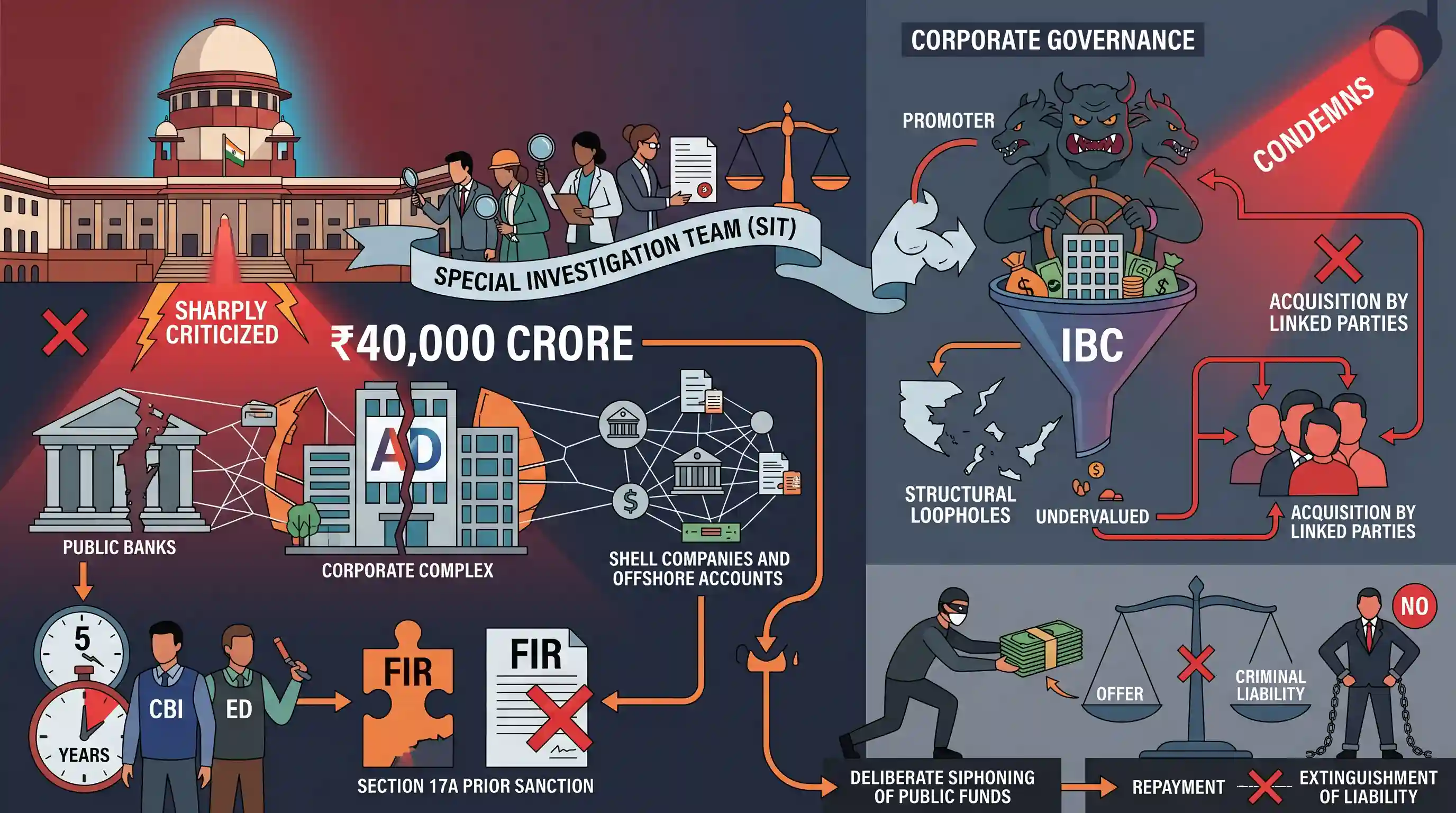
The Supreme Court of India ordered a Special Investigation Team (SIT) probe into an alleged ₹40,000 crore bank fraud involving the Anil Dhirubhai Ambani Group (ADAG). The Court sharply criticized the Central Bureau of Investigation (CBI) and the Enforcement Directorate (ED) for a five-year delay in filing an FIR, noting they wrongly assumed prior sanction under Section 17A of the Prevention of Corruption Act was required to investigate collusive acts by public officials. Highlighting structural loopholes, the SC condemned the misuse of the Insolvency and Bankruptcy Code (IBC), where assets of defaulting firms are severely undervalued and acquired by parties linked to the promoters. Furthermore, the Court ruled that offering to repay debts does not extinguish criminal liability if the deliberate siphoning of public funds is established.
Key Points
- The Supreme Court directed the Enforcement Directorate (ED) to constitute a Special Investigation Team (SIT) to probe an alleged ₹40,000 crore bank fraud involving the Anil Dhirubhai Ambani Group (ADAG).
- The investigation will focus on the nexus and collusion between the company's management, bank officials, and public authorities.
- The SC clarified that prior sanction under Section 17A of the Prevention of Corruption Act is not a prerequisite for investigative agencies to probe criminal conspiracy and connivance.
- The Court strongly criticized the CBI and ED for a five-year delay in registering an FIR after a 2020 forensic audit revealed systemic siphoning of funds and forged bank guarantees.
- The judgment highlighted the misuse of the Insolvency and Bankruptcy Code (IBC), where heavily indebted companies are bought at severely undervalued prices by entities linked to the original promoters.
- The Court established that a mere willingness to repay debts cannot absolve individuals of criminal liability if the deliberate siphoning of public funds is proven.
Important Terms
Section 17A (Prevention of Corruption Act)

A provision in the Prevention of Corruption Act (1988) requiring prior government approval before investigating public servants for decisions taken in official duty to protect honest officers.
UPSC context
GS-II/Polity; tests knowledge of bureaucratic accountability, investigative independence, and protection of public servants from frivolous probes.
Insolvency and Bankruptcy Code (IBC)
A 2016 framework for time-bound resolution of insolvent firms, aiming to maximize asset value and protect creditors while preventing promoters from gaming the system.
UPSC context
GS-III/Economy; critical for understanding NPA resolution, promoter accountability, and the legal challenges in India's credit culture.
Siphoning of Public Funds
The illegal diversion of institutional or public funds for unauthorized private use, which maintains criminal liability regardless of later offers to repay the debt.
UPSC context
GS-III/Banking; tests understanding of corporate fraud, wilful default, and the distinction between civil debt and criminal liability.
Central Bureau of Investigation (CBI)
India's premier agency for investigating corruption and high-profile crimes, deriving its powers from the Delhi Special Police Establishment (DSPE) Act, 1946.
UPSC context
GS-II/Statutory & Regulatory Bodies; important for governance, accountability, and the role of central agencies in financial fraud cases.
Enforcement Directorate (ED)
A specialized financial investigation agency under the Ministry of Finance that enforces laws against money laundering (PMLA) and foreign exchange violations (FEMA).
UPSC context
GS-II/GS-III; central to discussions on economic crimes, money laundering, and the powers of investigative agencies.
Special Investigation Team (SIT)
A court-mandated group of senior officers appointed to conduct an independent and specialized probe into high-stakes cases involving alleged systemic failures or delays.
UPSC context
GS-II/Judiciary; relevant for judicial activism and the Supreme Court’s role in ensuring fair and timely investigations in public interest.
Prelims Trap
Prior approval under Section 17A of PoCA is strictly mandatory before investigating any alleged offense committed by a public servant.
The SC clarified that Section 17A sanction is NOT required for probing criminal conspiracy and collusive fraud; it only protects bona fide administrative decisions.
Static Concepts Connected
What is the purpose of Section 29A in the Insolvency and Bankruptcy Code (IBC)?
- Core Objective: Prevents defaulting promoters and related parties from regaining control of their distressed assets at steeply discounted valuations during the resolution process.
- Disqualification Criteria: Bars willful defaulters, persons convicted of specific offenses, and individuals whose accounts have been classified as non-performing assets (NPAs) for over a year.
- Implementation Challenge: Promoters often use complex corporate veils and proxy entities to bypass this restriction, exploiting the structural loophole highlighted by the SC.
When does Section 17A of the Prevention of Corruption Act (PoCA) apply?
- Bona fide protection: Introduced via the 2018 amendment to shield honest public officials from undue harassment over bona fide administrative decisions or recommendations.
- Prior Approval: Requires prior sanction from the competent authority before conducting an inquiry, inquiry, or investigation into offenses under the Act.
- Critical Exemptions: Does not apply to on-the-spot arrests for bribery, nor does it act as a prerequisite for probing acts of criminal conspiracy and deliberate fraud.
Cross-Topic Patterns
CBI delays and PoCA safeguards
The 2018 PoCA amendment is frequently cited by agencies to delay probes. UPSC often tests how anti-corruption laws interact with the operational autonomy and jurisdiction of the CBI and ED.
RBI compromise settlements vs. criminal liability
RBI's framework allowing compromise settlements for willful defaulters contrasts sharply with the SC's ruling that merely offering to repay debts doesn't extinguish criminal liability for siphoning public funds.

Section 17A of PoCA (exemptions) and IBC Section 29A (promoter disqualifications) are prime targets for multi-statement Prelims questions.
Linked PYQs · 3
Linked PYQs · 3
- 2021MainsGS2
The jurisdiction of the Central Bureau of Investigation (CBI) regarding lodging an FIR and conducting probe within a particular State is being questioned by various States. However, the power of the States to withhold consent to the CBI is not absolute. Explain with special reference to the federal character of India.
- 2019PrelimsGS1
The Chairmen of public sector banks are selected by the
- 2019MainsGS4
"Non-performance of duty by a public servant is a form of corruption". Do you agree with this view? Justify your answer.
