Supreme Court Directives on Stray Animals and Public Safety
Source:The Hindu ↗
Why It Matters
This development is crucial for GS-2 (Governance and Polity) as it illustrates the judiciary's role in balancing statutory animal rights against citizens' fundamental right to life and safety. It also highlights the accountability of urban local bodies and agencies like NHAI in municipal administration and public infrastructure management.
Summary
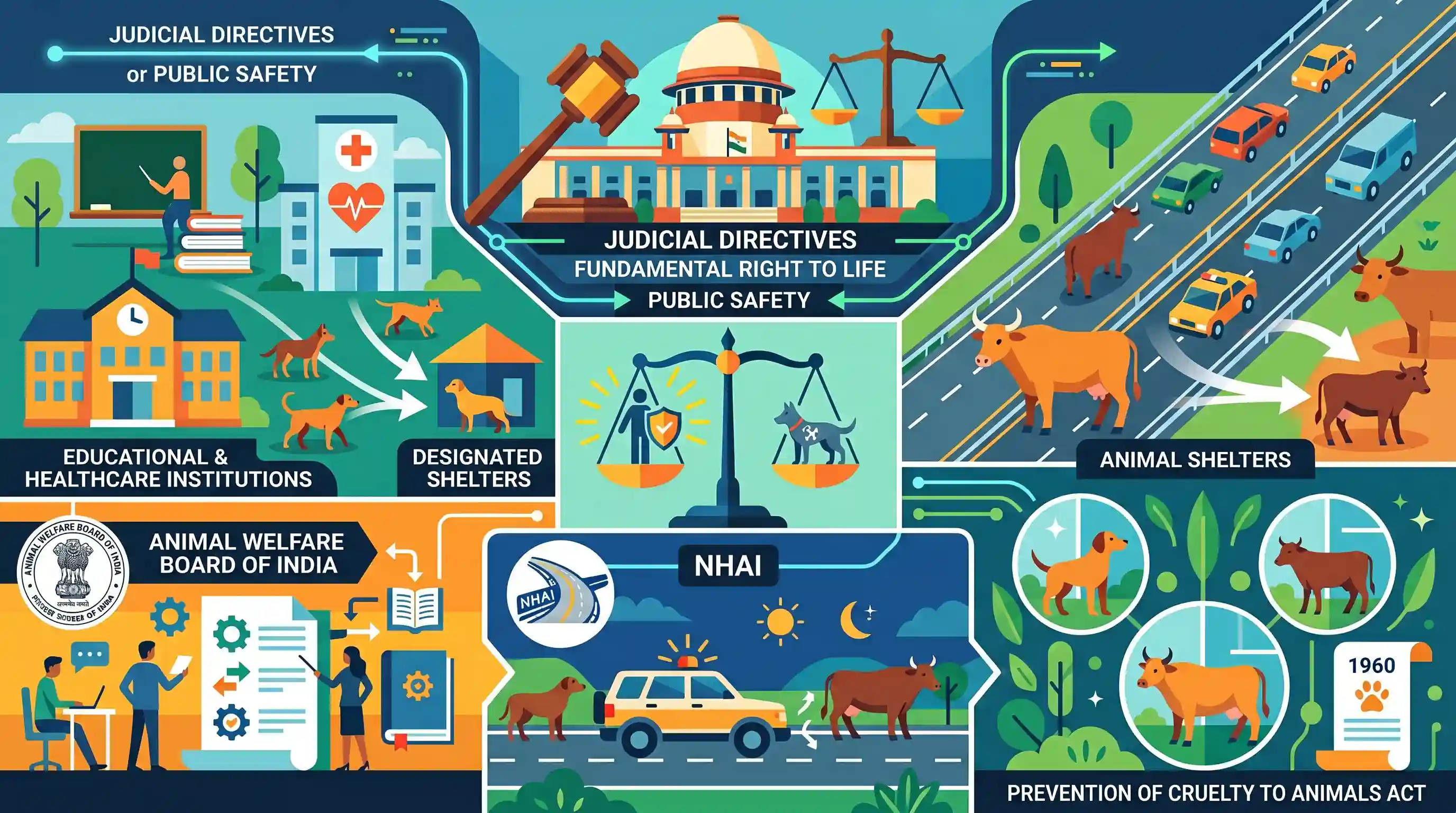
The Supreme Court of India has issued comprehensive directives to prioritize public safety by ordering the removal of stray dogs from educational and healthcare institutions, and cattle from national highways. Ruling that the fundamental right to life supersedes the release of sterilized canines back into high-footfall areas, the Court mandated their relocation to designated shelters in accordance with the Prevention of Cruelty to Animals Act, 1960. Furthermore, the Animal Welfare Board of India has been directed to frame national SOPs for stray dog management, while the NHAI must establish round-the-clock highway patrols to address the stray cattle menace.
Key Points
- The Supreme Court directed States and UTs to remove stray dogs from high-footfall public institutions like schools and hospitals, relocating them to shelters after sterilization and vaccination under the ABC Rules, 2023.
- Departing from the general rule of releasing sterilized dogs back to their original localities, the Court emphasized that public safety and the fundamental right to life must take precedence in these institutional areas.
- The Court ordered the NHAI and municipal authorities to clear cattle and stray animals from highways to prevent accidents, mandating relocation to gaushalas and the setup of 24/7 highway patrol units.
- The Animal Welfare Board of India (AWBI) was tasked with formulating uniform Standard Operating Procedures (SOPs) for stray dog management and bite prevention across all States and UTs.
Important Terms
Animal Birth Control (ABC) Rules, 2023

Statutory rules under the PCA Act mandating a 'catch-sterilize-vaccinate-release' model for stray dogs. They aim to humanely control populations while prohibiting relocation, though recent judicial orders limit their application in public institutions.
UPSC context
GS II (Governance) & GS III (Environment). Tests human-animal conflict management and statutory shifts in urban governance.
Prevention of Cruelty to Animals (PCA) Act, 1960
India's primary legislation enacted to prevent 'unnecessary pain or suffering' to animals. It established the Animal Welfare Board of India and provides the legal basis for all animal protection rules and penalties.
UPSC context
GS II (Statutory Frameworks). Foundational for understanding the legal status of animals and the limits of human-animal interaction.
Animal Welfare Board of India (AWBI)
A statutory advisory body established under the PCA Act, 1960, under the Ministry of Fisheries, Animal Husbandry and Dairying. It advises the government on animal welfare and monitors the implementation of protection laws.
UPSC context
GS II (Statutory Bodies). Tests knowledge of quasi-judicial and advisory institutions in environment and animal welfare.
Article 21 (Right to Life)
A fundamental right guaranteeing life and personal liberty. Recent Supreme Court interpretations prioritize this human right to safety and health over standard animal management protocols in high-risk public spaces.
UPSC context
GS II (Fundamental Rights). Crucial for analyzing judicial balancing between human safety and animal welfare obligations.
National Highways Authority of India (NHAI)
An autonomous statutory body responsible for the development and maintenance of National Highways. Recently tasked by the judiciary to eliminate the 'stray cattle menace' through 24/7 patrols and helplines.
UPSC context
GS III (Infrastructure). Important for discussions on road safety, administrative accountability, and infrastructure management.
Prelims Trap
"The ABC Rules 2023 mandate the permanent relocation of sterilized stray dogs to designated animal shelters."
False. The Rules explicitly prohibit relocation and mandate returning dogs to their original localities. The Supreme Court's order for institutional relocation is a judicial exception invoking Article 21.
Static Concepts Connected
What is the statutory status and mandate of the Animal Welfare Board of India (AWBI)?
- Statutory body: Established in 1962 under Section 4 of the Prevention of Cruelty to Animals Act, 1960.
- Advisory role: Advises central and state governments on animal welfare laws and provides financial assistance to recognized Animal Welfare Organisations (AWOs).
- Headquarters shift: Originally based in Chennai, the headquarters was relocated to Ballabgarh (Haryana) in 2018.
How does the Constitution distribute legislative and functional responsibilities for animal welfare?
- Concurrent List: Entry 17 of the Concurrent List (7th Schedule) explicitly covers the "Prevention of cruelty to animals," allowing both Parliament and States to legislate.
- Local Governance: The 12th Schedule (added by 74th Amendment, 1992) lists "Cattle pounds; prevention of cruelty to animals" as a functional responsibility for municipalities.
Cross-Topic Patterns
Article 21 overriding statutory rules
The SC's use of the Right to Life (Art 21) to bypass the ABC Rules 2023 mirrors past environmental judgments where public safety eclipsed specific statutory allowances.
NHAI mandates and municipal overlap
NHAI's highway mandate intersecting with local municipal duties (12th Schedule) for cattle pounds highlights the persistent jurisdictional overlap and governance deficit in India's peri-urban areas.

Expect a Prelims question pairing AWBI/NHAI to their parent Acts, or evaluating the 12th Schedule's mandate for municipal animal control.
Linked PYQs · 3
Linked PYQs · 3
- 2009PrelimsGS1
Where is the headquarters of Animal Welfare Board of India located?
- 2022PrelimsGS1
With reference to Indian laws about wildlife protection, consider the following statements : 1. Wild animals are the sole property of the government. 2. When a wild animal is declared protected, such animal is entitled for equal protection whether it is found in protected areas or outside. 3. Apprehension of a protected wild animal becoming a danger to human life is sufficient ground for its capture or killing. Which of the statements given above is/are correct?
- 2023MainsGS2
“The Constitution of India is a living instrument with capabilities of enormous dynamism. It is a constitution made for a progressive society.” Illustrate with special reference to the expanding horizons of the right to life and personal liberty.
