Supreme Court Directs Nationwide Expansion of Open Prisons
Source:Indian Express ↗
Why It Matters
Prison overcrowding and undertrial conditions are perennial challenges in India's criminal justice system. The Supreme Court's push for the Rajasthan 'Open Prison' model highlights a progressive shift towards rehabilitative justice, frequently tested in GS2 (Governance/Rights) and Prelims (State vs. Union subjects).
Summary
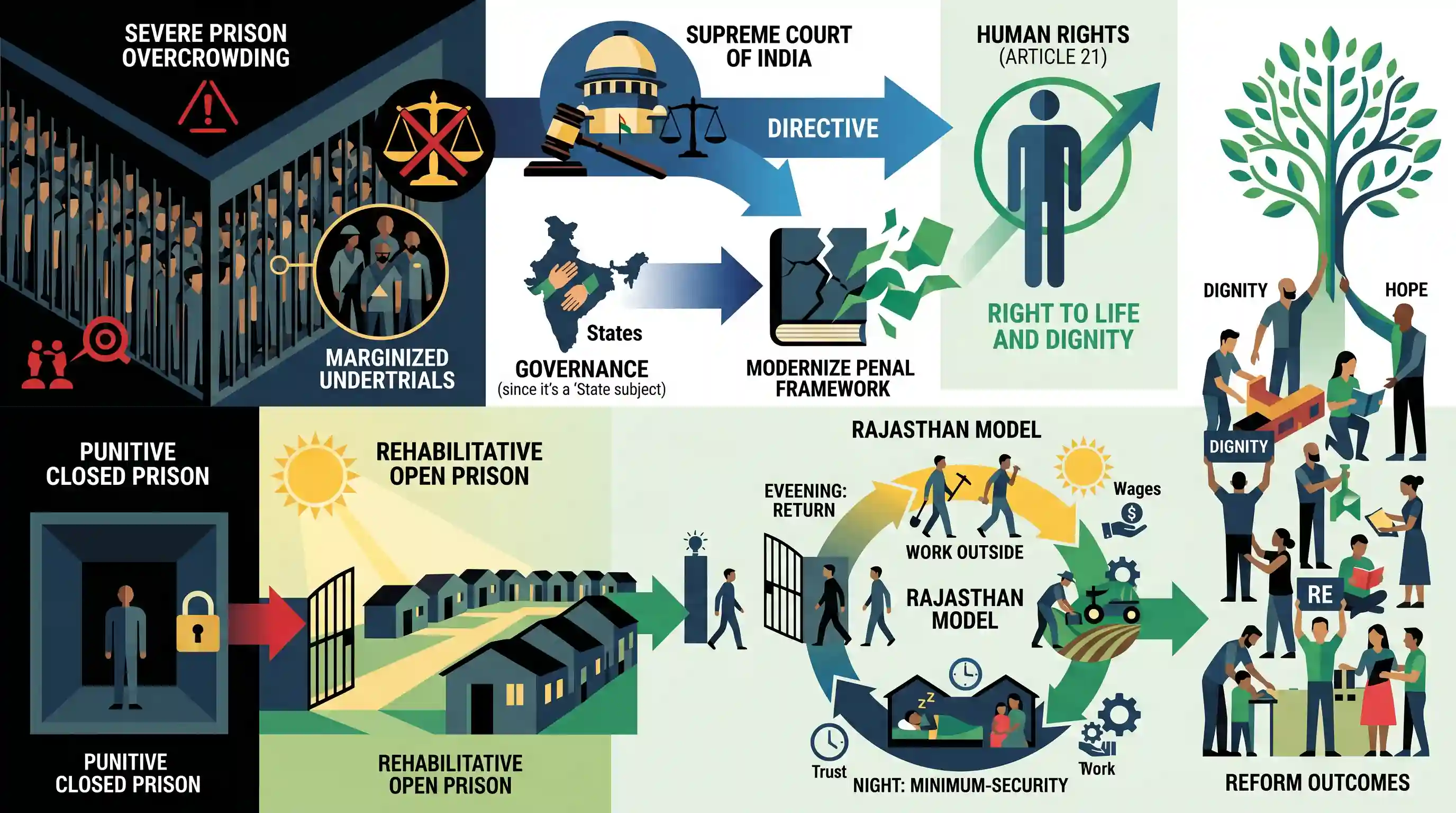
The Supreme Court of India has directed a massive expansion of 'Open Prisons' (Open Correctional Institutions) across the country to alleviate severe jail overcrowding and reform the criminal justice system. Emphasizing the successful 'Rajasthan model'—which allows prisoners to work outside during the day and return to minimum-security housing at night—the Court championed a rehabilitative approach over punitive measures. The directive highlights the chronic issue of overcrowded prisons, which predominantly affect marginalized undertrials, and urges State Governments (since 'Prisons' is a State subject) to modernize their penal framework.
Key Points
- The Supreme Court mandated the widespread establishment of Open Prisons (OCIs) across India to tackle rampant jail overcrowding.
- The Court advocated the 'Rajasthan model' of open prisons, which facilitates social reintegration by allowing inmates to maintain employment and family ties in a minimum-security environment.
- The initiative represents a paradigm shift in India's criminal justice system from retributive punishment to reformative and rehabilitative justice.
- Because 'Prisons/Persons detained therein' is a State subject (Entry 4, List II of the Seventh Schedule), State Governments hold the primary responsibility for enacting rules and building these facilities.
- Overcrowding fundamentally impacts the human rights (Article 21) of inmates, particularly the vast majority who are undertrials requiring better access to justice and legal aid.
Important Terms
Open Correctional Institutions (OCI)

Minimal-security facilities focusing on rehabilitation over punishment. Inmates often live with families and work outside, returning at night, relying on self-discipline rather than physical barriers to prevent escape.
UPSC context
GS Paper II (Governance/Social Justice); tests understanding of reformative justice and solutions to prison overcrowding.
Rajasthan Model
A highly successful open-prison system where inmates reside in 'Open Air Camps' with families, pursue independent livelihoods, and practice self-governance through a 'Bandi Panchayat' system.
UPSC context
GS Paper II/IV; excellent case study for prison reforms and human-rights-based governance models.
Prisons Act, 1894
A colonial-era law that remains the primary statutory framework for prison management. It focuses on custody, discipline, and punishment rather than reformation or prisoner rehabilitation.
UPSC context
GS Paper II; highlights the need for decolonizing Indian laws and moving toward a rehabilitative penal system.
Model Prisons Act, 2023
A 2023 legislative framework introduced by the Ministry of Home Affairs to replace colonial laws. It prioritizes reformation, rehabilitation, and modern technology in prison administration.
UPSC context
GS Paper II (Governance); relevant for questions on recent legislative efforts to overhaul criminal justice.
State List (Entry 4)
The constitutional provision in the Seventh Schedule (Entry 4) that designates 'Prisons' as a State subject, giving state governments primary authority over jail administration.
UPSC context
GS Paper II (Polity); essential for understanding federal distribution of powers regarding law and order.
Article 21
Guarantees the Right to Life and Personal Liberty. The Supreme Court interprets this to include the right of prisoners to live with dignity and experience humane conditions.
UPSC context
GS Paper II (Polity/Fundamental Rights); core constitutional basis for judicial intervention in prison overcrowding and reforms.
Prelims Trap
"Prisons are in the Concurrent List, enabling the Centre to mandate uniform Open Prison laws."
'Prisons' is strictly a State subject (Entry 4, List II). The Centre's Model Prisons Act is merely advisory, and states must legislate to enact it.
Static Concepts Connected
Which major committees have shaped India's prison reform and undertrial policies?
- Amitava Roy Committee: Constituted by the SC in 2018; highlighted the undertrial crisis (approx 77% of inmates) and recommended fast-track courts and modernizing jail infrastructure.
- Mulla Committee: A landmark 1980-83 committee that recommended a national policy on prisons, the creation of an All India Prison Service, and the expansion of open prisons.
- Krishna Iyer Committee: Focused heavily on human dignity, women prisoners, and the need for free legal aid, cementing the rehabilitative approach in Indian penology.
How does the Constitution distribute legislative power regarding prison management?
- State Subject: "Prisons, reformatories, Borstal institutions and other institutions of a like nature" fall entirely under the State List (Entry 4, List II).
- Implementation Hurdles: Because it is a State subject, uniform implementation of SC directives requires individual State Governments to amend their prison manuals and allocate budgets.
Cross-Topic Patterns
De-colonialization of Criminal Justice
The shift from the colonial 1894 Act to the Model Prisons Act 2023 parallels the recent replacement of IPC/CrPC with Bharatiya Nyaya Sanhita, highlighting a systemic shift from retributive to restorative justice.
Article 21 and Undertrial Jurisprudence
The Supreme Court heavily roots prison reform in Article 21. Overcrowding, lack of legal aid, and prolonged undertrial detention are routinely cited as structural violations of the Right to Life and Liberty.

Expect a multi-statement question in 2026 linking State List jurisdiction over prisons, undertrial stats (>75%), and Article 21 rights.
Linked PYQs · 3
Linked PYQs · 3
- 2023PrelimsGS1
Consider the following statements: Statement-I: In India, prisons are managed by State Governments with their own rules and regulations for the day-to-day administration of prisons. Statement-II: In India, prisons are governed by the Prisons Act, 1894 which expressly kept the subject of prisons in the control of Provincial Governments. Which one of the following is correct in respect of the above statements?
- 2021PrelimsGS1
With reference to India, consider the following statements : 1. When a prisoner makes out a sufficient case, parole cannot be denied to such prisoner because it becomes a matter of his/her right. 2. State Governments have their own Prisoners Release on Parole Rules. Which of the statements given above is/are correct?
- 2023MainsGS2
Who are entitled to receive free legal aid? Assess the role of the National Legal Services Authority (NALSA) in rendering free legal aid in India.
