Supreme Court Evaluates Pleas on Swaminathan Formula for MSP
Source:The Hindu ↗
Why It Matters
The article connects core agricultural topics (MSP calculation methodologies like C2 vs A2+FL) with current macroeconomic policies (NFSA impact on crop diversification) and international relations (impact of US trade deals and foreign agricultural subsidies on Indian farmers). This intersection is critical for GS-3 topics regarding farm incomes, PDS reforms, and WTO/trade issues.
Summary
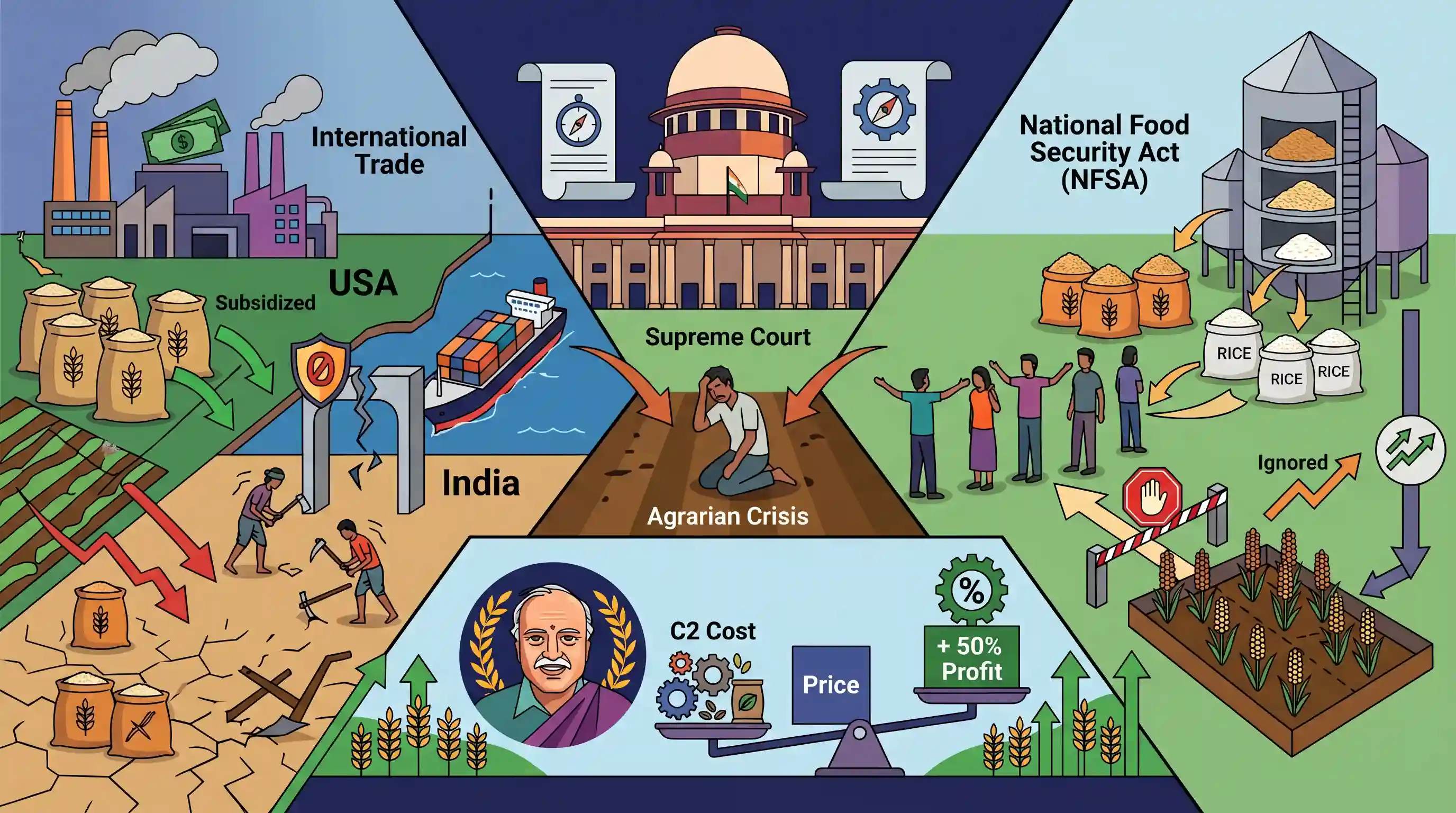
The Supreme Court of India is evaluating a petition urging the government to set the Minimum Support Price (MSP) using the comprehensive C2 cost formula plus a 50% profit margin, as recommended by the M.S. Swaminathan Commission. The plea highlights an agrarian crisis worsened by an India-U.S. trade pact permitting duty-free agricultural imports, which exposes Indian farmers to heavily subsidized American competition. Furthermore, the petition argues that the free distribution of wheat and rice under the National Food Security Act suppresses market demand for alternative crops like millets, thereby obstructing critical crop diversification efforts.
Key Points
- A petition before the Supreme Court demands MSP calculations based on the C2 cost (A2 + FL + land rent + working capital interest) plus a 50% profit margin.
- The petition cites the unfulfilled recommendations of the M.S. Swaminathan Commission Report for ensuring farming viability.
- A recent India-U.S. trade deal allowing duty-free agricultural imports is criticized for exposing Indian farmers to unfair competition from heavily subsidized American farmers.
- Free distribution of wheat and rice under the National Food Security Act is argued to artificially depress demand for alternative crops like millets, hindering crop diversification.
- Severe agrarian distress has led to widespread farmer suicides, with the petition noting 17,000 such deaths in Maharashtra over the past five years.
Important Terms
Minimum Support Price (MSP)

The pre-announced floor price at which the government procures crops from farmers to prevent distress sales and ensure price stability.
UPSC context
GS III (Agriculture). Crucial for understanding farm subsidies, government intervention, and agrarian welfare policies.
M.S. Swaminathan Commission
Formally the National Commission on Farmers (2004), it recommended that MSP be at least 50% above the comprehensive cost of production (C2).
UPSC context
GS III (Subsidies/Policy). Central to debates on doubling farmers' income and addressing historical agrarian distress.
C2 Cost Formula
A comprehensive agricultural cost accounting for paid-out expenses, family labor, and the imputed value of rent on owned land and interest on capital.
UPSC context
GS III (Farm Economics). Tests technical knowledge of price-fixing mechanisms and differences between A2+FL and comprehensive cost metrics.
National Food Security Act (NFSA), 2013
A 2013 legislation providing legal entitlements to subsidized foodgrains for two-thirds of India's population, shifting food security to a rights-based framework.
UPSC context
GS II (Social Justice) and GS III (Food Security). Tests understanding of the Public Distribution System (PDS) and welfare governance.
Crop Diversification
The practice of shifting from monoculture (like wheat-rice) to a variety of crops to improve soil health, water conservation, and income stability.
UPSC context
GS III (Cropping Patterns). Relevant to discussions on sustainable agriculture, climate resilience, and resource conservation.
Millets (Nutri-cereals)
Nutrient-rich, climate-resilient grains (like Jowar and Bajra) requiring minimal water, promoted as 'Shree Anna' for nutritional security and sustainable farming.
UPSC context
GS III (Environment/Agriculture). Significant due to the International Year of Millets and shifting focus toward climate-smart agriculture.
Prelims Trap
The government currently calculates Minimum Support Price (MSP) strictly using the comprehensive C2 cost formula.
The government currently uses the 'A2+FL' formula (paid-out costs + imputed family labour) to guarantee a 50% return, not the comprehensive 'C2' formula (which includes land rent and interest).
Static Concepts Connected
What are the three main cost formulas for MSP calculation?
- A2 Cost: Covers all actual paid-out costs directly incurred by the farmer on seeds, fertilizers, pesticides, hired labour, and fuel.
- A2+FL Cost: Includes actual paid-out costs (A2) plus the imputed value of unpaid family labour. This is the formula currently used by the government.
- C2 Cost: A comprehensive cost factor that includes A2+FL plus the imputed rent on owned land and interest forgone on fixed capital assets.
How does the WTO Agreement on Agriculture classify domestic subsidies?
- Amber Box: Trade-distorting subsidies like MSP and fertilizer subsidies. They are subject to strict reduction commitments.
- Blue Box: Broadly Amber Box subsidies but tied to conditions designed to limit production. Currently, there are no spending limits on these.
- Green Box: Non-trade-distorting subsidies, such as agricultural research or environmental protection programs. These are permitted without limits.
Cross-Topic Patterns
NFSA procurement vs. Crop Diversification
Assured procurement of wheat and paddy for NFSA creates a systemic disincentive for farmers to shift toward climate-resilient, water-efficient millets, exacerbating groundwater depletion and soil degradation.
Trade Pacts & WTO Subsidies
Duty-free agricultural imports expose Indian farmers to unequal competition because developed nations heavily utilize massive Green and Blue Box exemptions under WTO to subsidize their domestic farm sectors.

A 2026 multi-statement Prelims question will likely contrast A2+FL vs C2 formulas alongside the ecological impacts of NFSA cereal procurement.
Linked PYQs · 5
Linked PYQs · 5
- 2018MainsGS3
What do you mean by Minimum Support Price (MSP)? How will MSP rescue the farmers from the low income trap?
- 2017MainsGS3
How do subsidies affect the cropping pattern, crop diversity and economy of farmers? What is the significance of crop insurance, minimum support price and food processing for small and marginal farmers?
- 2024MainsGS3
Explain the role of millets for ensuring health and nutritional security in India.
- 2021MainsGS3
What are the present challenges before crop diversification? How do emerging technologies provide an opportunity for crop diversification?
- 2023MainsGS3
What are the direct and indirect subsidies provided to farm sector in India? Discuss the issues raised by the World Trade Organization (WTO) in relation to agricultural subsidies.
