Supreme Court ruling on menstrual health and school facilities
Source:The Hindu ↗
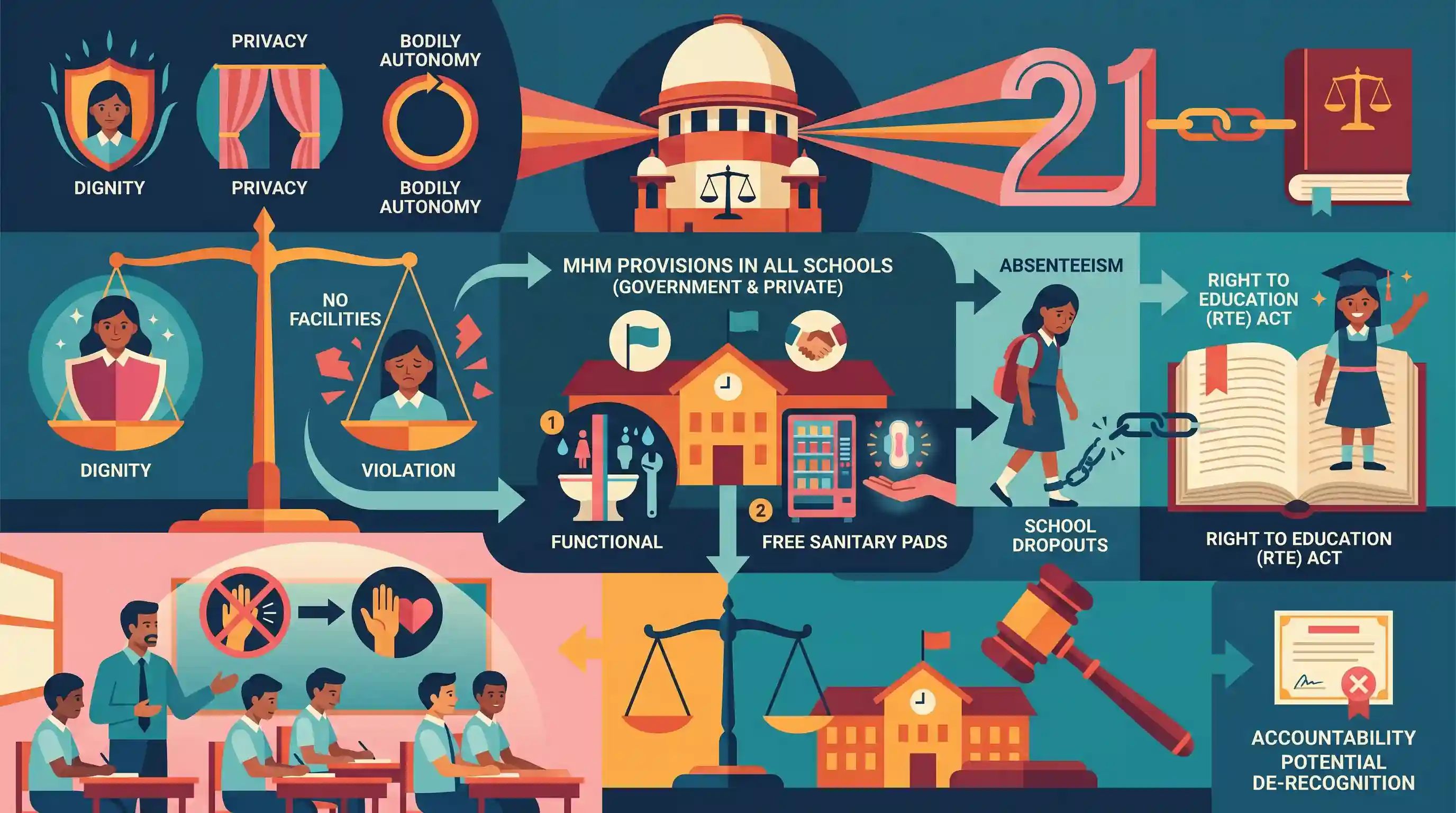
Why It Matters
This judgment represents a significant expansion of Article 21, interpreting the right to life and dignity to encompass bodily autonomy and menstrual health. It highlights the intersection of public health, gender equality, and education, addressing structural barriers that hinder girls from exercising their rights under the Right to Education Act. This is highly relevant for questions on the evolving nature of Fundamental Rights, gender justice, and social sector initiatives in India.
Summary
The Supreme Court of India has issued a landmark ruling recognizing menstrual health and access to Menstrual Hygiene Management (MHM) as fundamental rights under Article 21 of the Constitution. Emphasizing that lack of facilities violates a girl's dignity, privacy, and bodily autonomy, the Court mandated that all government and private schools must provide functional, gender-segregated toilets and free sanitary pads. The judgment addresses the gender-specific barriers that lead to absenteeism and school dropouts among adolescent girls, explicitly linking these provisions to the effective implementation of the Right to Education (RTE) Act. Furthermore, the Court called for the sensitization of male students and teachers to eliminate menstrual stigma and directed strict accountability measures, including the potential de-recognition of non-compliant private schools.
Key Points
- The Supreme Court declared menstrual health and access to Menstrual Hygiene Management (MHM) as part of the fundamental right to life and dignity under Article 21.
- Lack of proper MHM measures violates girls' bodily autonomy, contributes to school absenteeism and dropouts, and defeats the guarantee of free and compulsory education.
- The Court directed States and UTs to ensure free access to sanitary napkins and functional, gender-segregated toilets in all government and private schools.
- Schools must establish 'MHM corners' with essential supplies and sensitize male teachers and students about menstruation to prevent harassment and stigma.
- Government schools will face accountability under Section 19 of the RTE Act for non-compliance, while private schools risk de-recognition.
Important Terms
Article 21 of the Constitution

Guarantees the Right to Life and Personal Liberty. The Supreme Court expanded this to include 'dignified menstrual health,' emphasizing that privacy, bodily autonomy, and health are essential facets of a dignified life.
UPSC context
GS Paper II: Indian Constitution. Tests understanding of the judiciary's role in expanding fundamental rights to include health and dignity.
Right to Education (RTE) Act, 2009
Legislation mandating free and compulsory education for children (6–14 years). The SC ruling links menstrual hygiene to RTE, classifying the lack of pads as a 'financial barrier' to education.
UPSC context
GS Paper II: Social Justice/Education. Tests knowledge of legal frameworks ensuring universal education and state obligations to students.
Section 19 of the RTE Act
Specifies mandatory 'Norms and Standards' for school infrastructure. The Supreme Court invoked this section to mandate gender-segregated toilets and menstrual hygiene facilities as prerequisite standards for school recognition.
UPSC context
GS Paper II: Governance. Tests ability to link specific legislative provisions to administrative accountability and infrastructure standards.
Menstrual Hygiene Management (MHM)
A holistic approach involving access to menstrual products, private facilities, safe disposal, and education. The SC recognized it as an enforceable legal entitlement vital for reducing school dropouts.
UPSC context
GS Paper II/III: Health/Gender Issues. Relevant for questions on women’s empowerment, public health, and human development indicators.
Substantive Equality
A legal principle (Article 14) requiring the state to remove specific structural barriers faced by marginalized groups to ensure real equality of opportunity, rather than just formal equality on paper.
UPSC context
GS Paper II: Polity. Tests understanding of constitutional theories of justice and the state's proactive duty to protect vulnerable sections.
Bodily Autonomy
The right to self-governance over one's own body. The Court held that denying menstrual products violates this right by forcing girls to face embarrassment or choose between health and education.
UPSC context
GS Paper II: Social Justice/Rights. Key for essays and ethics (GS IV) regarding human dignity and individual rights.
Prelims Trap
The SC mandate for free sanitary pads applies exclusively to government schools under the RTE Act.
The Supreme Court explicitly included both government and private schools in its mandate, warning that private schools risk de-recognition for non-compliance under the RTE Act.
Static Concepts Connected
How has the Supreme Court expanded Article 21 regarding dignity and health?
- Right to Privacy: The Puttaswamy judgment recognized privacy and bodily autonomy as intrinsic to the fundamental right to life and liberty.
- Right to Health: The Paschim Banga Khet Mazdoor case imposed a constitutional obligation on the state to preserve life and provide medical aid.
- Right to Dignity: The Francis Coralie case ruled that the right to life includes living with human dignity, not just mere physical survival.
What are the infrastructure mandates under Section 19 of the RTE Act?
- Prescribed Norms: Mandates schools to fulfill specific infrastructure requirements, such as functional and separate toilets for boys and girls, detailed in the Act's Schedule.
- Penalty Provision: Private schools failing to fulfill these statutory norms face withdrawal of recognition, while government schools face strict statutory accountability.
Cross-Topic Patterns
Solid Waste Management & MHM
The judicial push for 'oxo-biodegradable' pads connects fundamental rights to Plastic Waste Management Rules, highlighting the ecological burden of non-compostable sanitary waste in municipal solid waste.
Period Poverty & Demographic Dividend
Curbing adolescent school dropouts due to poor MHM infrastructure is critical for improving long-term female labor force participation (FLFP) and harnessing India's demographic dividend.

Expect a 2026 Prelims question linking the judicial expansion of Article 21 (MHM) to the penal provisions of the RTE Act for private schools.
Linked PYQs · 3
Linked PYQs · 3
- 2023MainsGS2
“The Constitution of India is a living instrument with capabilities of enormous dynamism. It is a constitution made for a progressive society.” Illustrate with special reference to the expanding horizons of the right to life and personal liberty.
- 2022MainsGS2
The Right of Children to Free and Compulsory Education Act, 2009 remains inadequate in promoting incentive-based system for children's education without generating awareness about the importance of schooling. Analyse.
- 2024MainsGS1
Distinguish between gender equality, gender equity and women's empowerment. Why is it important to take gender concerns into account in programme design and implementation?
