Supreme Court directives on menstrual health in schools
Source:The Hindu ↗
Why It Matters
This landmark judgment substantially expands the scope of Article 21 to include bodily autonomy and menstrual health. It addresses a critical gender-specific barrier in education by linking school infrastructure to constitutional rights and the RTE Act, directly aiding answers on women's empowerment, health, and gender justice.
Summary
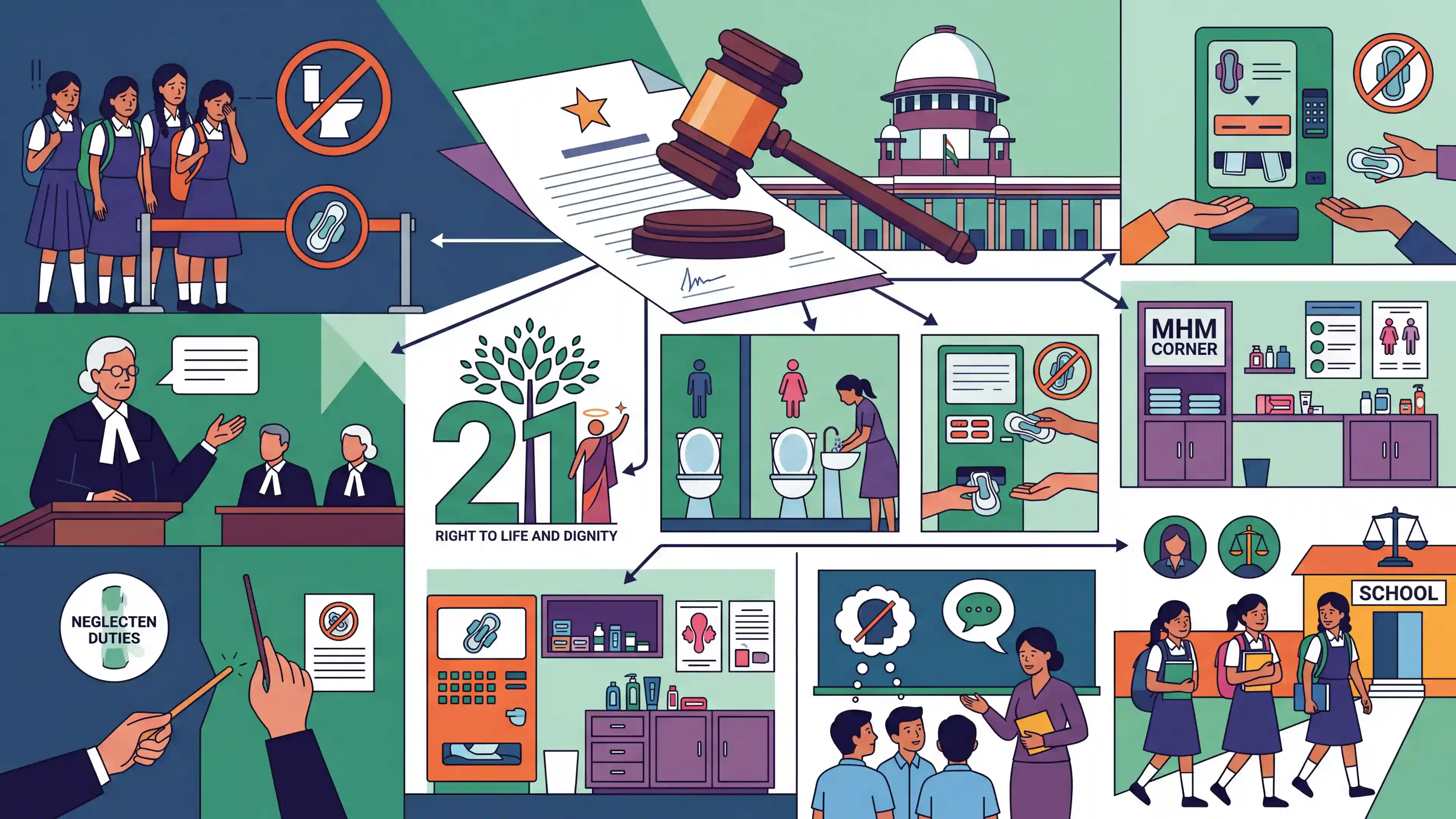
The Supreme Court of India delivered a landmark judgment recognizing menstrual health and access to menstrual hygiene management (MHM) in schools as intrinsic to the fundamental right to life and dignity under Article 21. The Court directed all States and Union Territories to equip government and private schools with functional gender-segregated toilets, free sanitary pad vending machines, and dedicated MHM corners. Highlighting that menstrual poverty and lack of hygiene infrastructure pose gender-specific barriers leading to school dropouts, the Court ruled that non-compliance will invoke penalties under the Right to Education (RTE) Act. It also stressed the importance of sensitizing males in schools to eradicate menstrual stigma.
Key Points
- The Supreme Court ruled that menstrual health and access to menstrual hygiene management (MHM) in educational institutions are part of the fundamental right to life and dignity under Article 21.
- The judgment notes that lack of safe menstrual management violates bodily autonomy and forces girls to choose between dignity and education, leading to absenteeism and dropouts.
- States and Union Territories are directed to ensure functional gender-segregated toilets and free oxo-biodegradable sanitary napkins via vending machines in all government and private schools.
- Schools must set up 'MHM corners' with spare innerwear, uniforms, and disposable bags to handle menstrual emergencies.
- Non-compliance with these infrastructure norms under Section 19 of the Right to Education (RTE) Act will result in state accountability for government schools and de-recognition for private schools.
- The Court also emphasized the need to educate and sensitize male teachers and students about menstruation to eliminate stigma, harassment, and invasive questioning.
Important Terms
Article 21 of the Constitution

A fundamental right guaranteeing life and personal liberty; the Supreme Court interprets this to include the right to live with dignity, health, and privacy.
UPSC context
GS Paper II (Polity). The most interpreted fundamental right, central to cases on health, privacy, and human dignity.
Right to Education (RTE) Act, 2009
Legislation under Article 21A that mandates free and compulsory education for children aged 6-14, requiring schools to provide basic infrastructure like functional toilets.
UPSC context
GS Paper II (Social Justice/Governance). Vital for topics on educational policy, child welfare, and developmental goals.
Menstrual Hygiene Management (MHM)
The practice of using clean materials to manage menstruation with access to private facilities, water for washing, and safe disposal methods.
UPSC context
GS Paper I (Social Issues) and GS II (Health). Key to discussing gender-specific barriers to education and public health.
Judicial Activism
A judicial philosophy where courts proactively interpret the Constitution to protect rights and compel the executive to address social or legislative gaps.
UPSC context
GS Paper II (Polity). Essential for discussing the separation of powers and the judiciary's role in policy-making.
Substantive Equality
A legal principle ensuring that equality is achieved by removing systemic barriers (like lack of menstrual facilities) that prevent disadvantaged groups from exercising rights.
UPSC context
GS Paper II (Polity/Social Justice). Tests the ability to analyze fairness and equity beyond formal legal status.
Article 21A of the Constitution
A fundamental right inserted by the 86th Amendment making free and compulsory education a constitutional obligation for the state for children aged 6-14.
UPSC context
GS Paper II (Polity). Central to the right to education and the evolution of socio-economic rights.
Prelims Trap
"The Supreme Court mandated free sanitary pads and MHM corners exclusively for government-funded schools."
The Supreme Court explicitly directed BOTH government and private schools to comply. Non-compliance leads to de-recognition for private schools under the RTE Act.
Static Concepts Connected
What are the infrastructure norms mandated under Section 19 of the RTE Act?
- Basic Infrastructure: Schools must have an all-weather building with barrier-free access, a library, and a playground.
- WASH Facilities: Mandatory provision of separate, functional toilets for boys and girls, alongside safe and adequate drinking water facilities.
- Penalties: Failure to meet these norms within a specified timeframe can result in the withdrawal of recognition for private schools.
How has the judiciary expanded Article 21 regarding health and human dignity?
- Right to Dignity: The Supreme Court has consistently ruled that the right to life includes the right to live with human dignity (Francis Coralie case).
- Right to Health: Recognized as a fundamental right under Article 21, obligating the state to preserve human life and ensure public health (Bandhua Mukti Morcha).
- Bodily Autonomy: Enshrined via the Puttaswamy judgment, it ensures an individual's right to govern their own body, now explicitly linked to menstrual management.
Cross-Topic Patterns
WASH, Female Dropouts & FLFP
Menstrual dropouts directly impact secondary education completion rates, serving as an upstream bottleneck that depresses India's already low Female Labour Force Participation (FLFP) and limits demographic dividend.
Oxo-biodegradable Plastics vs Microplastics
The mandate for 'oxo-biodegradable' pads ties to GS3 Environment. Aspirants should know oxo-degradable plastics fragment into microplastics, differentiating them from truly compostable bioplastics.

Expect a 2026 prelims question testing RTE Act Section 19 penalties alongside the judicial expansion of Article 21 for bodily autonomy.
Linked PYQs · 4
Linked PYQs · 4
- 2024MainsGS2
Right to privacy is intrinsic to life and personal liberty and is inherently protected under Article 21 of the constitution. Explain. In this reference discuss the law relating to D.N.A. testing of child in the womb to establish its paternity.
- 2023MainsGS2
Explain the constitutional perspectives of Gender Justice with the help of relevant Constitutional Provisions and case laws.
- 2022MainsGS2
The Right of Children to Free and Compulsory Education Act, 2009 remains inadequate in promoting incentive-based system for children's education without generating awareness about the importance of schooling. Analyse.
- 2024MainsGS1
Distinguish between gender equality, gender equity and women's empowerment. Why is it important to take gender concerns into account in programme design and implementation?
