Supreme Court PIL review on toxic cough syrup regulatory failures
Source:The Hindu ↗
Why It Matters
Repeated incidents of contaminated pharmaceuticals (like the presence of Diethylene Glycol) undermine India's reputation as the 'pharmacy of the world.' This issue highlights critical systemic gaps in regulatory oversight under the Drugs and Cosmetics Act and emphasizes the need for robust quality control and judicial intervention to protect public health.
Summary
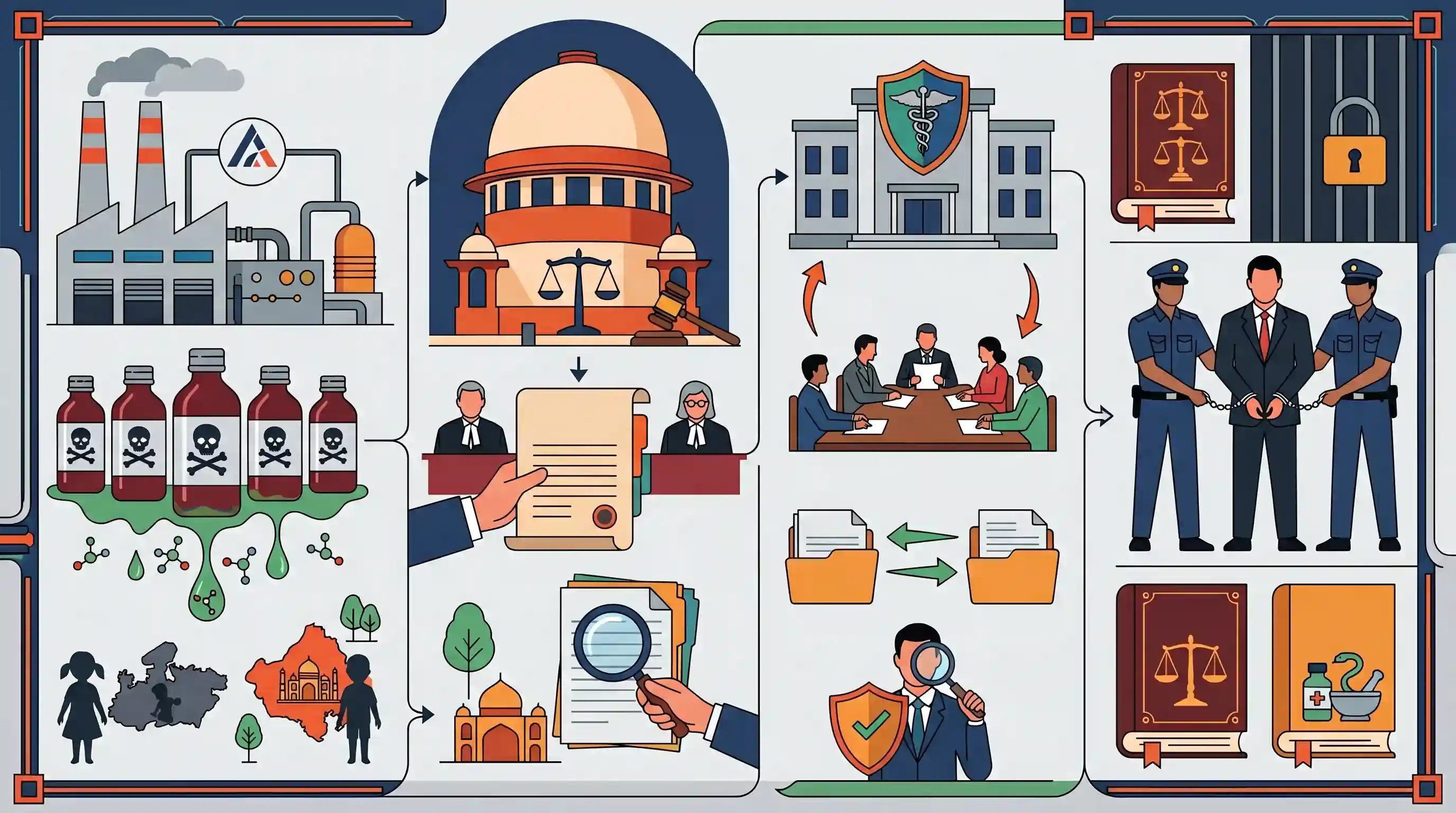
The Supreme Court of India is examining a Public Interest Litigation (PIL) seeking an independent probe into the deaths of children in Madhya Pradesh and Rajasthan, which are allegedly linked to toxic cough syrups. The plea demands the establishment of an expert committee, the transfer of existing FIRs to the Central Bureau of Investigation (CBI), and a comprehensive review of the regulatory oversight by the Central Drugs Standard Control Organisation (CDSCO). The allegedly contaminated medicine, manufactured by Sresan Pharmaceuticals, contained lethal levels of Diethylene Glycol. Authorities have arrested key individuals, including the company's owner, invoking provisions of the Bharatiya Nyaya Sanhita (BNS) and the Drugs and Cosmetics Act, 1940.
Key Points
- The Supreme Court is reviewing a PIL regarding the deaths of children in Madhya Pradesh and Rajasthan allegedly due to toxic cough syrups.
- The petition seeks an expert panel or judicial commission to investigate regulatory failures and suggests transferring the probe to the CBI.
- The implicated cough syrup, manufactured by Tamil Nadu-based Sresan Pharmaceuticals, reportedly contained lethal contaminants like Diethylene Glycol.
- The PIL demands an urgent nationwide ban on the syrup and an overhaul of the regulatory mechanisms overseen by the CDSCO.
- Key arrests have been made, including a pediatrician and the company's managing director, with an SIT formed to investigate under BNS and the Drugs and Cosmetics Act.
Important Terms
Central Drugs Standard Control Organisation (CDSCO)

India's national regulatory body for pharmaceuticals and medical devices under the Ministry of Health and Family Welfare. It oversees drug approvals, clinical trials, and quality standards under federal law.
UPSC context
GS Paper 2 (Regulatory Bodies); tests knowledge of pharmaceutical governance and drug safety oversight in India.
Drugs and Cosmetics Act, 1940
The primary legislation governing the import, manufacture, distribution, and sale of drugs and cosmetics in India. It aims to ensure that medicines are safe, effective, and meet prescribed standards.
UPSC context
GS Paper 2 (Statutes & Governance); tests understanding of the legal framework for public health and medicine regulation.
Bharatiya Nyaya Sanhita (BNS)
India’s new primary criminal code replacing the colonial-era Indian Penal Code (IPC). It modernizes definitions of crimes and introduces new penalties for organized crime, terrorism, and offenses against body.
UPSC context
GS Paper 2 (Polity); essential for questions on criminal justice reforms and the transition from colonial to modern laws.
Public Interest Litigation (PIL)
A legal mechanism allowing any public-spirited individual or group to approach the court for the protection of public interest, especially for those unable to represent themselves.
UPSC context
GS Paper 2 (Judiciary); tests understanding of judicial activism and the expansion of access to justice.
Central Bureau of Investigation (CBI)
India’s premier investigative agency under the Ministry of Personnel. It handles high-profile corruption, economic offenses, and special crimes on the request of states or orders from higher courts.
UPSC context
GS Paper 2 (Polity/Statutory Bodies); tests knowledge of central agencies and issues surrounding their independence and jurisdiction.
National Accreditation Board for Testing and Calibration Laboratories (NABL)
A constituent board of the Quality Council of India (QCI) that provides formal accreditation to testing and calibration laboratories, verifying their technical competence according to international standards.
UPSC context
GS Paper 2/3 (Governance/Standards); relevant for questions on quality infrastructure and industrial standards in health sectors.
Special Investigation Team (SIT)
A team of experts or police officers temporarily formed by the government or judiciary to investigate a specific, often high-profile, case that requires specialized focus or impartiality.
UPSC context
GS Paper 2 (Polity & Governance); tests understanding of investigative processes and the role of independent probes in sensitive issues.
Prelims Trap
The Supreme Court requires state government consent to transfer a probe to the CBI.
While the CBI needs state consent under the DSPE Act, constitutional courts (SC/HC) can order a CBI probe anywhere in India without it.
Static Concepts Connected
When can the CBI investigate a case without the concerned State government's consent?
- Constitutional Courts: The Supreme Court and High Courts can order a CBI probe anywhere in India under Articles 32 and 226, overriding the DSPE Act's state consent requirement.
- Union Territories: The CBI inherently possesses original jurisdiction to investigate offenses within Union Territories without needing special consent.
What makes Diethylene Glycol (DEG) contamination fatal in pharmaceutical syrups?
- Toxic Substitution: DEG is a cheap, toxic industrial solvent used in antifreeze, illegally substituted by manufacturers for safer, expensive pharmaceutical-grade solvents like propylene glycol.
- Organ Failure: Once ingested, DEG metabolizes into highly toxic compounds that rapidly cause severe acute kidney injury, neurological complications, and often fatal systemic failure in children.
Cross-Topic Patterns
India's Pharmacy of the World reputation
Domestic DEG deaths mirror previous tragedies in Gambia and Uzbekistan, directly threatening India's pharmaceutical export dominance and soft power diplomacy under the 'Pharmacy of the World' tag.
Federal friction in drug regulation
While CDSCO sets overarching national standards, State drug authorities actually issue manufacturing licenses. This fragmented, concurrent regulatory architecture frequently creates critical blind spots in quality control.

Expect a 2026 prelims question merging the toxicity of Diethylene Glycol (DEG) with the jurisdictional divide between CDSCO and States.
Linked PYQs · 3
Linked PYQs · 3
- 2024MainsGS2
Explain the reasons for the growth of public interest litigation in India. As a result of it, has the Indian Supreme Court emerged as the world's most powerful judiciary ?
- 2021PrelimsGS1
'Triclosan', considered harmful when exposed to high levels for a long time, is most likely present in which of the following?
- 2024PrelimsGS1
In which of the following are hydrogels used? 1. Controlled drug delivery in patients 2. Mobile air-conditioning systems 3. Preparation of industrial lubricants Select the correct answer using the code given below:
