Supreme Court Clarifies OBC Creamy Layer Rules and Parental Income
Source:Indian Express ↗
Why It Matters
This judgment directly impacts the implementation of reservation policies, social justice frameworks, and executive guidelines concerning the OBC creamy layer criteria, affecting recruitment and service allocations in public employment like the Civil Services Examination.
Summary
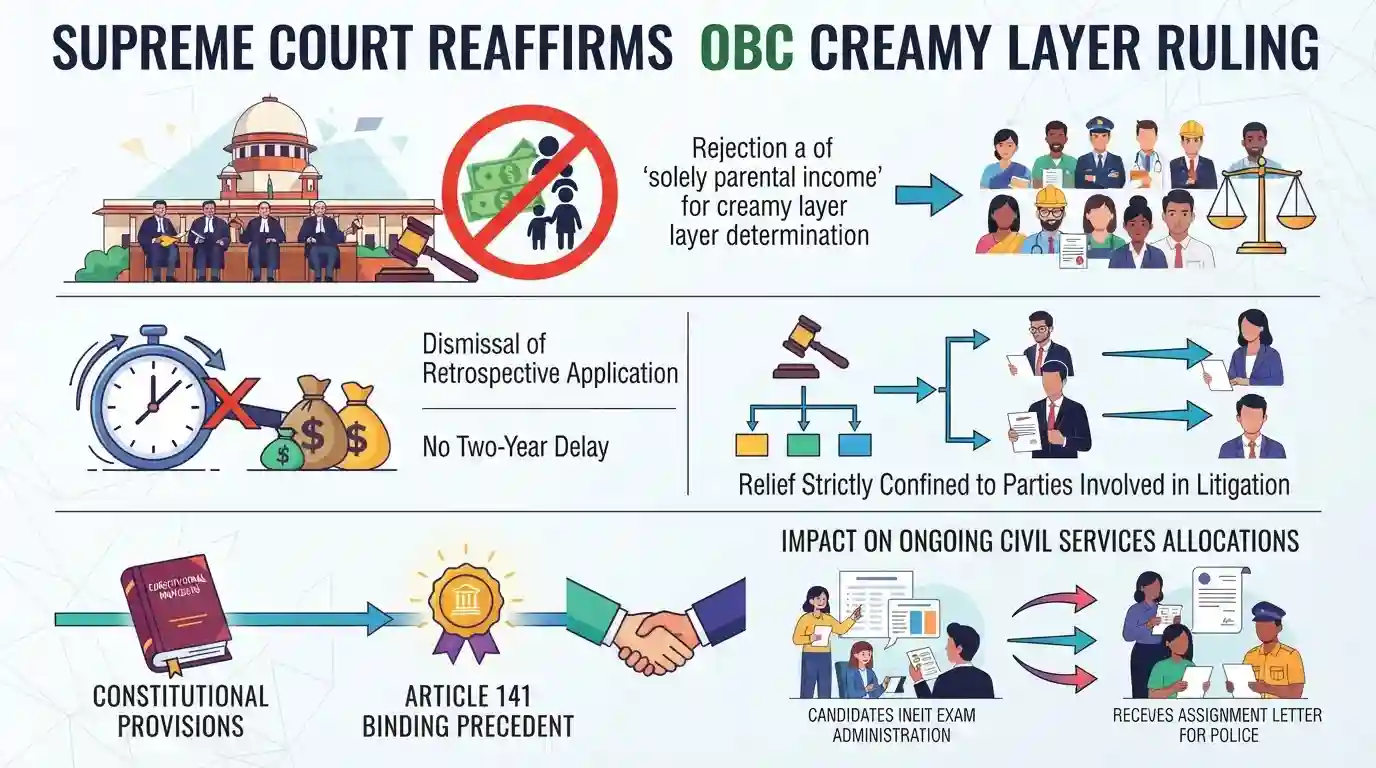
The Supreme Court reaffirmed its landmark ruling that OBC creamy layer status cannot be determined solely by parental income, dismissing the Centre's plea for retrospective application and a two-year delay in implementation. The Court clarified that while its legal interpretation is a binding precedent under Article 141, the relief is strictly confined to the parties involved in the litigation, impacting ongoing civil services allocations.
Key Points
- The Supreme Court reaffirmed its March 11 judgment, holding that the creamy layer status for Other Backward Classes (OBCs) cannot be decided solely on the basis of parental income.
- The dispute originated from a 1993 Office Memorandum and a 2004 clarification letter regarding the inclusion of salary and agricultural income in determining the creamy layer.
- The Court rejected the Centre's plea for a two-year extension to implement the order universally and for retrospective application, clarifying that relief is restricted to the parties before it.
- Service allocation for candidates selected through the Civil Services Examination (CSE) will be governed by the interpretation of the creamy layer principle laid down in the judgment.
Static Concepts Connected
What are the constitutional provisions and landmark judgments governing OBC reservations and the creamy layer?
- Constitutional Basis: Article 16(4) empowers the State to make provisions for the reservation of appointments in favor of any backward class of citizens not adequately represented.
- Indra Sawhney (1992): The 1992 Indra Sawhney judgment upheld OBC reservations but mandated the exclusion of the 'creamy layer' to ensure benefits reach the genuinely needy.
- Educational Quotas: The 93rd Constitutional Amendment introduced Article 15(5), extending reservation provisions to socially and educationally backward classes in educational institutions.
Cross-Topic Patterns
OBC Reservations and Article 16 Frameworks
The Indra Sawhney judgment intersects constitutional law and governance by balancing affirmative action with administrative efficiency and the exclusion of advanced sections.
Executive Guidelines vs. Judicial Interpretation
Judicial pronouncements on service allocations frequently challenge executive circulars like DoPT Office Memorandums, testing the boundary of delegated legislation and administrative discretion.

OBC creamy layer criteria + Indra Sawhney principles + Article 141 precedent scope likely to feature in a statement-based prelims Q.
Linked PYQs · 3
Linked PYQs · 3
- 2020PrelimsGS1
In India, Legal Services Authorities provide free legal services to which of the following type of citizens? 1. Person with an annual income of less than ₹ 1,00,000 2. Transgender with an annual income of less than ₹ 2,00,000 3. Member of Other Backward Classes (OBC) with an annual income of less than ₹ 3,00,000 4. All Senior Citizens Select the correct answer using the code given below:
- 2023PrelimsGS1
Consider the following statements: Statement-I: The Supreme Court of India has held in some judgements that the reservation policies made under Article 16(4) of the Constitution of India would be limited by Article 335 for maintenance of efficiency of administration. Statement-II: Article 335 of the Constitution of India defines the term 'efficiency of administration'. Which one of the following is correct in respect of the above statements?
- 2026PrelimsGS1
Consider the following statements about the provisions pertaining to the Scheduled Castes and the Scheduled Tribes in India : 1. Provisions regarding the administration of the Tribal Areas in the States of Assam, Meghalaya, Tripura and Mizoram are given in the Fifth Schedule of the Constitution of India. 2. Some tribes of India are entitled to exemption from paying Income Tax on certain incomes. 3. The Constitution of India provides for reservation of seats in Panchayats for women belonging to the Scheduled Castes and the Scheduled Tribes. Which one of the following conclusions based on the above statements is correct ?
