Supreme Court Constitutes Nine Judge Bench for Sabarimala Review
Source:The Hindu ↗
Why It Matters
This constitutes a monumental constitutional test regarding the balance between the fundamental right to equality/gender justice and the freedom to manage religious affairs. The upcoming ruling by the nine-judge bench will redefine the 'essential religious practice' doctrine and establish a definitive precedent for judicial intervention in religious customs across all faiths in India.
Summary
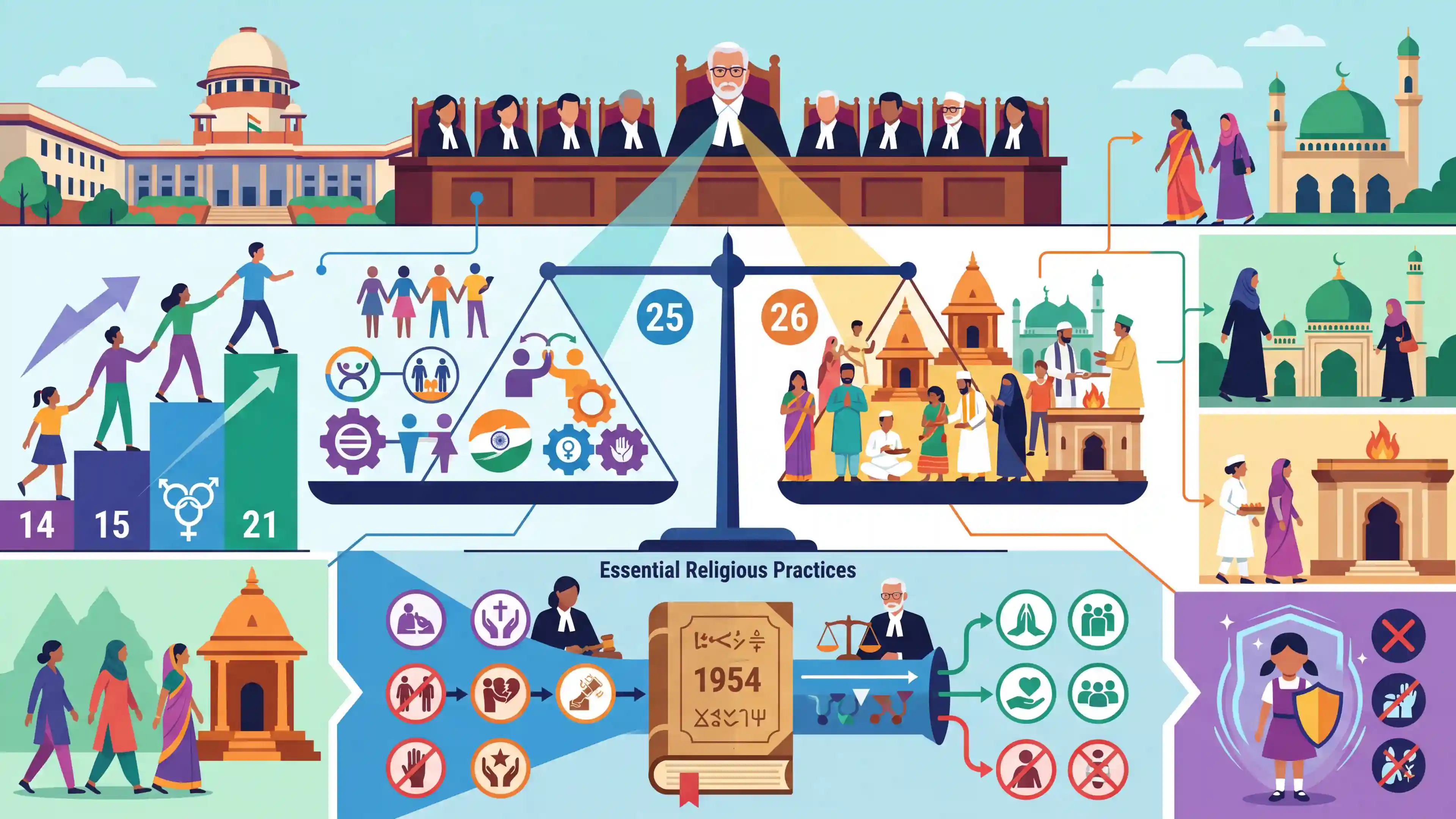
The Supreme Court of India has constituted a nine-judge Constitution Bench led by Chief Justice Surya Kant to hear review and writ petitions concerning the 2018 Sabarimala verdict. The 2018 decision originally permitted women of menstruating age to enter the Lord Ayyappa temple in Kerala. However, a five-judge Bench in 2019 expanded the case's scope beyond Sabarimala, referring broader issues regarding "essential religious practices" (ERP) and the limits of judicial intervention to a larger bench. The review has clubbed the Sabarimala case with other significant matters involving religious customs, such as the entry of Muslim women into mosques, the entry of Parsi women into fire temples, and the practice of female genital mutilation within the Dawoodi Bohra community. The nine-judge bench will critically examine the ERP doctrine as originally formulated in the 1954 Shirur Mutt case, attempting to balance individual fundamental rights, like gender equality, with collective religious freedoms.
Key Points
- A nine-judge Constitution Bench of the Supreme Court will hear the Sabarimala review petitions starting April 7, 2026.
- The review stems from a 2018 judgment that allowed women of menstruating age to enter the Sabarimala temple, sparking a larger constitutional debate.
- In 2019, a five-judge Bench expanded the scope beyond Sabarimala to address the broader interplay between religious freedom and individual rights (such as gender equality).
- The nine-judge Bench will evaluate the 'essential religious practices' (ERP) doctrine, requiring a review of the landmark 1954 Shirur Mutt judgment (delivered by a seven-judge bench).
- The case clubs the Sabarimala issue with other petitions concerning Muslim women's entry into mosques, Parsi women's entry into fire temples, and female genital mutilation in the Dawoodi Bohra sect.
Important Terms
Essential Religious Practices Doctrine

A judicial test used to determine which religious practices are integral to a faith and protected under Article 25, versus those that are secular or superstitious.
UPSC context
GS II (Polity). Tests the balance between judicial intervention and religious freedom under the concept of 'Constitutional Morality'.
Shirur Mutt Case
A landmark 1954 Supreme Court judgment that established the 'Essential Religious Practices' doctrine, granting the judiciary power to define the core tenets of a religion.
UPSC context
GS II (Judiciary). Tests knowledge of landmark precedents defining the scope of religious rights and secularism in India.
Constitution Bench
A Supreme Court bench of five or more judges constituted under Article 145(3) to decide matters involving substantial questions of law or constitutional interpretation.
UPSC context
GS II (Polity). Tests understanding of Supreme Court procedures and its role as the final interpreter of the Constitution.
Dawoodi Bohra community
A Shia Muslim sub-sect whose practice of female circumcision (khatna) is under Supreme Court review to balance religious freedom against individual rights and gender justice.
UPSC context
GS I (Society) / GS II (Social Justice). Tests issues concerning minority rights, gender equality, and the limits of religious customs.
Article 25
Constitutional provision guaranteeing an individual's right to freely profess, practice, and propagate religion, subject to public order, morality, and health.
UPSC context
GS II (Fundamental Rights). Essential for understanding individual religious liberty and the state's power to reform social practices.
Prelims Trap
The 9-judge bench was formed exclusively to review the 2018 Sabarimala temple entry verdict.
The 2019 reference expanded the scope to broad constitutional questions of religious freedom versus individual rights, clubbing issues like mosque entry and Dawoodi Bohra FGM.
Static Concepts Connected
What is the Essential Religious Practices (ERP) doctrine?
- Origin (1954): The Supreme Court held that only the "essential" or integral parts of a religion are protected under Articles 25 and 26.
- Judicial determination: The Court itself decides what constitutes an essential practice by examining the doctrines, tenets, and historical texts of the religion in question.
- Exceptions: Even essential practices can be restricted by the State on the grounds of public order, morality, and health.
How is a Constitution Bench formed under the Indian Constitution?
- Article 145(3): Mandates a minimum of five judges to decide cases involving a substantial question of law regarding the interpretation of the Constitution.
- Presidential Reference: Constitution Benches are also constituted to hear and advise on references made by the President of India under Article 143.
- Master of Roster: The Chief Justice of India, as the 'Master of the Roster', has the sole prerogative to constitute these benches and allocate cases.
Cross-Topic Patterns
UCC and Essential Religious Practices
The ERP verdict will directly impact the Uniform Civil Code debate. Redefining the limits of religious customs establishes a judicial precedent for overriding discriminatory personal laws with principles of gender justice.
Constitutional Morality vs Religious Autonomy
The case highlights the growing jurisprudence of 'Constitutional Morality,' pitting collective religious denomination rights (Article 26) against individual fundamental rights to equality and dignity (Articles 14, 15, and 21).

Expect a Mains question on 'Constitutional Morality vs. Essential Religious Practices' and a Prelims statement on Article 145(3) rules.
Linked PYQs · 3
Linked PYQs · 3
- 2019MainsGS1
What are the challenges to our cultural practices in the name of secularism?
- 2023MainsGS2
Explain the constitutional perspectives of Gender Justice with the help of relevant Constitutional Provisions and case laws.
- 2020MainsGS2
Judicial Legislation is antithetical to the doctrine of separation of powers as envisaged in the Indian Constitution. In this context justify the filing of large number of public interest petitions praying for issuing guidelines to executive authorities.
