Supreme Court Seeks Response On Wrongful Incarceration Compensation
Source:The Hindu ↗
Why It Matters
The issue of compensation for wrongful incarceration is central to discussions on state liability, constitutional guarantees under Article 21, and criminal justice reforms. It represents a critical intersection of human rights, governance, and the role of the judiciary in prompting legislative action, making it highly relevant for GS2 Polity and Governance questions.
Summary
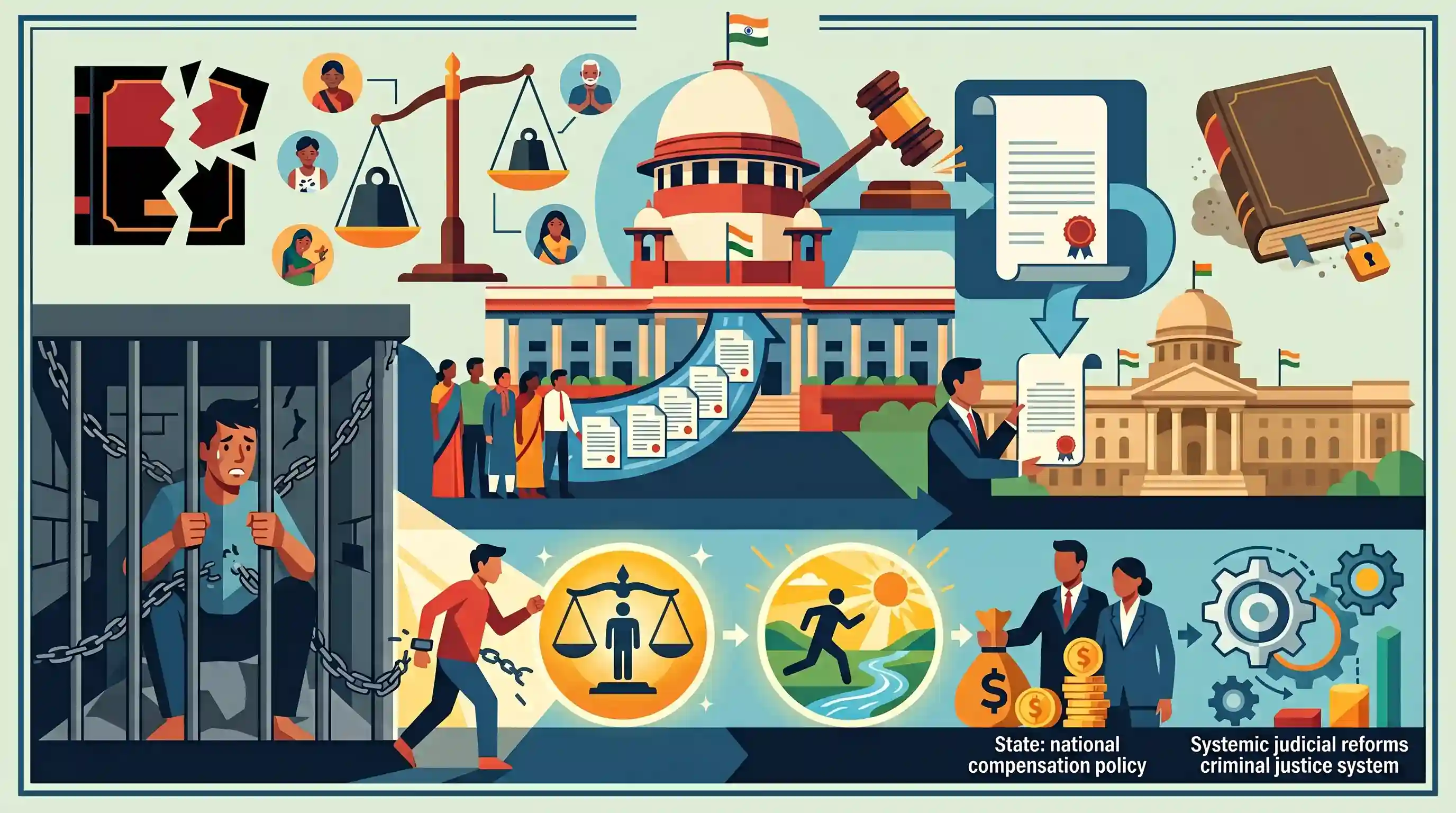
The Supreme Court of India has issued a notice to the Union government regarding a Public Interest Litigation (PIL) seeking the establishment of a national compensation policy for individuals subjected to unjust and arbitrary imprisonment. The plea highlights the legal void in addressing wrongful prosecution, which forces innocent individuals, often marginalized, to suffer prolonged incarceration without state redress. Emphasizing that this violates Articles 14 and 21 of the Constitution, the petition references the unimplemented recommendations of the Law Commission's 277th report. The case underscores the need for state liability and systemic reforms within India's criminal justice system to protect citizens' fundamental rights.
Key Points
- The Supreme Court has sought the Union government's response on a PIL demanding a uniform national policy to compensate individuals for unjust imprisonment.
- The plea argued that wrongful incarceration and arbitrary detention severely violate fundamental rights, specifically the right to life and personal liberty (Article 21) and equality (Article 14).
- Currently, India lacks a statutory framework or policy for state compensation to victims of wrongful prosecution, forcing them to pursue lengthy civil suits for damages.
- The petitioner noted that the prolonged nature of India's criminal justice system effectively acts as a punishment, rendering a mere acquittal inadequate to restore a person's lost years and dignity.
- The plea referenced the Law Commission of India's 277th report, which had previously recommended creating a specific legal mechanism to compensate victims of wrongful prosecution, a recommendation that remains unimplemented.
Important Terms
Article 21 of the Constitution

A fundamental right guaranteeing life and personal liberty except by procedure established by law. Courts interpret this to include the right to compensation for state-inflicted violations like wrongful imprisonment.
UPSC context
GS II: Fundamental Rights. Essential for understanding judicial interpretations of liberty and state obligations toward citizens.
Law Commission of India
A non-statutory executive body that recommends legal reforms. Its 277th Report (2018) specifically proposed a statutory framework and Special Courts to address 'miscarriage of justice' through wrongful prosecution.
UPSC context
GS II: Statutory/Regulatory Bodies. Tests awareness of policy recommendations for criminal justice and legal system reforms.
Wrongful Prosecution
Initiating criminal proceedings against an individual without reasonable cause or in bad faith. It often involves police or prosecutorial misconduct, leading to unjust incarceration and requiring state-funded rehabilitation.
UPSC context
GS II: Criminal Justice System. Relevant for discussions on police reforms and judicial accountability.
Public Interest Litigation (PIL)
A legal mechanism allowing individuals or groups to file petitions for the protection of public interest. It is the primary tool for judicial intervention in systemic rights violations.
UPSC context
GS II: Judiciary. Tests knowledge of judicial activism and mechanisms for protecting marginalized sections.
Article 14 of the Constitution
Guarantees equality before the law and equal protection of laws. In criminal justice, it is invoked to challenge arbitrary detention and advocate for uniform state compensation policies.
UPSC context
GS II: Fundamental Rights. Key for understanding the principle of 'reasonableness' and prohibition of arbitrary executive actions.
Supreme Court of India
The highest judicial body under the Constitution. It uses writ jurisdiction under Article 32 to safeguard fundamental rights and issue directions to the government on policy gaps.
UPSC context
GS II: Judiciary. Focuses on the court's power of judicial review and its role as the protector of the Constitution.
Prelims Trap
"India has a specific statutory framework to compensate victims of wrongful prosecution in line with ICCPR obligations."
While courts frequently award compensation via public law remedies (constitutional torts), India currently lacks any specific statutory law or executive policy mandating this compensation.
Static Concepts Connected
What is the Doctrine of Constitutional Tort in India?
- Public Law Remedy: Evolved by the Supreme Court (starting with the 1983 Rudul Sah case) allowing monetary compensation under Articles 32 or 226 for fundamental rights violations.
- Strict State Liability: The State is held strictly liable for the actions of its officials that breach citizens' Part III fundamental rights.
- Overriding Sovereign Immunity: It defeats the traditional defense of sovereign immunity (derived from Article 300), ensuring the State cannot evade liability for rights violations.
What were the key recommendations of the Law Commission's 277th Report (2018)?
- Statutory Framework: Recommended creating a specific legal mechanism and amending criminal laws to systematically compensate victims of miscarriage of justice.
- Special Courts: Suggested designating special courts in every district to adjudicate claims of wrongful prosecution efficiently and swiftly.
- Compensation Standard: Proposed that compensation should be comprehensive, covering both pecuniary (loss of income/health) and non-pecuniary (loss of reputation/dignity) damages.
Cross-Topic Patterns
Undertrials and Prison Overcrowding
Connects to the chronic issue of undertrials constituting over 75% of India's prison population. Without a compensation policy, prolonged pre-trial detention effectively becomes an uncompensated, unlawful punishment.
Article 300 vs Article 21
Highlights the tension between the State's tortious liability (Article 300) and the Right to Life (Article 21), tracing how judicial activism has diluted colonial-era sovereign immunity in favor of citizens.

Expect a 2026 Prelims trap claiming India has statutory laws for wrongful prosecution compensation, or a Mains Q on Constitutional Torts.
Linked PYQs · 4
Linked PYQs · 4
- 2021MainsGS2
Though the Human Rights Commissions have contributed immensely to the protection of human rights in India, yet they have failed to assert themselves against the mighty and powerful. Analyzing their structural and practical limitations, suggest remedial measures.
- 2014MainsGS2
National Human Rights Commission (NHRC) in India can be most effective when its tasks are adequately supported by other mechanisms that ensure the accountability of a government. In light of the above observation assess the role of NHRC as an effective complement to the judiciary and other institutions in promoting and protecting human rights standards.
- 2024PrelimsGS1
Under which of the following Articles of the Constitution of India, has the Supreme Court of India placed the Right to Privacy ?
- 2021PrelimsGS1
'Right to Privacy' is protected under which Article of the Constitution of India?
