Supreme Court Questions Delhi Government on DERC Vacancies
Source:The Hindu ↗
Why It Matters
Demonstrates the critical necessity of timely appointments and proper composition (specifically judicial members) in regulatory bodies to ensure adjudicatory independence, functional efficacy, and protection of consumer rights. It also indirectly reflects on the governance challenges in the NCT of Delhi.
Summary
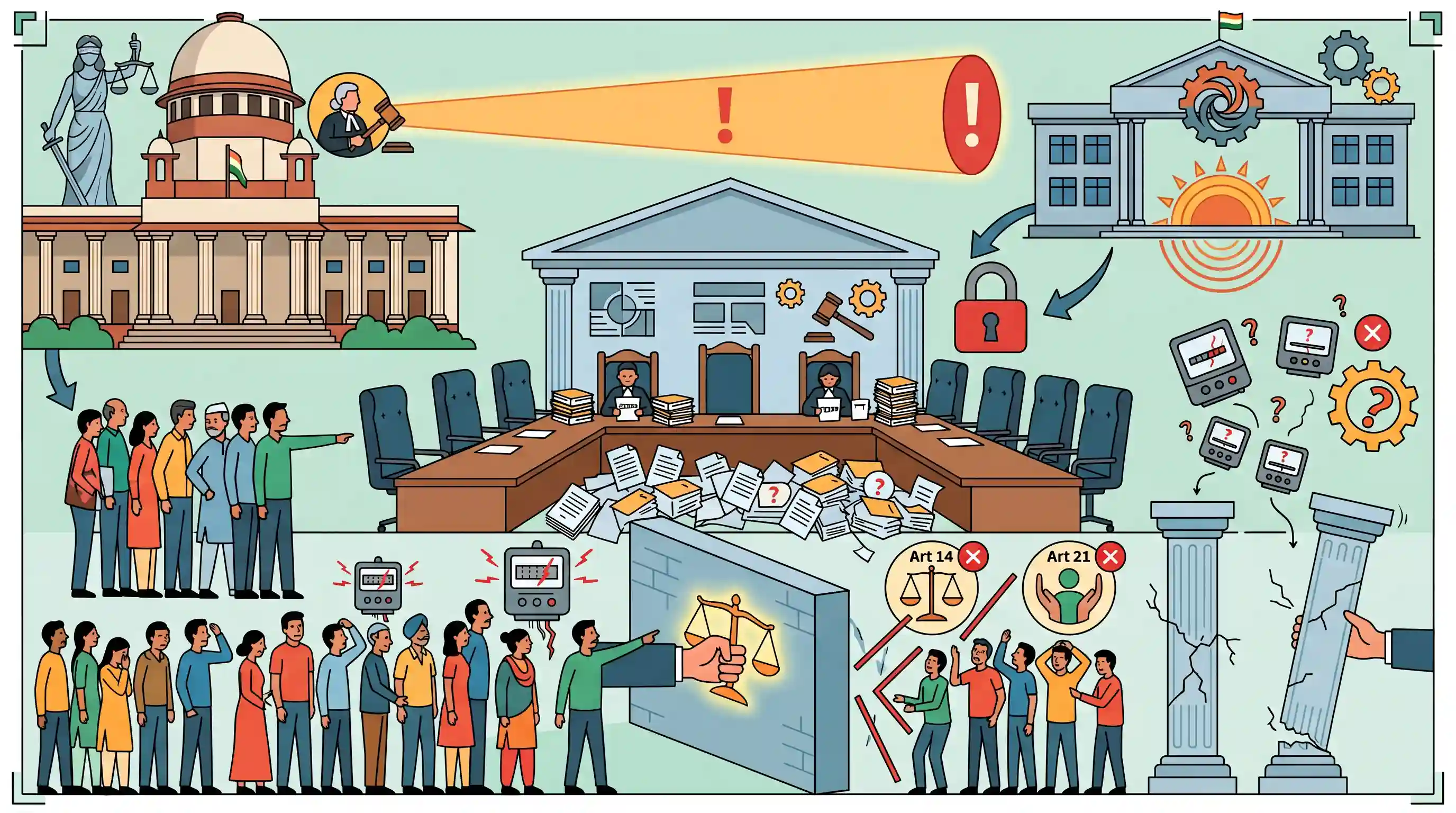
The Supreme Court has issued a notice to the Delhi Government concerning the lack of regular appointments to the Delhi Electricity Regulatory Commission (DERC). A petition filed by the NGO Energy Watchdog highlighted that the DERC is operating with only two temporary members and lacks a chairperson or a judicial member, violating the Electricity Act's provisions for regulatory autonomy. This dysfunctional setup has led to a massive backlog of unresolved consumer petitions, compromising the commission's adjudicatory functions. The plea emphasized that this delay infringes upon the constitutional principles of separation of powers and adjudicatory independence, while also violating citizens' fundamental rights under Articles 14 and 21.
Key Points
- The Supreme Court issued a notice to the Delhi Government regarding the prolonged delay in making regular appointments, including a chairperson, to the DERC.
- A petition by NGO Energy Watchdog argued that DERC's current ad-hoc setup (functioning with only two pro tem members and no judicial member) has paralysed its adjudicatory functions.
- The lack of regular and legally qualified members violates the autonomy and independence mandates of the Electricity Act for state regulatory bodies.
- The situation undermines basic structure principles like the separation of powers and adjudicatory independence, rendering the commission a 'dead letter'.
- Failure to hear consumer grievance petitions breaches citizens' fundamental rights under Articles 14 and 21 of the Constitution.
Important Terms
Delhi Electricity Regulatory Commission (DERC)

A statutory body established under the Electricity Act to regulate power tariffs, license distribution companies (DISCOMs), and adjudicate disputes within the National Capital Territory of Delhi.
UPSC context
GS Paper II: Statutory, Regulatory, and Quasi-Judicial bodies. Tests understanding of sector-specific regulators and administrative accountability.
Electricity Act, 2003
The landmark 2003 legislation that consolidated laws relating to electricity, promoting competition and establishing independent regulatory commissions at both central and state levels to protect consumer interests.
UPSC context
GS Paper II: Government policies and interventions. Essential for understanding the legal framework of India's power sector and regulatory reforms.
Energy Watchdog
A prominent non-governmental organization (NGO) known for public interest litigation in the energy sector, notably establishing legal benchmarks for 'force majeure' and regulatory appointments in India.
UPSC context
GS Paper II: Role of NGOs and Civil Society. Demonstrates the impact of judicial activism on sector-specific governance and administrative law.
State Electricity Regulatory Commissions (SERCs)
Independent statutory bodies established in each state to determine tariffs, regulate intrastate transmission, and ensure quality service, aimed at insulating the power sector from political interference.
UPSC context
GS Paper II: Federalism and Regulatory Bodies. Relevant for issues pertaining to the functional autonomy of state-level institutions.
Article 14
Guarantees equality before the law and prohibits arbitrary state action, ensuring that administrative appointments and procedures follow a fair, non-discriminatory, and rational basis.
UPSC context
GS Paper II: Fundamental Rights. Tests the application of the 'non-arbitrariness' doctrine to state administrative delays and appointments.
Article 21
Protects the right to life and personal liberty, which the judiciary has interpreted to include access to justice and the fair adjudication of grievances through functional regulatory bodies.
UPSC context
GS Paper II: Fundamental Rights. Important for understanding the expansion of 'Right to Life' to include procedural fairness and judicial redress.
Prelims Trap
State Electricity Regulatory Commissions are purely administrative bodies and do not require judicial members.
SERCs are actually quasi-judicial bodies. The Supreme Court ruled in 2018 that SERCs must include a judicial member when performing adjudicatory functions to uphold the separation of powers.
Static Concepts Connected
What are the core functions of State Electricity Regulatory Commissions (SERCs)?
- Tariff determination: They determine the tariffs for electricity generation, supply, transmission, and wheeling within the state.
- Licensing: They grant, regulate, and revoke licenses for electricity transmission, distribution, and trading operations.
- Quasi-judicial adjudication: They resolve disputes between power licensees and generating companies, functioning as quasi-judicial authorities.
How does tribunal or commission paralyzation violate fundamental rights?
- Article 21 (Justice): The Supreme Court interprets the right to a speedy and effective grievance redressal forum as an integral part of the Right to Life and Personal Liberty.
- Article 14 (Equality): Leaving quasi-judicial bodies non-functional creates an arbitrary vacuum in dispute resolution, breaching the protection against state arbitrariness.
Cross-Topic Patterns
Federal friction over Delhi statutory appointments
DERC appointment delays stem directly from the persistent jurisdictional tug-of-war between the elected Delhi Government and the Lieutenant Governor over administrative control under Article 239AA.
Tribunal vacancies crippling access to justice
Vacancies in regulatory commissions mirror broader systemic issues seen in NCLT, Information Commissions, and AFTs. The Supreme Court often treats such executive inaction as a backdoor threat to adjudicatory independence.

Expect a 2026 Mains GS2 question linking chronic vacancies in statutory/quasi-judicial bodies to the violation of Article 21 (access to justice).
Linked PYQs · 4
Linked PYQs · 4
- 2015MainsGS2
For achieving the desired objectives, it is necessary to ensure that the regulatory institutions remain independent and autonomous. Discuss in the light of the experiences in recent past.
- 2016MainsGS2
Discuss the essentials of the 69th Constitutional Amendment Act and anomalies, if any, that have led to recent reported conflicts between the elected representatives and the institution of the Lieutenant Governor in the administration of Delhi. Do you think that this will give rise to a new trend in the functioning of the Indian federal politics?
- 2018MainsGS2
Whether the Supreme Court Judgement (July 2018) can settle the political tussle between the Lt. Governor and elected government of Delhi? Examine.
- 2023MainsGS2
“Constitutionally guaranteed judicial independence is a prerequisite of democracy.” Comment.
