Digital Content Regulation and Separation of Powers in Supreme Court
Source:The Hindu ↗
Why It Matters
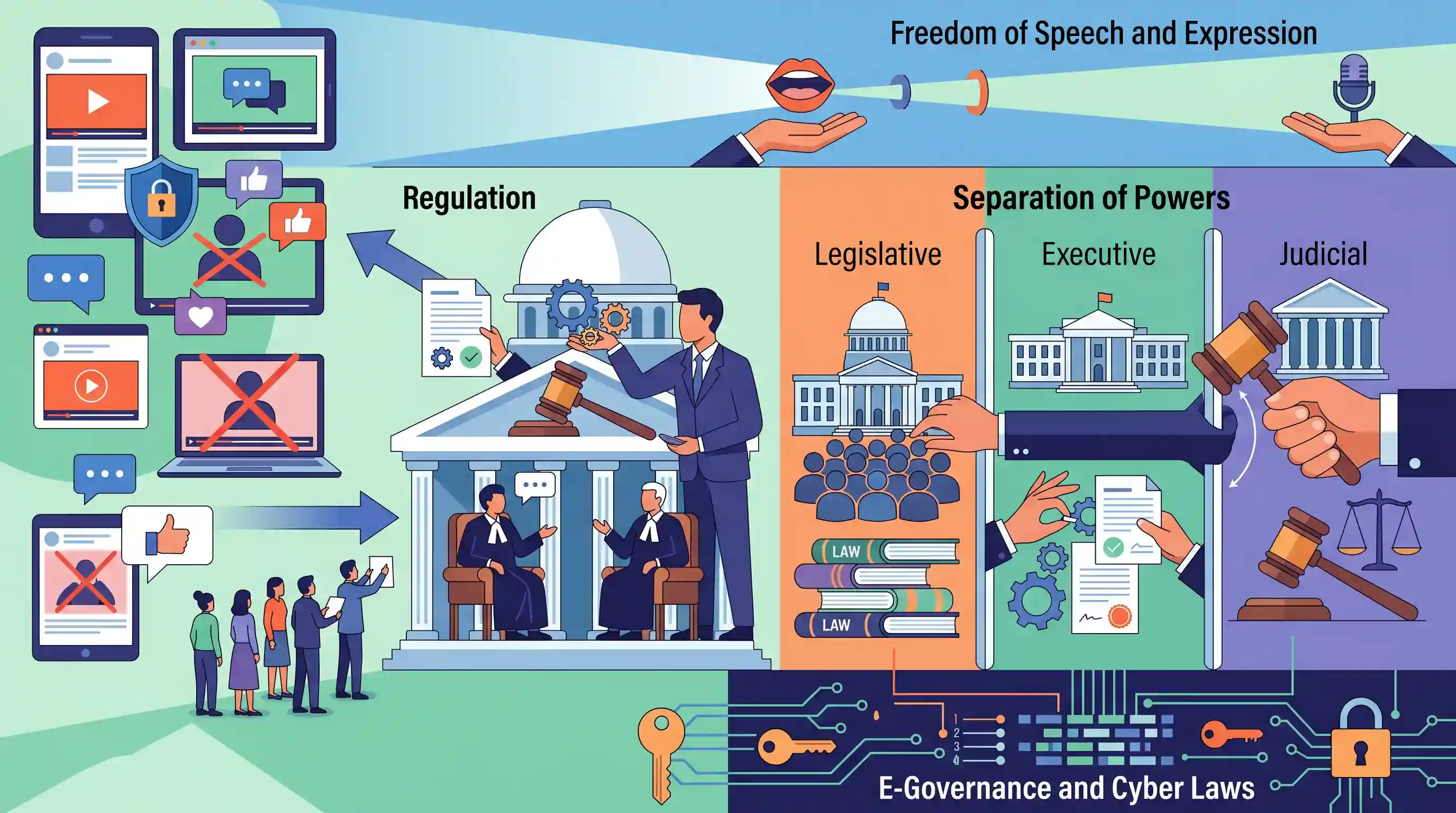
This issue highlights the persistent challenge of regulating digital spaces (OTT, social media) in India without violating constitutional freedoms. Furthermore, the Supreme Court's explicit reluctance to issue guidelines underscores a crucial debate on the limits of Public Interest Litigation (PIL) and the doctrine of Separation of Powers—frequent themes in UPSC Mains GS Paper 2.
Summary
The Supreme Court has sought a response from the Union Government on a PIL seeking the establishment of a 'National Content Control Authority' to regulate and ban sexually explicit material on OTT and social media platforms. While the Solicitor General affirmed that regulations are either in place or under consideration, the Bench, comprising Justices B.R. Gavai and Augustine George Masih, expressed reservations about judicially mandating such guidelines. The Court observed that crafting regulations for digital platforms is fundamentally the responsibility of the executive and legislature, emphasizing the need to respect the doctrine of separation of powers and avoid judicial overreach.
Key Points
- The Supreme Court issued a notice to the Centre regarding a PIL seeking the creation of guidelines and a 'National Content Control Authority' to ban sexually explicit content on OTT and social media platforms.
- Solicitor General Tushar Mehta indicated that some government regulations currently exist to address this issue, while further regulatory measures are under contemplation.
- The Court cautioned against judicial overreach, noting that content regulation primarily falls under the legislative and executive domains, emphasizing the constitutional principle of the separation of powers.
- This development underscores the ongoing tension between freedom of expression on digital platforms, public morality, and the boundaries of judicial intervention via PILs.
Important Terms
IT Rules, 2021

2021 regulations under the IT Act, 2000, establishing a three-tier grievance redressal mechanism and a Code of Ethics for OTT, digital news, and social media intermediaries.
UPSC context
GS Paper 2: E-governance, regulatory bodies, and freedom of speech; tests understanding of digital media oversight.
Separation of Powers
A constitutional doctrine where the Executive, Legislature, and Judiciary have distinct functions, ensuring no branch exercises absolute power or encroaches on another's domain.
UPSC context
GS Paper 2: Constitutional framework and institutional checks; tests knowledge of the basic structure of the Constitution.
Judicial Overreach
An instance where the judiciary interferes in the legislative or executive domain, often by making policy or law instead of strictly interpreting it.
UPSC context
GS Paper 2: Judiciary; tests the ability to distinguish between judicial activism and unconstitutional interference in governance.
Section 67A, IT Act
A specific provision of the Information Technology Act, 2000, that penalizes the electronic publishing or transmission of material containing sexually explicit acts or conduct.
UPSC context
GS Paper 3: Cyber security and law; GS Paper 2: Social justice and protection of vulnerable groups online.
Solicitor General of India
The second-highest law officer in India, appointed to represent the Union Government in legal proceedings and assist the Attorney General; it is a statutory post.
UPSC context
GS Paper 2: Executive and Judiciary; tests knowledge of legal officers and government representation in courts.
OTT Platforms
Digital services that deliver film and television content via the internet directly to viewers, bypassing traditional cable, broadcast, and satellite television platforms.
UPSC context
GS Paper 2 & 3: Media regulation and technology; tests awareness of emerging digital infrastructure and content governance.
Prelims Trap
"OTT platforms in India are subject to pre-censorship by a statutory regulatory authority similar to the CBFC."
OTT platforms do not face pre-censorship. Unlike theatrical films, they operate on self-classification and a post-publication three-tier grievance redressal mechanism under the IT Rules 2021.
Static Concepts Connected
What is the regulatory framework for OTT platforms under the IT Rules 2021?
- Self-Classification: Publishers must self-classify content into five age-based categories (U, U/A 7+, U/A 13+, U/A 16+, A) and implement parental locks.
- Three-Tier Mechanism: Level 1 (Self-regulation by publisher), Level 2 (Self-regulating body of publishers), and Level 3 (Oversight mechanism by the I&B Ministry).
- No Pre-censorship: The framework focuses on post-publication grievance redressal rather than the pre-certification required for traditional theatrical releases.
How does the Constitution balance free speech with public morality?
- Article 19(1)(a): It guarantees all citizens the fundamental right to freedom of speech and expression.
- Article 19(2): It allows the state to impose reasonable restrictions on free speech on specified grounds, including public order, decency, or morality.
- Judicial Standards: Courts have shifted from the strict 'Hicklin Test' to evaluating obscenity based on contemporary community standards and looking at works as a whole.
Cross-Topic Patterns
Fundamental Rights + Digital Media
The tension between Article 19(1)(a) and restrictions under 19(2) ('decency or morality') frequently links to digital regulation, as previously seen when the SC struck down Section 66A of the IT Act.
Separation of Powers + PILs
The SC's reluctance to frame OTT guidelines highlights the crucial boundary between judicial activism (protecting rights) and overreach (encroaching on executive/legislative policy-making domains).

A 2026 Prelims multi-statement question will likely contrast CBFC's pre-censorship statutory powers with the IT Rules 2021 OTT framework.
Linked PYQs · 3
Linked PYQs · 3
- 2020MainsGS2
Judicial Legislation is antithetical to the doctrine of separation of powers as envisaged in the Indian Constitution. In this context justify the filing of large number of public interest petitions praying for issuing guidelines to executive authorities.
- 2014MainsGS2
What do you understand by the concept "freedom of speech and expression"? Does it cover hate speech also ? Why do the films in India stand on a slightly different plane from other forms of expression ? Discuss.
- 2025MainsGS2
The National Commission for Protection of Child Rights has to address the challenges faced by children in the digital era. Examine the existing policies and suggest measures the Commission can initiate to tackle the issue.
