Plea in Supreme Court for Specialized Revenue Judicial Service
Source:The Hindu ↗
Why It Matters
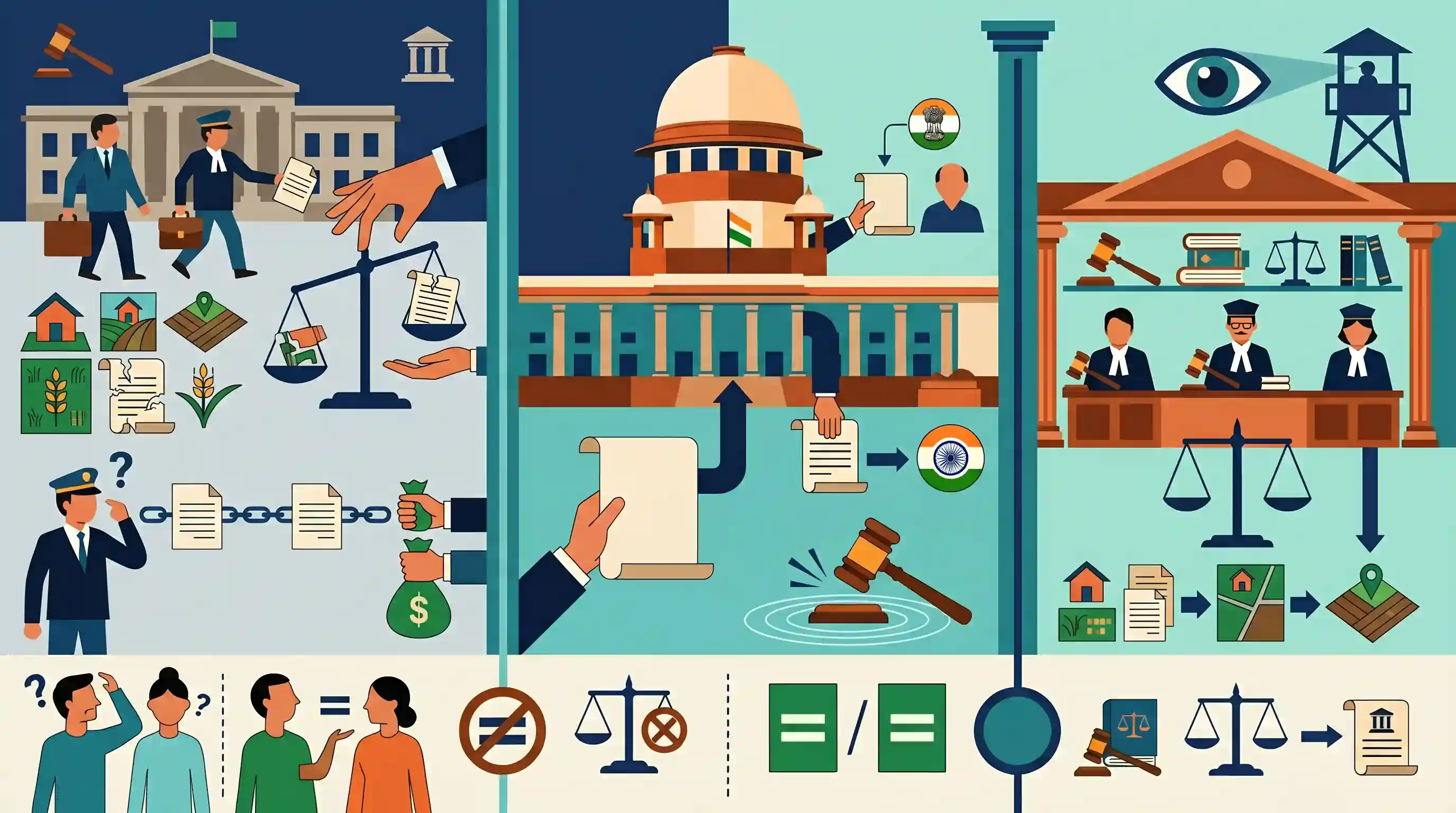
The issue brings to light a significant overlap between administrative and judicial functions at the grassroots level. It is highly relevant for GS Paper 2 as it directly touches upon the constitutional doctrine of Separation of Powers (Article 50), the functioning of quasi-judicial bodies, and systemic judicial reforms needed for fair land dispute resolution.
Summary
The Supreme Court has issued notices to the Centre and States concerning a public interest litigation that seeks the creation of a specialized 'revenue judicial service' to handle land and property disputes. The petitioner challenges the existing framework where executive revenue officers, who often lack formal legal education, adjudicate complex civil matters such as titles, successions, and property rights. The plea contends that this practice is arbitrary, violating Article 14, and undermines Article 50 of the Constitution, which mandates the separation of the judiciary from the executive. Additionally, the petition calls for High Courts to actively supervise these quasi-judicial processes to ensure legally sound dispute resolution.
Key Points
- The Supreme Court sought responses from the Centre and States on a plea to establish a dedicated 'revenue judicial service' cadre exclusively for land dispute adjudication.
- The petition argues that allowing revenue and consolidation officers without formal legal training to decide complex property rights and titles violates Article 14 (Right to Equality).
- It emphasizes that delegating judicial functions to public servants under executive control breaches the constitutional mandate of separating the judiciary from the executive (Article 50).
- The plea also seeks directions for High Courts to supervise and monitor the adjudication of land matters like succession, inheritance, and possession.
Important Terms
Article 50

A Directive Principle of State Policy (DPSP) that mandates the State to take steps to separate the judiciary from the executive in public services.
UPSC context
GS Paper II: Essential for topics on Judiciary, DPSP, and the independence of judicial functions from executive interference.
Separation of Powers
A constitutional doctrine dividing government into legislative, executive, and judicial branches to prevent power concentration; in India, it includes a system of 'checks and balances'.
UPSC context
GS Paper II: A basic structure of the Constitution; tested via the functional overlap between organs.
Quasi-Judicial Bodies
Non-judicial entities (like tribunals or revenue officers) empowered to adjudicate specific disputes, interpret laws, and impose penalties, though they are not formal courts.
UPSC context
GS Paper II: Governance and Statutory bodies; relates to administrative justice and specialized dispute redressal.
Article 14
Guarantees equality before the law and equal protection of laws. It prohibits 'manifest arbitrariness' in state actions, including the appointment of non-experts to judicial roles.
UPSC context
GS Paper II: Fundamental Rights; tested in the context of fairness in administrative and judicial procedures.
Revenue Courts
Authorities (like Tehsildars or Collectors) that adjudicate land-related disputes, successions, and boundaries under state local laws, often criticized for lacking formal judicial training.
UPSC context
GS Paper II & III: Governance and Land Reforms; critical for discussing delays and reforms in rural dispute resolution.
All India Judicial Service (AIJS)
A proposed centralized recruitment system for district judges under Article 312, aimed at standardizing judicial expertise and reducing vacancies across states.
UPSC context
GS Paper II: Judicial Reforms; a recurring theme in debates over centralized vs. state-level judicial control.
Prelims Trap
High Courts lack supervisory jurisdiction over revenue courts because they are administered by executive officers rather than judicial officers.
Article 227 grants High Courts supervisory jurisdiction over ALL courts and tribunals within their territory, explicitly including executive-run revenue courts and tribunals.
Static Concepts Connected
What distinguishes a quasi-judicial body from a formal judicial court?
- Procedural Strictness: Courts strictly adhere to the Civil/Criminal Procedure Codes and Evidence Act, while quasi-judicial bodies primarily follow the principles of natural justice.
- Scope of Jurisdiction: Courts exercise general jurisdiction over diverse civil/criminal matters; quasi-judicial bodies have limited jurisdiction restricted to specific domains (e.g., land, taxation).
- Composition: Courts are presided over by legally trained judges, whereas quasi-judicial bodies are often run by technical experts or executive officers.
How does the Constitution mandate the separation of powers regarding the judiciary?
- Constitutional Mandate: Article 50, a Directive Principle of State Policy (Part IV), mandates the State to separate the judiciary from the executive in public services.
- Core Objective: It aims to ensure judicial independence, preventing the executive from acting as a judge in matters where it might also be an interested party.
- Statutory Implementation: The separation was largely formalized at the lower levels via the Code of Criminal Procedure (CrPC), 1973, distinguishing Judicial and Executive Magistrates.
Cross-Topic Patterns
Tribunalisation & Judicial Independence
Connects to the SC's Madras Bar Association judgments, which repeatedly struck down tribunal frameworks that allowed excessive executive control over quasi-judicial bodies.
Conclusive Land Titling & Credit Access
Delays and arbitrary decisions in revenue courts directly hinder India's push for conclusive land titling (DILRMP), stifling formal credit access for farmers.

A Prelims question combining Article 50 (DPSP), Article 227 (HC powers), and the adjudicatory powers of Executive Magistrates is highly probable.
Linked PYQs · 5
Linked PYQs · 5
- 2020MainsGS2
Judicial Legislation is antithetical to the doctrine of separation of powers as envisaged in the Indian Constitution. In this context justify the filing of large number of public interest petitions praying for issuing guidelines to executive authorities.
- 2020PrelimsGS1
In India, separation of judiciary from the executive is enjoined by
- 2025PrelimsGS1
Consider the following pairs : Provision in the Constitution of India Stated under I. Separation of Judiciary from the Executive in the public services of the State : The Directive Principles of the State Policy II. Valuing and preserving of the rich heritage of our composite culture : The Fundamental Duties III. Prohibition of employment of children below the age of 14 years in factories : The Fundamental Rights How many of the above pairs are correctly matched?
- 2025MainsGS2
Comment on the need of administrative tribunals as compared to the court system. Assess the impact of the recent tribunal reforms through rationalization of tribunals made in 2021.
- 2016MainsGS2
What is a quasi-judicial body? Explain with the help of concrete examples.
