Supreme Court Seeks Response on Voter Biometric Verification
Source:The Hindu ↗
Why It Matters
This issue is critical for UPSC Mains GS2 (Electoral Reforms, Governance) as it touches upon the ongoing debate around purifying electoral rolls and the use of technology in elections. It echoes the recent controversies surrounding the linking of Aadhaar with Voter IDs, highlighting the delicate balance between ensuring free and fair elections and addressing concerns related to state expenditure, technological exclusion, and the Right to Privacy.
Summary
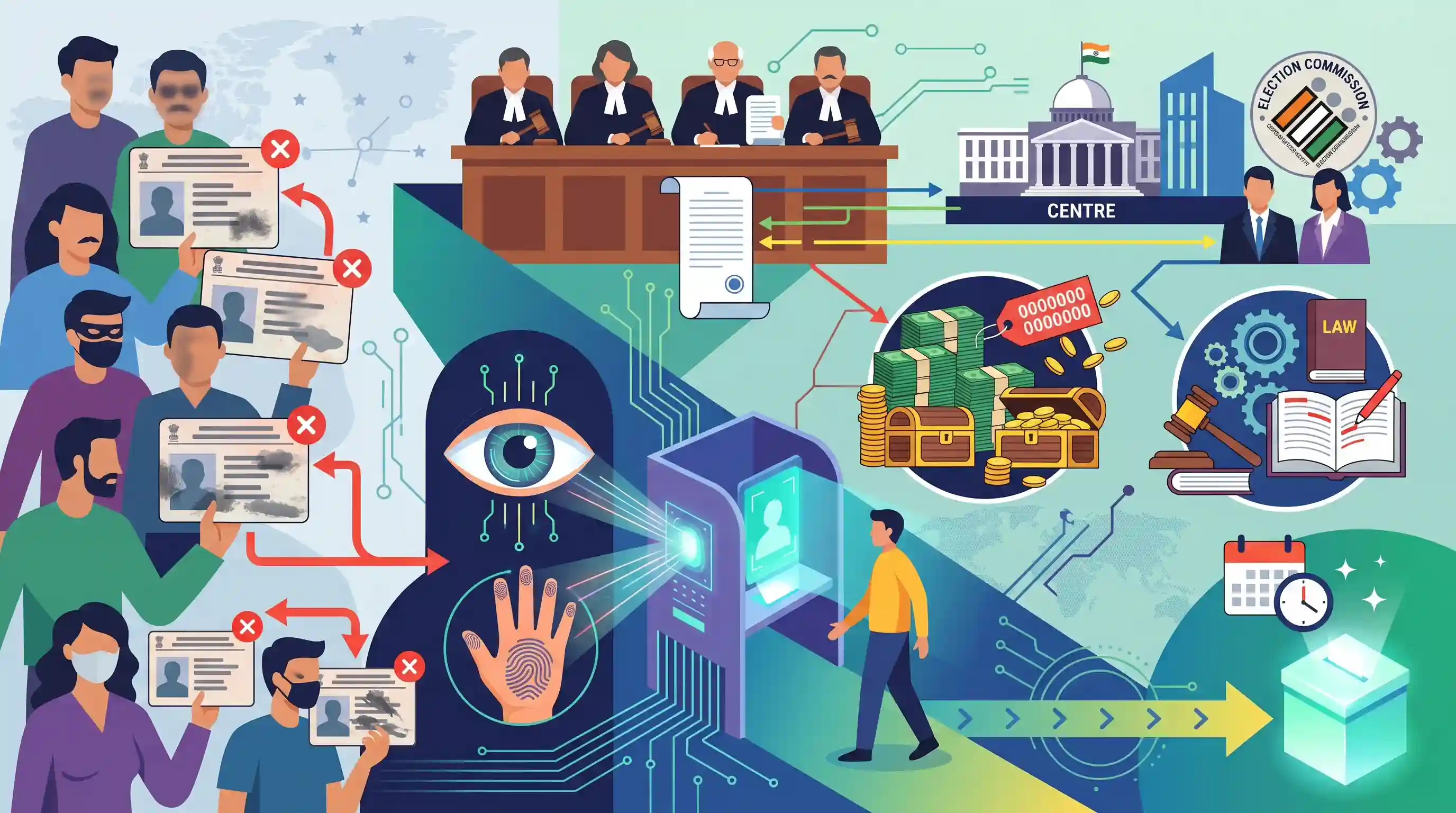
The Supreme Court has asked the Centre and the Election Commission to respond to a public interest litigation seeking the introduction of finger and iris biometric verification at polling booths. The petition argues that the current system of manual verification using voter ID cards is vulnerable to fraud, including impersonation and duplicate voting, due to outdated photographs and clerical errors. While acknowledging the intent to clean up the electoral process, the Court observed that such a nationwide exercise would involve immense financial costs and necessitate major legislative amendments. The Court plans to examine the feasibility of these reforms before the next General Election.
Key Points
- The Supreme Court has issued notices to the Union Government and the Election Commission on a petition seeking biometric verification (fingerprints and iris scans) of voters at polling booths.
- The plea aims to prevent electoral malpractices such as duplicate voting, ghost voting, and impersonation, to ensure the principle of 'One Citizen, One Vote'.
- A bench headed by Chief Justice of India Surya Kant noted that implementing this would have massive financial implications and require major statutory amendments.
- The Supreme Court has decided to consider the matter thoroughly before the next General Election.
Important Terms
Representation of the People Act (RPA)

The legislative framework for Indian elections. RPA 1950 covers seat allocation and electoral rolls; RPA 1951 governs the conduct of elections, qualifications, disqualifications, and corrupt practices.
UPSC context
GS Paper II (Elections). Tests understanding of the statutory basis of the democratic process and grounds for disqualifying representatives.
Election Commission of India (ECI)
An autonomous constitutional body established under Article 324 to conduct and supervise elections for Parliament, State Legislatures, and the offices of the President and Vice-President.
UPSC context
GS Paper II (Constitutional Bodies). Tests the administrative, advisory, and quasi-judicial powers essential for maintaining electoral integrity.
Public Interest Litigation (PIL)
Legal action brought before a court for the protection of public interest, where the rule of 'locus standi' is relaxed to allow individuals to represent marginalized groups.
UPSC context
GS Paper II (Judiciary). Tests the concept of judicial activism and the expansion of access to justice for the general public.
Electoral Reforms
Systematic changes intended to enhance the transparency and fairness of elections, including technological updates like EVMs, VVPATs, and potential biometric verification to prevent fraud.
UPSC context
GS Paper II (Governance). Focused on strengthening democratic institutions and addressing issues like impersonation and criminalization in politics.
Supreme Court of India
The apex judicial body in India, serving as the final court of appeal and the guardian of the Constitution, with the power of judicial review.
UPSC context
GS Paper II (Judiciary). Tests constitutional provisions regarding the court's jurisdiction and its role in interpreting laws and protecting fundamental rights.
Right to Privacy
A fundamental right under Article 21 (Right to Life and Liberty) as per the Justice K.S. Puttaswamy (2017) judgment, protecting individual autonomy and data.
UPSC context
GS Paper II (Fundamental Rights). Vital for debating the balance between state security/technology (biometrics) and individual liberty.
Prelims Trap
Linking Aadhaar biometrics with the Voter ID card is mandatory to cast a vote in India.
The Election Laws (Amendment) Act 2021 allows Aadhaar-EPIC linking purely on a voluntary basis. No voter can be denied the right to vote for lacking Aadhaar.
Static Concepts Connected
What is the threefold test to restrict the Right to Privacy (Puttaswamy judgment)?
- Legality: The restriction must be backed by a valid, existing statutory framework.
- Legitimate Need: The measure must serve a legitimate state aim, such as preventing electoral fraud.
- Proportionality: The intervention must be the least restrictive method available to achieve the stated goal.
How do Corrupt Practices differ from Electoral Offenses under Indian law?
- Corrupt Practices: Defined under Section 123 of RPA 1951 (e.g., bribery); proven instances can void an election and disqualify the candidate.
- Electoral Offenses: Criminal acts like booth capturing or voter impersonation, punishable under the BNS or specific RPA sections with imprisonment or fines.
Cross-Topic Patterns
Biometrics and the Privacy Doctrine
Mandating iris scans at booths revives the Aadhaar vs. Privacy debate, testing whether curbing 'ghost voting' satisfies the strict proportionality test established in the Puttaswamy judgment.
BNS 2023 and Electoral Offenses
The shift of 'personation at elections' from the IPC to Section 172 of the Bharatiya Nyaya Sanhita (BNS) highlights the ongoing overhaul of India's criminal statutes intersecting with electoral laws.

Expect 2026 prelims to test the voluntary nature of Aadhaar-Voter ID linking alongside RPA corrupt practices and voting rights.
Linked PYQs · 5
Linked PYQs · 5
- 2024MainsGS2
Examine the need for electoral reforms as suggested by various committees with particular reference to "one nation one election" principle.
- 2024MainsGS2
Right to privacy is intrinsic to life and personal liberty and is inherently protected under Article 21 of the constitution. Explain. In this reference discuss the law relating to D.N.A. testing of child in the womb to establish its paternity.
- 2017MainsGS2
Examine the scope of Fundamental Rights in the light of the latest judgement of the Supreme Court on Right to Privacy.
- 2017PrelimsGS1
Right to vote and to be elected in India is a
- 2017PrelimsGS1
For election to the Lok Sabha, a nomination paper can be filed by
