Judicial scrutiny on campaign expenditure limits for political parties
Source:Indian Express ↗
Why It Matters
Political funding and the role of money power in elections are critical aspects of India's democratic structure. The tension between regulating campaign finance to ensure a level playing field (under the RPA) and protecting the freedom of expression (Article 19) directly intersects with the core syllabus of GS-2 (Polity and Governance).
Summary
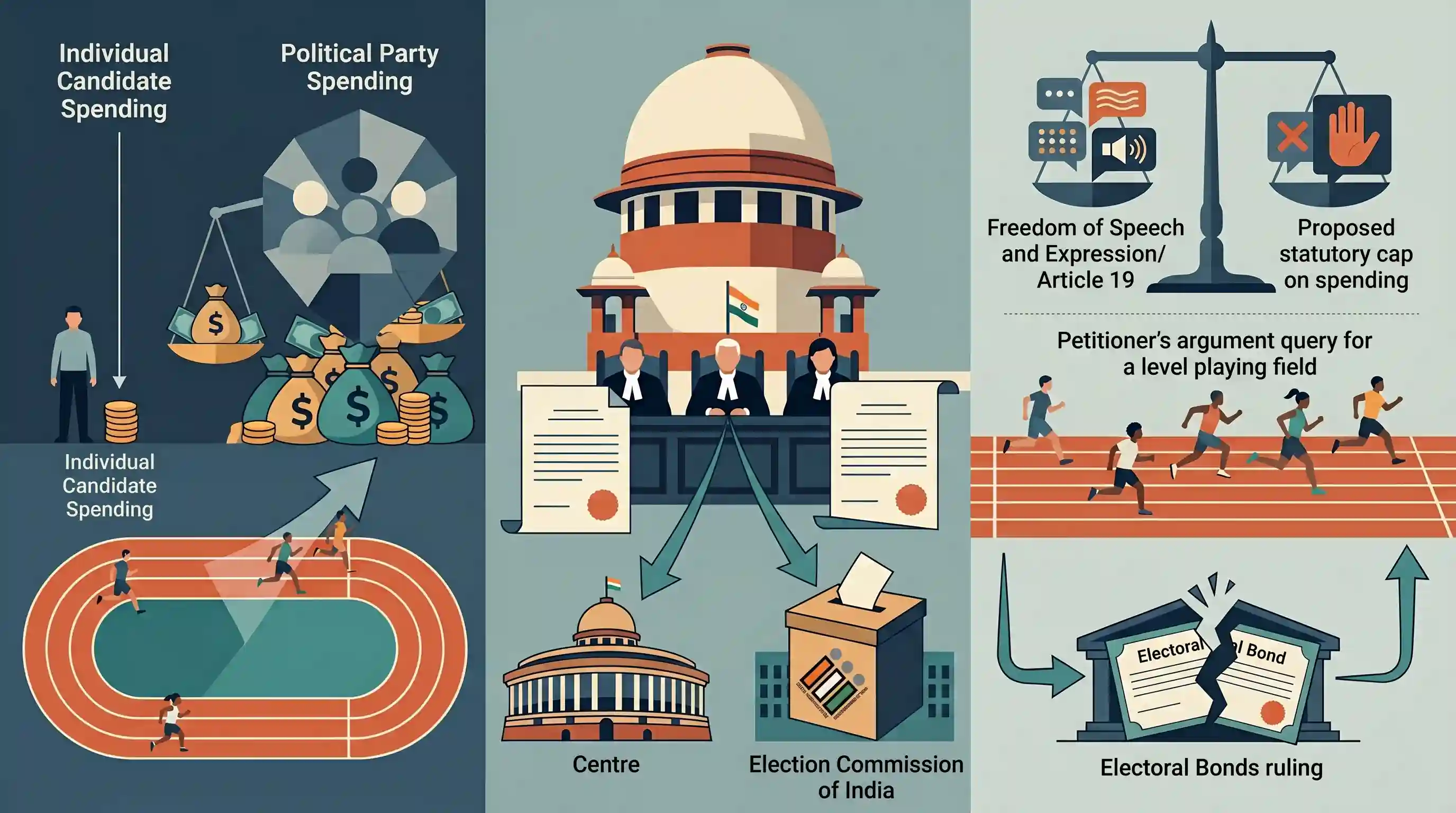
The Supreme Court has issued notices to the Centre and the Election Commission of India (ECI) in response to a Public Interest Litigation (PIL) by the NGO Centre for Public Interest Litigation (CPIL) seeking a statutory cap on election-related expenditure by political parties. While current laws restrict individual candidates' spending, political parties have no such limits, enabling disproportionate money power in elections. During the hearing, the Supreme Court bench raised critical questions about whether restricting party expenditure could infringe upon the fundamental right to freedom of speech and expression (Article 19(1)(a)), drawing a comparison to election funding in the United States. The petitioner argued that unregulated spending disrupts the level electoral playing field, leaning on the apex court's recent ruling striking down the Electoral Bonds scheme.
Key Points
- The Supreme Court issued notices to the Centre and the Election Commission on a PIL seeking to cap election expenditures of political parties.
- Currently, the Representation of the People Act imposes an expenditure ceiling on individual candidates, but political parties can spend unlimited amounts.
- The SC bench questioned whether limiting financial contributions to a political cause might violate the fundamental right to freedom of speech and expression under Article 19(1)(a).
- The petitioners referenced the recent Electoral Bonds judgment, arguing that unbridled money power undermines the democratic process and level playing field.
- The bench drew parallels to the US election system and Political Action Committees (PACs) while debating the balance between expressive rights and campaign finance regulations.
Important Terms
Representation of the People Act, 1951

A cornerstone law governing the conduct of elections in India, including candidate qualifications, corrupt practices, and election expense tracking under Section 77.
UPSC context
GS Paper II (Elections); essential for understanding the legal framework and reforms needed to ensure free and fair polling.
Article 19(1)(a) of the Constitution
A fundamental right guaranteeing freedom of speech and expression; currently under judicial scrutiny regarding whether political spending constitutes a form of 'material support' for expression.
UPSC context
GS Paper II (Fundamental Rights); tests the ability to balance individual liberties with democratic transparency and regulatory oversight.
Electoral Bonds Scheme
A defunct financial tool for anonymous political donations, struck down by the Supreme Court in 2024 for violating the voters' right to information and transparency.
UPSC context
GS Paper II (Governance/Electoral Reforms); critical for questions on political funding, transparency, and recent landmark judicial interventions.
Election Commission of India (ECI)
An autonomous constitutional body established under Article 324 to manage and oversee elections to the Lok Sabha, Rajya Sabha, and State Legislative Assemblies.
UPSC context
GS Paper II (Constitutional Bodies); central to topics involving electoral integrity, administrative autonomy, and the Model Code of Conduct.
Supreme Court of India
The highest judicial authority in India, empowered with original, appellate, and advisory jurisdictions, and the ultimate interpreter of the Constitution.
UPSC context
GS Paper II (Judiciary); relevant for understanding judicial activism, the Basic Structure doctrine, and protection of democratic values.
Centre for Public Interest Litigation (CPIL)
A prominent non-profit organization that files Public Interest Litigations (PILs) to promote transparency, accountability, and judicial reform in Indian governance.
UPSC context
GS Paper II (Civil Society/NGOs); serves as an example of how non-state actors influence legal policy through PILs.
Prelims Trap
"The Representation of the People Act, 1951, imposes a statutory ceiling on the election expenditure of both candidates and political parties."
UPSC frequently conflates candidate rules with party rules. While individual candidates have strict expenditure ceilings, there is currently no legal limit on what a political party can spend.
Static Concepts Connected
How does the RPA, 1951 regulate election expenditure limits?
- Section 77: Mandates candidates to keep a separate, correct account of all election expenditure incurred between nomination and declaration of results.
- Corrupt Practice (Sec 123): Incurring or authorizing expenditure beyond the prescribed limit is legally classified as a 'corrupt practice', which can void an election.
- Disqualification (Sec 10A): Failure to lodge an account of election expenses within the required time and manner can result in disqualification for three years.
How is political spending linked to Fundamental Rights under the Indian Constitution?
- Article 19(1)(a): Courts debate whether spending money to promote a political cause is intrinsically tied to a citizen's or entity's right to free speech.
- Article 19(2) Restrictions: Any statutory limit on party spending must be justified under the eight explicit grounds for reasonable restrictions, which do not explicitly include 'electoral fairness'.
Cross-Topic Patterns
Electoral Bonds to Party Spending Caps
The ongoing jurisprudence connects campaign finance directly to Article 19(1)(a), extending the logic used to strike down Electoral Bonds into scrutinizing the boundaries of political party expenditure.
The "Star Campaigner" Exemption Loophole
Uncapped party spending heavily relies on the Section 77 RPA exemption for "leaders of a political party" (star campaigners), linking candidate spending caps to unregulated party-level mobilization.

Expect a 2026 Prelims statement differentiating candidate expenditure caps (Sec 77 RPA) from the uncapped spending of political parties.
Linked PYQs · 4
Linked PYQs · 4
- 2025MainsGS2
Discuss the 'corrupt practices' for the purpose of the Representation of the People Act, 1951. Analyze whether the increase in the assets of the legislators and/or their associates, disproportionate to their known sources of income, would constitute 'undue influence' and consequently a corrupt practice.
- 2024MainsGS2
Examine the need for electoral reforms as suggested by various committees with particular reference to "one nation one election" principle.
- 2022MainsGS2
Discuss the role of the Election Commission of India in the light of the evolution of the Model Code of Conduct.
- 2020MainsGS2
There is a need for simplification of procedure for disqualification of persons found guilty of corrupt practices under the Representation of Peoples Act". Comment.
