DPDP Act Challenge and Privacy Versus Press Freedom Balance
Source:Indian Express ↗
ఇది ఎందుకు ముఖ్యం
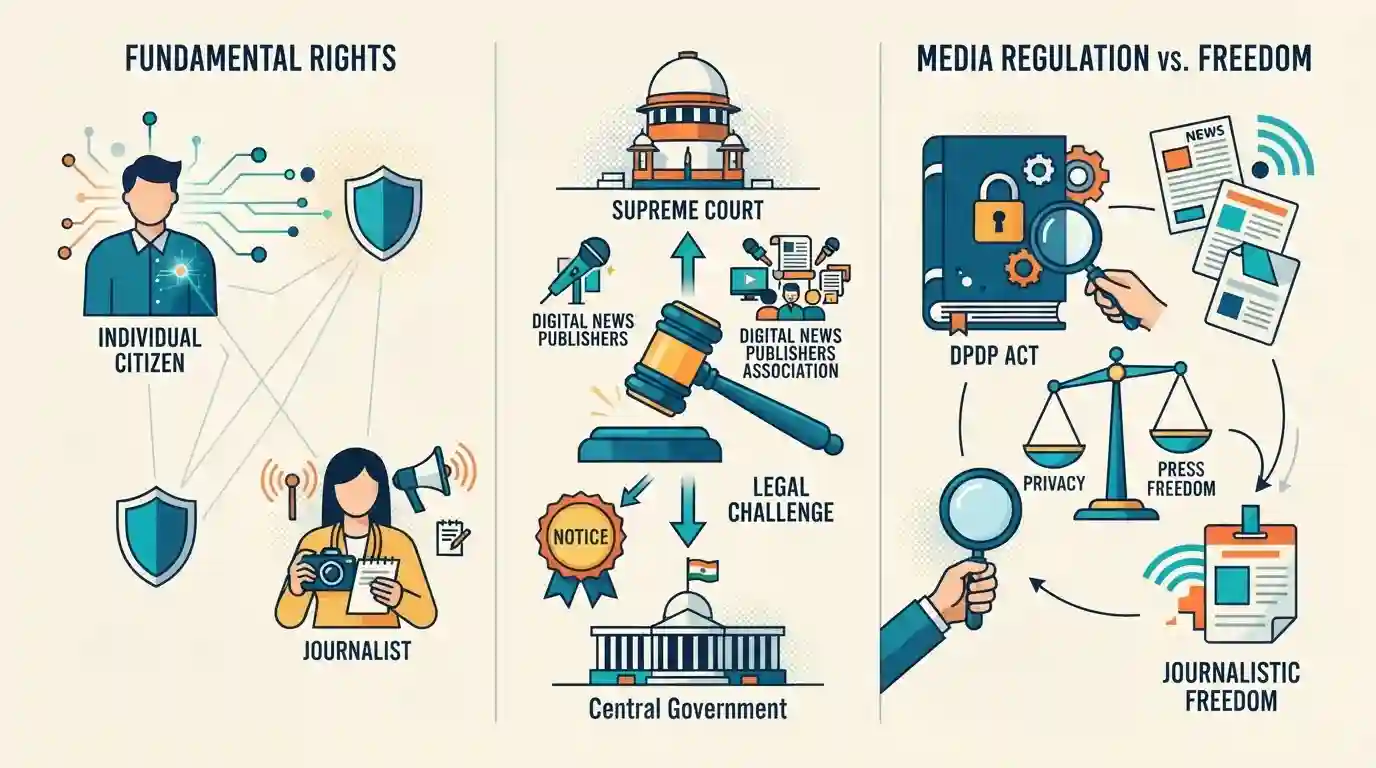
This case deals with the vital constitutional balance between two core fundamental rights—the Right to Privacy (Article 21) and Freedom of Speech and Expression / Press Freedom (Article 19)—impacting how journalism and data protection intersect in India.
సారాంశం
The Supreme Court issued a notice to the Central government after the Digital News Publishers Association (DNPA) filed a legal challenge against India's privacy law, the Digital Personal Data Protection (DPDP) Act. The challenge highlights tensions between individual data privacy rights and journalistic freedom/freedom of the press.
ముఖ్య అంశాలు
- The Supreme Court issued a notice to the Centre following a petition by the Digital News Publishers Association (DNPA) challenging provisions of the Digital Personal Data Protection (DPDP) Act.
- The petition raises core questions regarding the balance between the fundamental right to privacy and freedom of the press and expression under Article 19.
- News publishers argue that certain strictures of data protection laws may encumber journalistic freedom, investigative reporting, and public interest dissemination of information.
ముఖ్యమైన పదాలు
Digital Personal Data Protection Act (DPDP Act)

India's core legislation governing the processing and protection of digital personal data, establishing compliance obligations for data fiduciaries and rights for data principals.
UPSC context
UPSC CSE Paper II (Polity & Governance) – Statutory frameworks, data privacy, governance, and balancing fundamental rights.
Right to Privacy
A fundamental right recognized under Article 21 of the Indian Constitution, affirming an individual's autonomy over personal information and bodily integrity.
UPSC context
UPSC CSE Paper II (Indian Constitution & Fundamental Rights) – Landmark judicial rulings and civil liberties.
Digital News Publishers Association (DNPA)
An umbrella body representing leading digital news publishers in India, advocating for digital media interests and regulatory standards.
UPSC context
UPSC CSE Paper II – Freedom of the press, media regulation, and civil society organizations.
అనుసంధానమైన స్థిర భావనలు
What are the reasonable restrictions on Freedom of Speech and Expression under Article 19(2)?
- Exhaustive Grounds: Sovereignty and integrity, security of the State, friendly relations with foreign States, public order, decency or morality, contempt of court, defamation, or incitement to an offence.
- Historical Origin: Added by the 1st Constitutional Amendment Act (1951) to curtail unfettered speech that threatened public order and state security.
అంతర-అంశ నమూనాలు
DPDP Act vs RTI Act Transparency Tensions
The DPDP Act's amendment to the RTI Act through Section 44(3) illustrates the clash between transparency and confidentiality, connecting governance transparency to judicial review.

Expect a multi-statement question balancing Article 19(1)(a) freedom of press against Article 21 right to privacy under the DPDP Act.
అనుసంధాన PYQలు · 3
అనుసంధాన PYQలు · 3
- 2024MainsGS2
Right to privacy is intrinsic to life and personal liberty and is inherently protected under Article 21 of the constitution. Explain. In this reference discuss the law relating to D.N.A. testing of child in the womb to establish its paternity.
- 2017MainsGS2
Examine the scope of Fundamental Rights in the light of the latest judgement of the Supreme Court on Right to Privacy.
- 2024PrelimsGS1
Under which of the following Articles of the Constitution of India, has the Supreme Court of India placed the Right to Privacy ?
