Supreme Court issues notice to Centre over data privacy law
Source:Indian Express ↗
Why It Matters
The case addresses a vital constitutional and legal friction point between data privacy regulations (DPDP Act) and the freedom of the press, impacting how investigative journalism and media reporting operate in India.
Summary
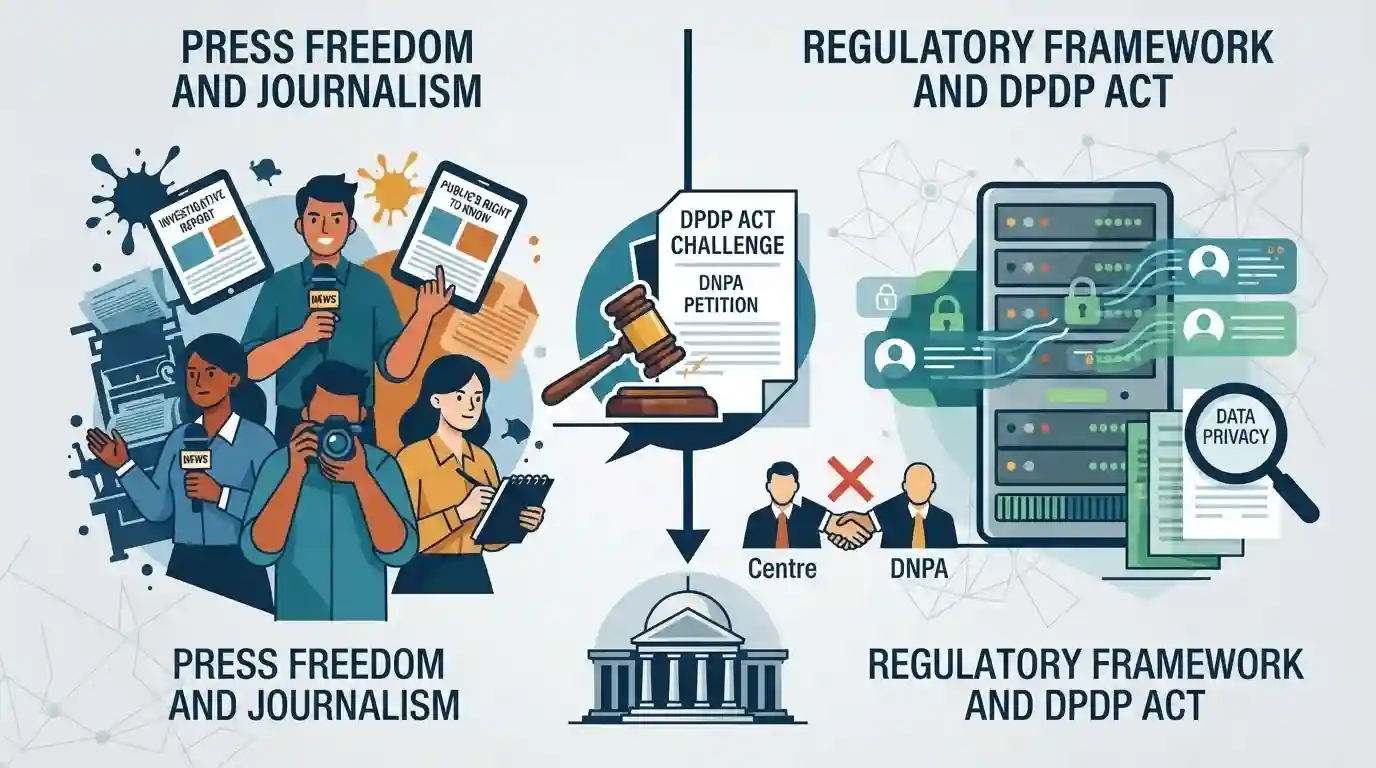
The Supreme Court of India has issued a notice to the Centre following a petition by the Digital News Publishers Association (DNPA) challenging the Digital Personal Data Protection (DPDP) Act over concerns that it adversely impacts press freedom, investigative journalism, and the public's right to know.
Key Points
- The Digital News Publishers Association (DNPA) has approached the Supreme Court challenging provisions of the Digital Personal Data Protection (DPDP) Act, arguing it infringes on press freedom and journalistic reporting.
- The Supreme Court has issued a notice to the Centre seeking its response on the petition filed by news publishers.
- The legal tussle centers on balancing individual privacy rights under the DPDP framework against the public's right to information and the exemptions required for journalistic and media organizations.
- This case highlights the ongoing tension between data protection regulations and freedom of speech and expression (Article 19(1)(a)).
Important Terms
Digital Personal Data Protection (DPDP) Act

India's comprehensive legislative framework governing the processing of digital personal data, balancing individual privacy rights with lawful data processing needs.
UPSC context
GS Paper II (Polity & Governance - Statutory frameworks, rights, and regulatory mechanisms). Tests understanding of data privacy laws and executive-legislative balance.
Digital News Publishers Association (DNPA)
An industry body representing prominent digital news publishers in India, advocating for fair digital media policies, copyright standards, and press freedom.
UPSC context
GS Paper II (Polity & Governance - Media regulation, civil society, and freedom of speech). Essential for questions on press freedom vs regulation.
Article 19 of the Constitution
Guarantees freedom of speech and expression to all citizens, serving as a cornerstone for media freedom, investigative journalism, and democratic discourse.
UPSC context
GS Paper II (Fundamental Rights - Freedom of speech, reasonable restrictions, and judicial scrutiny). Vital for balancing rights like privacy versus free expression.
Article 21 of the Constitution
Protects the right to life and personal liberty, which the Supreme Court has interpreted to include the fundamental right to privacy.
UPSC context
GS Paper II (Fundamental Rights - Right to Privacy, due process, and judicial interpretation). Crucial for examining individual liberties against state or institutional action.
Prelims Trap
The DPDP Act provides blanket statutory exemptions for journalistic and media organizations similar to traditional privacy laws globally.
The DPDP Act, 2023 lacks explicit, broad statutory exemptions for journalistic processing unlike earlier drafts, treating media organizations similarly to standard data fiduciaries in many contexts.
Static Concepts Connected
What are the constitutional parameters and reasonable restrictions governing Freedom of Speech and Expression under Article 19(1)(a)?
- Implicit Freedom: Article 19(1)(a) guarantees freedom of speech and expression, which inherently includes freedom of the press though not explicitly named as a separate right.
- Exhaustive Grounds: Reasonable restrictions under Article 19(2) include sovereignty and integrity of India, security of the State, public order, decency, morality, contempt of court, defamation, or incitement to an offence.
- Proportionality Test: Any legislative restriction (like data protection laws) must pass the proportionality test established in the K.S. Puttaswamy judgment.
Cross-Topic Patterns
DPDP Act vs. RTI Act Transparency
The DPDP Act's amendment to the RTI Act through Section 44(3) demonstrates how privacy frameworks directly intersect with transparency laws and executive accountability.

Expect a 2-statement Prelims question on whether the DPDP Act provides explicit blanket exemptions for journalistic data processing.
Linked PYQs · 3
Linked PYQs · 3
- 2024MainsGS2
Right to privacy is intrinsic to life and personal liberty and is inherently protected under Article 21 of the constitution. Explain. In this reference discuss the law relating to D.N.A. testing of child in the womb to establish its paternity.
- 2024PrelimsGS1
Under which of the following Articles of the Constitution of India, has the Supreme Court of India placed the Right to Privacy ?
- 2021PrelimsGS1
'Right to Privacy' is protected under which Article of the Constitution of India?
