ASI Monument Protection and Temple Administration
Source:The Hindu ↗
Why It Matters
This issue is crucial for UPSC aspirants as it highlights the intersection of heritage conservation and religious freedom. It presents a real-world conflict between central archaeological preservation laws (AMASR Act) and state-level religious administration (HR&CE) over ancient, living religious monuments, which directly maps to GS1 (Art & Culture) and GS2 (Governance/Secularism).
Summary
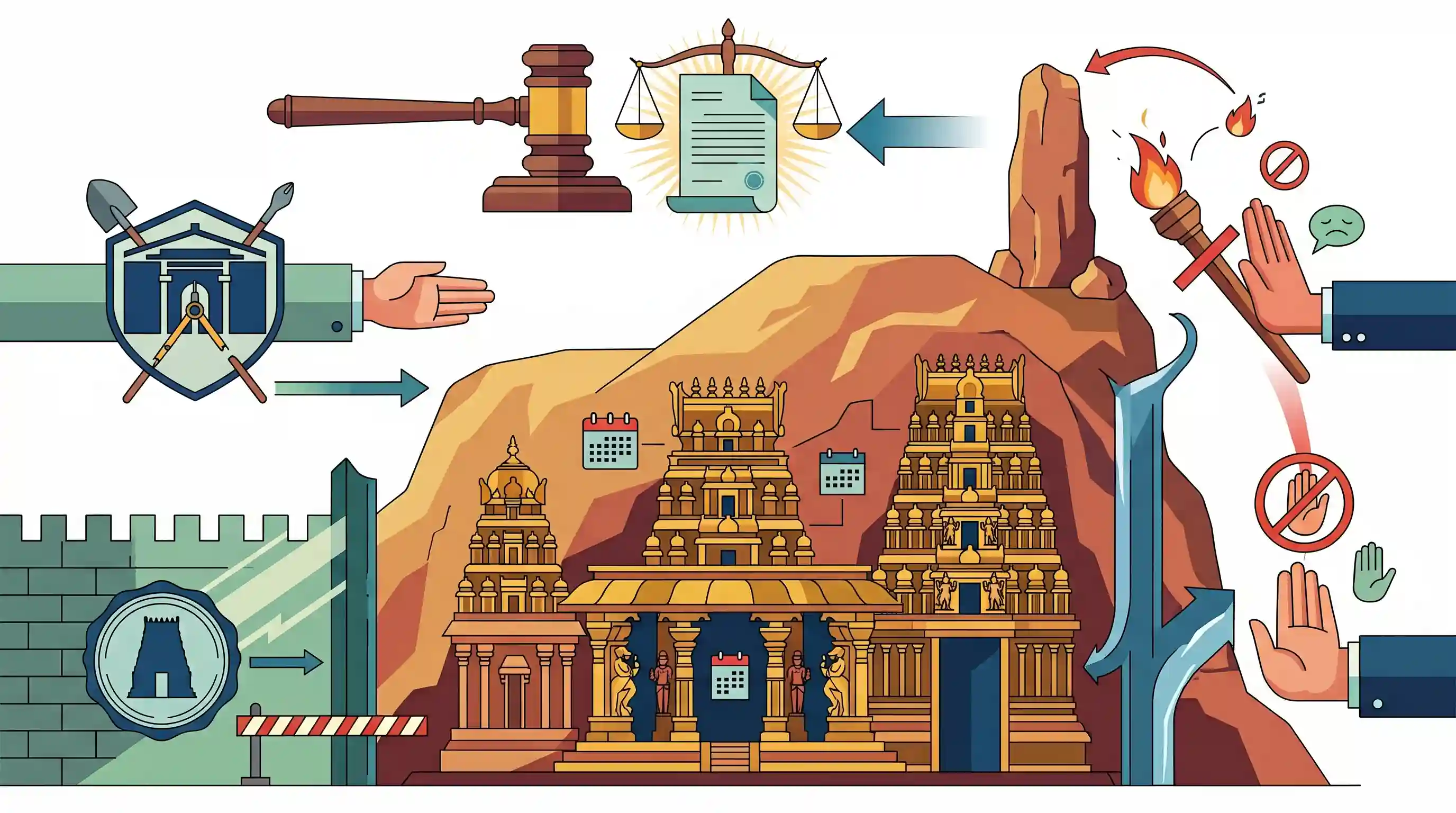
The Supreme Court of India has issued a notice regarding a plea to direct the Archaeological Survey of India (ASI) to take over the administration and protection of the Subramaniya Swamy Temple at Thirupparankundram, Madurai. The plea alleges that the Tamil Nadu Hindu Religious and Charitable Endowments (HR&CE) department is acting high-handedly and hindering religious practices, specifically the continuous lighting of the Karthigai Deepam at a protected rock pillar (deepathoon) atop the hill. The 8th-century rock-cut temple, reflecting Pandya and Nayak architectural styles, is currently caught in a dual-control struggle involving ASI monument protection laws (AMASR Act, 1958) and state-level religious administration.
Key Points
- The Supreme Court issued notices to the Centre, Tamil Nadu government, ASI, and the state HR&CE department on a plea seeking the ASI takeover of the Thirupparankundram Subramaniya Swamy Temple.
- The conflict centers on the petitioner's claim that the HR&CE department is obstructing the traditional continuous lighting of the Karthigai Deepam at a protected rock pillar (deepathoon) on the hillock.
- The hilltop and specific structures are protected under the Ancient Monuments and Archaeological Sites and Remains (AMASR) Act of 1958, leading to a jurisdictional clash between archaeological preservation and state religious administration.
- The Subramaniya Swamy Temple is a significant 8th-century rock-cut architectural marvel with historical associations to the Pandya dynasty and later Nayak additions.
Important Terms
Ancient Monuments and Archaeological Sites and Remains (AMASR) Act, 1958

A 1958 legislation providing for the preservation of historical monuments and archaeological sites of national importance, regulating excavations, and defining 100-meter 'prohibited' zones around heritage sites.
UPSC context
GS Paper 1 (Art and Culture) and Paper 2 (Governance); tests statutory frameworks for heritage conservation.
Archaeological Survey of India (ASI)
An attached agency of the Ministry of Culture responsible for archaeological research, conservation, and the preservation of over 3,600 centrally protected monuments across India.
UPSC context
GS Paper 1 (Heritage Management) and Paper 2; tests institutional roles in safeguarding national cultural identity.
Hindu Religious and Charitable Endowments (HR&CE) department
A Tamil Nadu government department established under the 1959 Act to administer, manage, and protect the assets, finances, and religious traditions of Hindu and Jain temples.
UPSC context
GS Paper 2 (Polity/Governance); tests constitutional limits of state control over religious institutions (Articles 25-26).
Rock-cut architecture
An architectural style where structures are carved directly into natural rock formations, notably used by the Pandya dynasty (6th–9th centuries) for cave temples in South India.
UPSC context
GS Paper 1 (Art and Culture); tests evolution of Indian temple architecture and dynastic patronage.
Karthigai Deepam
A traditional Tamil Hindu festival of lights symbolizing spiritual enlightenment, famously celebrated with the lighting of a massive lamp (Mahadeepam) atop hills like Thirupparankundram.
UPSC context
GS Paper 1 (Indian Culture); tests knowledge of regional festivals and their integration with historical temple rituals.
Prelims Trap
ASI-protected monuments cannot be managed by state religious endowment boards.
The AMASR Act protects the physical monument, but active places of worship can still have their religious affairs and administration managed by state boards (HR&CE).
Static Concepts Connected
What are the key features of Early Pandya temple architecture?
- Rock-cut caves: Similar to Pallavas, they excavated cave temples in southern Tamil Nadu, with notable examples at Thirupparankundram and Pillayarpatti.
- Monolithic vimanas: They sculpted entire free-standing temples from single rocks, most notably the unfinished Vettuvan Koil at Kalugumalai.
- Layered expansions: These core shrines feature monolithic rock cuts that were often expanded centuries later by Nayak rulers with elaborate structural additions.
What are the regulatory zones under the AMASR Act for protected monuments?
- Prohibited Area: A 100-metre radius around an ASI-protected monument where all new construction, mining, or excavation is strictly banned.
- Regulated Area: An additional 200-metre radius where repairs or new construction require specific permission from the National Monuments Authority (NMA).
- 100-Year Criterion: A historical structure, site, or artifact must have existed for not less than 100 years to be declared of 'national importance'.
Cross-Topic Patterns
Temple Architecture + Article 26
The dual control of ancient living temples by ASI (physical preservation) and State HR&CE (administration) frequently tests the limits of religious autonomy under Article 26.
Pandya Shrines + Nayak Mandapas
Southern temples showcase layered patronage. Early Pandya rock-cut shrines often form the core, enveloped by later intricate Nayak-era pillared mandapas and towering gopurams.

Expect a 2026 prelims pairing question on rock-cut temples, matching southern dynasties (Pandya/Pallava) with specific cave sites.
Linked PYQs · 3
Linked PYQs · 3
- 2020MainsGS1
The rock-cut architecture represents one of the most important sources of our knowledge of early Indian art and history. Discuss.
- 2024MainsGS2
Discuss India as a secular state and compare with the secular principles of the US constitution.
- 2019PrelimsGS1
Building 'Kalyaana Mandapas' was a notable feature in the temple construction in the kingdom of
