Temple Priest Appointment Qualifications and Judicial Review
Source:The Hindu ↗
Why It Matters
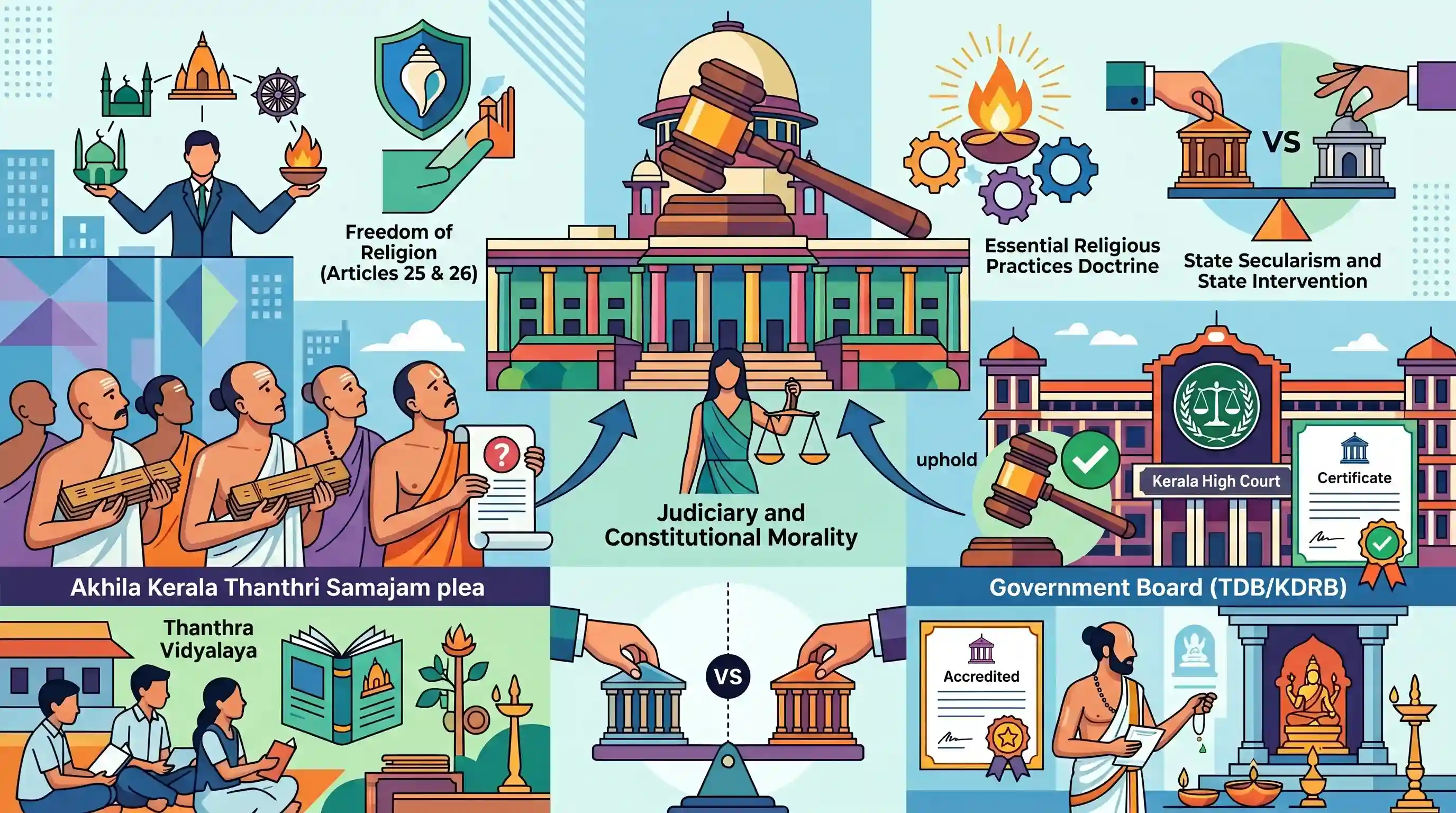
The appointment of temple priests by state-run Devaswom Boards highlights the complex constitutional relationship between the secular State and religious institutions in India. It raises critical questions for UPSC aspirants regarding the 'Essential Religious Practices' doctrine, the scope of Articles 25 and 26, and how the judiciary balances secular administrative functions with purely religious traditions.
Summary
The Supreme Court has agreed to examine a plea challenging a Kerala High Court decision which upheld the appointment of temple priests based on religious texts and certificates issued by state-accredited Thanthra Vidyalayas. The petition, brought by the Akhila Kerala Thanthri Samajam, questions the role of the Travancore Devaswom Board (TDB) and the Kerala Devaswom Recruitment Board (KDRB) in prescribing qualifications for religious functions. The High Court had previously dismissed concerns that individuals unconnected to spiritual functions were being appointed, noting that the state-approved qualifications involved proper expert input.
Key Points
- The Supreme Court has issued notices to the Kerala government and Devaswom Boards regarding a plea challenging a Kerala High Court order on temple priest appointments.
- The Kerala High Court previously ruled that temple priests must be appointed in strict accordance with religious texts.
- The petition, filed by the Akhila Kerala Thanthri Samajam, challenges the validity and constitutionality of priest certification issued by accredited Thanthra Vidyalayas under the TDB and KDRB.
- The High Court had dismissed the argument that unqualified individuals were being selected, noting that the qualifications for priests were formed with expert input and approved by the government.
Important Terms
Travancore Devaswom Board (TDB)

A statutory autonomous body managing over 1,200 temples in southern Kerala, including Sabarimala, under the Travancore-Cochin Hindu Religious Institutions Act, 1950.
UPSC context
GS Paper II: Statutory/Regulatory Bodies; Governance of religious institutions and state intervention in temple administration.
Kerala Devaswom Recruitment Board (KDRB)
A state-level statutory body established in 2015 to conduct transparent, merit-based recruitment for non-hereditary posts in Kerala's five Devaswom Boards.
UPSC context
GS Paper II: Governance; Transparency in public recruitment and management of religious endowments.
Essential Religious Practices Doctrine
A judicial principle used to determine which rituals are integral to a religion and protected from state interference under Articles 25 and 26.
UPSC context
GS Paper II: Indian Constitution; Balancing individual/group religious freedoms with social reform and constitutional morality.
Article 26 of the Constitution
Fundamental Right granting religious denominations the power to manage their own affairs in matters of religion, subject to public order, morality, and health.
UPSC context
GS Paper II: Fundamental Rights; Collective rights of religious groups versus state regulatory authority.
Thanthra Vidyalayas
State-accredited institutions providing formal training in Thanthra (temple rituals) and Vedic texts, whose certificates are now recognized for official priest appointments.
UPSC context
GS Paper I/II: Art and Culture/Polity; Formalization of religious education and the move from heredity to qualification.
Akhila Kerala Thanthri Samajam
A registered society representing traditional Thanthri (chief priest) families in Kerala that advocates for preserving hereditary rights in temple rituals.
UPSC context
GS Paper II: Judiciary; Stakeholders in constitutional litigation regarding tradition versus statutory reforms.
Prelims Trap
"The appointment of a temple priest is protected as an essential religious practice immune from State regulation."
The Supreme Court (Seshammal case, 1972) established that the appointment of a priest is a secular administrative function, while the rituals performed are religious.
Static Concepts Connected
What is the Essential Religious Practices (ERP) doctrine?
- Judicial Origin: Formulated by the Supreme Court in the landmark Shirur Mutt Case (1954) to determine religious autonomy boundaries.
- Core Principle: Protects only those practices and rituals that are "essential and integral" to a religion under Articles 25 and 26.
- Judicial Review: The judiciary assumes the power to determine what constitutes an essential practice, often by analyzing religious texts and historical customs.
How does Indian secularism differ from Western models?
- Principled Distance: Unlike the strict US/French separation, India follows 'Principled Distance'—allowing the State to intervene in religion to enact social reforms (e.g., ending untouchability).
- Constitutional Backing: Article 25(2)(a) and (b) explicitly permit the State to regulate secular/economic activities associated with religion and provide for social welfare.
Cross-Topic Patterns
Art 26 Autonomy vs State Control
The debate over Devaswom Boards connects to the broader 'Free Temples' movement, questioning the constitutional limits of state-run religious endowments under Article 26.
Social Justice vs Religious Custom
State-mandated priest qualifications intersect with the Sabarimala judgment and affirmative action, pitting Article 14 (Equality) against traditional religious customs and hereditary privileges.

Expect a 2026 Prelims question testing Art 25(2) limits, specifically distinguishing secular administrative appointments from core rituals.
Linked PYQs · 3
Linked PYQs · 3
- 2024MainsGS2
Discuss India as a secular state and compare with the secular principles of the US constitution.
- 2021MainsGS2
‘Constitutional Morality’ is rooted in the Constitution itself and is founded on its essential facets. Explain the doctrine of ‘Constitutional Morality’ with the help of relevant judicial decisions.
- 2020MainsGS2
Judicial Legislation is antithetical to the doctrine of separation of powers as envisaged in the Indian Constitution. In this context justify the filing of large number of public interest petitions praying for issuing guidelines to executive authorities.
