Supreme Court Trial Judge Appointment for Coal Scam Cases
Source:The Hindu ↗
Why It Matters
Illustrates the long-term judicial management of high-profile corruption and resource-allocation scams. It is relevant for understanding the roles of the CBI, Enforcement Directorate, and special courts in handling complex cases involving the Prevention of Corruption Act and PMLA.
Summary
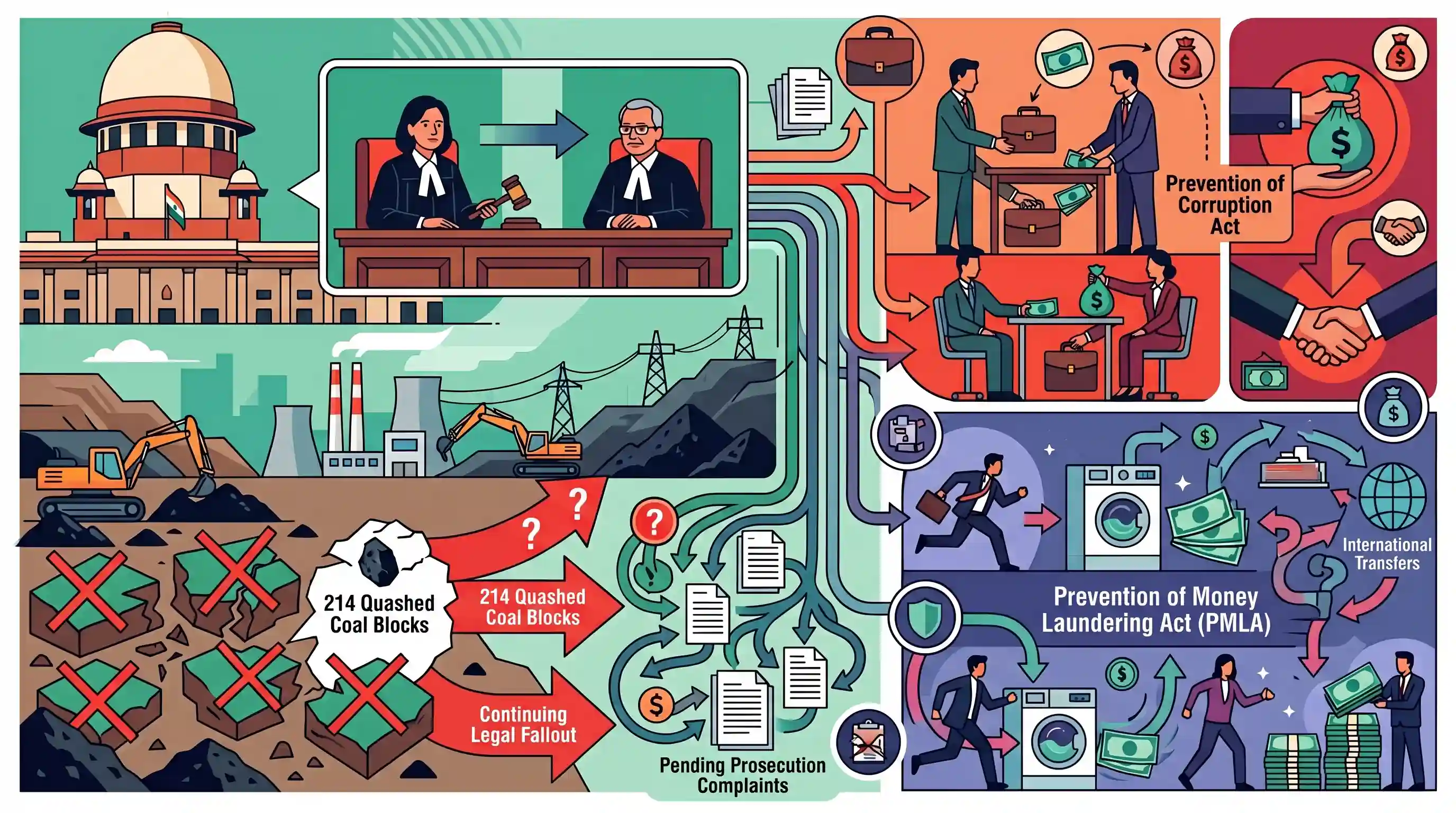
The Supreme Court appointed a new special judge, Sunaina Sharma, to conduct ongoing trials in the CBI's coal block allocation scam cases, replacing Sanjay Bansal. The cases largely involve violations under the Prevention of Corruption Act and the Prevention of Money Laundering Act (PMLA). The article highlights the continuing legal fallout and pending prosecution complaints from the landmark 2014 Supreme Court ruling that quashed the allocation of 214 coal blocks.
Key Points
- The Supreme Court appointed Sunaina Sharma as the new special judge to conduct trials in coal block allocation scam cases probed by the CBI.
- She replaces incumbent Special CBI Judge Sanjay Bansal whose extended term recently expired.
- A total of 29 corruption cases filed by the CBI are currently pending before two special courts, alongside 45 pending prosecution complaints filed by the ED under the PMLA.
- The 2014 landmark Supreme Court judgment had notably quashed the allocation of 214 coal blocks by the Centre between 1993 and 2010.
Important Terms
Prevention of Money Laundering Act (PMLA)

A 2002 law enacted to prevent money laundering and enable the confiscation of property derived from the "proceeds of crime."
UPSC context
GS Paper III: Internal Security; tests knowledge of economic offenses and Enforcement Directorate powers.
Prevention of Corruption Act (PC Act)
A 1988 statute aiming to combat bribery and criminal misconduct among public servants; significantly amended in 2018 to include bribe-givers.
UPSC context
GS Paper II: Governance and GS Paper IV: Ethics; tests administrative integrity frameworks.
Central Bureau of Investigation (CBI)
India's premier investigating agency established in 1963, deriving its powers from the Delhi Special Police Establishment (DSPE) Act, 1946.
UPSC context
GS Paper II: Statutory/Regulatory bodies; tests understanding of federal investigative powers and autonomy.
Special Courts (Judiciary)
Specialized judicial bodies established under laws like the PC Act to ensure the expeditious trial of specific categories of offenses.
UPSC context
GS Paper II: Judiciary; tests knowledge of judicial reforms and the mechanism for speedy justice.
Directorate of Enforcement (ED)
A specialized financial investigation agency under the Ministry of Finance responsible for enforcing PMLA and FEMA regulations.
UPSC context
GS Paper III: Money laundering; tests knowledge of specialized law enforcement and financial security.
Coal Block Allocation Scam
A major legal scandal involving irregularities in resource assignments, leading to a landmark 2014 SC ruling quashing 214 block allocations.
UPSC context
GS Paper III: Natural Resources; tests knowledge of resource allocation transparency and accountability.
Prelims Trap
Special Courts under the PMLA are designated directly by the Supreme Court of India.
Under Section 43 of the PMLA, the Central Government (not the SC), in consultation with the High Court's Chief Justice, designates Sessions Courts as Special Courts.
Static Concepts Connected
How does the Public Trust Doctrine govern natural resource allocation?
- State as Trustee: The State holds natural resources (like coal and spectrum) as a trustee for the public, not as an absolute corporate owner.
- Article 39(b) Mandate: Allocation mechanisms must ensure ownership and control of material resources are distributed to subserve the common good.
- Article 14 Compliance: Allocation processes must be fair, transparent, and non-arbitrary. The SC has stressed auctions over discretionary allocations to ensure equality.
What are the unique evidentiary rules under the PMLA?
- Reverse Burden: Under Section 24 of the PMLA, the burden of proof rests on the accused to show that alleged assets are untainted.
- Proceeds of Crime: The accused must prove the attached property is not derived, directly or indirectly, from criminal activity related to a scheduled offence.
Cross-Topic Patterns
Public Trust Doctrine & DPSPs
The 2014 coal block cancellation explicitly linked arbitrary resource allocation (Article 14 violation) with the failure to distribute material resources for the common good (Article 39(b)).
PMLA Adjudication Hierarchy
While ED attaches property via its Adjudicating Authority, actual criminal trials for money laundering offences are exclusively conducted in designated Special Sessions Courts.

Expect a 2026 Prelims question mixing PMLA's reverse burden of proof with the Central Govt's role in designating Special Courts.
Linked PYQs · 4
Linked PYQs · 4
- 2021MainsGS2
The jurisdiction of the Central Bureau of Investigation (CBI) regarding lodging an FIR and conducting probe within a particular State is being questioned by various States. However, the power of the States to withhold consent to the CBI is not absolute. Explain with special reference to the federal character of India.
- 2025MainsGS2
Discuss the 'corrupt practices' for the purpose of the Representation of the People Act, 1951. Analyze whether the increase in the assets of the legislators and/or their associates, disproportionate to their known sources of income, would constitute 'undue influence' and consequently a corrupt practice.
- 2021MainsGS3
Discuss how emerging technologies and globalisation contribute to money laundering. Elaborate measures to tackle the problem of money laundering both at national and international levels.
- 2013MainsGS3
Money laundering poses a serious security threat to a country's economic sovereignty. What is its significance for India and what steps are required to be taken to control this menace?
