Emergency judicial protocols for personal liberty
Source:The Hindu ↗
Why It Matters
This development is highly significant for GS-2 (Polity and Governance). It deals directly with the expansion and practical enforcement of Article 21 (Right to Life and Personal Liberty) and the Right to Constitutional Remedies (Article 32/226). It also highlights the intersection of technology (e-filing/virtual courts) in ensuring continuous access to justice, while addressing the critical constitutional nuances of federalism (the administrative independence of High Courts from the Supreme Court) and the separation of powers when addressing overnight executive actions.
Summary
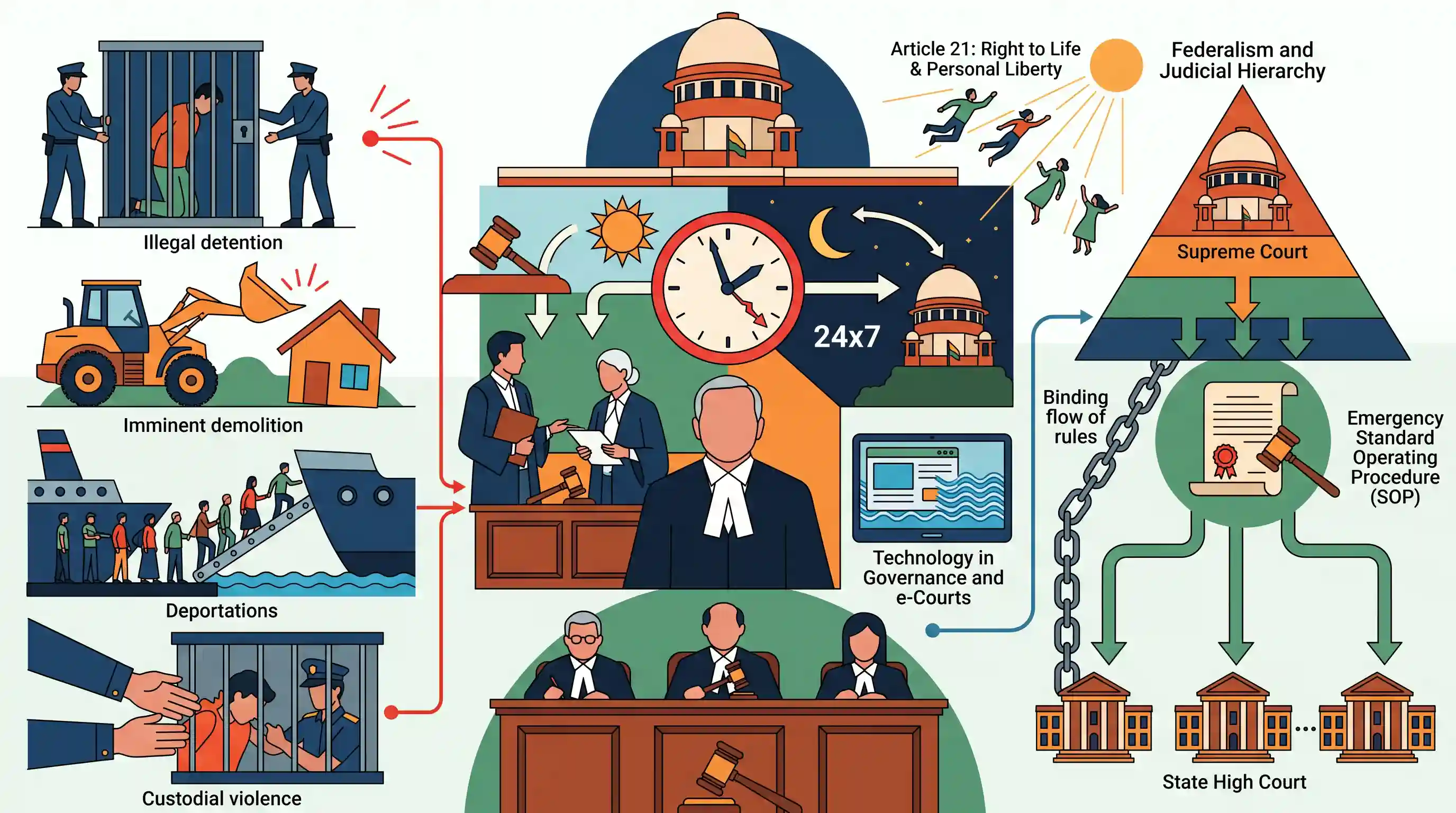
The Supreme Court of India is considering the creation of a 24x7 emergency Standard Operating Procedure (SOP) to allow citizens to approach courts at any time—day or night—in urgent cases involving violations of personal life and liberty (such as illegal detentions, imminent demolitions, deportations, and custodial violence). A three-judge Bench led by Chief Justice Surya Kant emphasized that protection of liberty under Article 21 cannot be bound by court working hours. The court is discussing whether this procedural framework should be issued on the judicial side to ensure it binds State High Courts within India's federal structure.
Key Points
- The Supreme Court of India is mulling a Standard Operating Procedure (SOP) to enable a 24x7 emergency protocol for citizens to seek immediate judicial relief in critical matters affecting life and liberty.
- This proposed mechanism addresses urgent violations of fundamental rights that occur outside standard court hours, such as late-night arrests, early-morning demolition drives (bulldozer action), deportations, or custodial violence during weekends and judicial recesses.
- Advocate Maheravish Rein argued that because of restricted office hours, citizens often face irreversible consequences. She asserted that the Constitution cannot 'fall silent at night' and that access to justice must be continuously available.
- Justice Joymalya Bagchi highlighted that while technological advancements like e-filing, virtual courts, and electronic communication exist, they currently lack integration into a uniform, institutionalized framework specifically designed for emergency access.
- Chief Justice Surya Kant suggested that an SOP could reduce judicial response times in emergency scenarios to within an hour of an urgent mention.
- A key federalism and constitutional debate emerged when Solicitor General Tushar Mehta suggested framing the SOP on the administrative side. CJI Surya Kant noted that in India's federal structure, State High Courts do not fall under the administrative control of the Supreme Court, implying the protocol might need to be established through a judicial order.
Important Terms
Standard Operating Procedure for Emergency Judicial Access

A proposed uniform procedural framework to enable citizens to approach constitutional courts 24/7 (during off-hours, weekends, and holidays) for urgent relief against imminent violations of life and personal liberty.
UPSC context
GS Paper II: Indian Polity & Judiciary. Tests understanding of judicial reforms, access to justice, and protection of fundamental rights under Article 21.
Article 21 of the Indian Constitution
A fundamental right guaranteeing that no person shall be deprived of their life or personal liberty except according to procedure established by law, acting as a bedrock for civil liberties.
UPSC context
GS Paper II: Fundamental Rights. Tests conceptual clarity on constitutional protections, judicial interpretations, and expanding dimensions of liberty.
Supreme Court of India
The highest constitutional court and the apex judicial body of India, serving as the ultimate interpreter of the Constitution and the guarantor of fundamental rights.
UPSC context
GS Paper II: Structure of Judiciary. Tests knowledge of the apex court's original, appellate, and advisory jurisdictions and role in constitutional governance.
State High Courts
The highest judicial bodies at the state level in India, exercising original, appellate, and supervisory jurisdiction, including the power to issue writs under Article 226.
UPSC context
GS Paper II: Structure of Judiciary. Tests understanding of judicial hierarchy, writ jurisdiction, and the federal structure of India's judicial system.
Article 32 of the Indian Constitution
A fundamental right that empowers individuals to approach the Supreme Court directly for the enforcement of fundamental rights, described as the heart and soul of the Constitution.
UPSC context
GS Paper II: Constitutional Remedies. Tests understanding of the Supreme Court's writ jurisdiction and mechanisms to protect citizens against state overreach.
Article 226 of the Indian Constitution
A constitutional provision empowering High Courts to issue writs for the enforcement of fundamental rights and other purposes, offering wider scope than Article 32.
UPSC context
GS Paper II: Constitutional Provisions. Tests knowledge of High Courts' writ power, comparison with Article 32, and regional judicial remedies.
Public Interest Litigation (PIL)
A legal filing in constitutional courts by public-spirited individuals or groups to secure justice for marginalized communities or address issues of public interest.
UPSC context
GS Paper II: Judicial Activism. Tests awareness of judicial innovations, democratization of justice, and checking executive overreach.
Judicial Activism
A judicial philosophy where courts take an active role in protecting fundamental rights and enforcing public policy, correcting institutional failures of other state organs.
UPSC context
GS Paper II: Separation of Powers. Tests understanding of judicial overreach vs. activism and the delicate balance between state organs.
Prelims Trap
The Supreme Court exercises administrative control and supervisory jurisdiction over State High Courts under the Indian Constitution.
High Courts are independent constitutional bodies. Under Article 227, supervisory control over subordinate courts belongs to High Courts, and the SC lacks administrative control over HCs.
Static Concepts Connected
How do SC and HC relationships differ administratively versus judicially?
- No administrative link: High Courts are independent constitutional entities, not administrative subordinates to the Supreme Court.
- Judicial bindingness: Under Article 141, judicial decisions of the Supreme Court are strictly binding on all High Courts.
- Supervisory role: High Courts hold exclusive administrative and supervisory control over state subordinate courts under Article 227.
Why is the High Court's writ jurisdiction wider than the Supreme Court's?
- Scope of enforcement: Article 226 extends to fundamental rights and ordinary legal rights, whereas Article 32 only covers fundamental rights.
- Nature of remedy: Accessing the Supreme Court under Article 32 is a fundamental right, while Article 226 is a discretionary constitutional remedy.
Cross-Topic Patterns
E-Courts + Article 21 realization
Utilizing Phase-III e-courts technology to establish a 24/7 emergency filing framework directly converts digital public infrastructure into a tool for safeguarding personal liberty.
Judicial federalism + Article 141
Using judicial-side orders instead of administrative circulars to bind High Courts showcases the delicate federal balance and strict division of administrative powers in India's judiciary.

The 2026 exam will likely test the SC's lack of administrative authority over HCs versus its binding judicial powers under Article 141.
Linked PYQs · 4
Linked PYQs · 4
- 2023PrelimsGS1
In essence, what does 'Due Process of Law' mean?
- 2020MainsGS2
Judicial Legislation is antithetical to the doctrine of separation of powers as envisaged in the Indian Constitution. In this context justify the filing of large number of public interest petitions praying for issuing guidelines to executive authorities.
- 2024PrelimsGS1
Under which of the following Articles of the Constitution of India, has the Supreme Court of India placed the Right to Privacy ?
- 2019PrelimsGS1
Which Article of the Constitution of India safeguards one's right to marry the person of one's choice?
