Supreme Court modifies order on stray dog release in Delhi
Source:The Hindu ↗
Why It Matters
The management of stray dogs is a chronic urban governance issue that requires balancing public health and safety with statutory animal welfare rights. This case illustrates the practical challenges urban local bodies face in implementing the Animal Birth Control Rules and highlights the Supreme Court's role in harmonizing conflicting interests to forge a national policy.
Summary
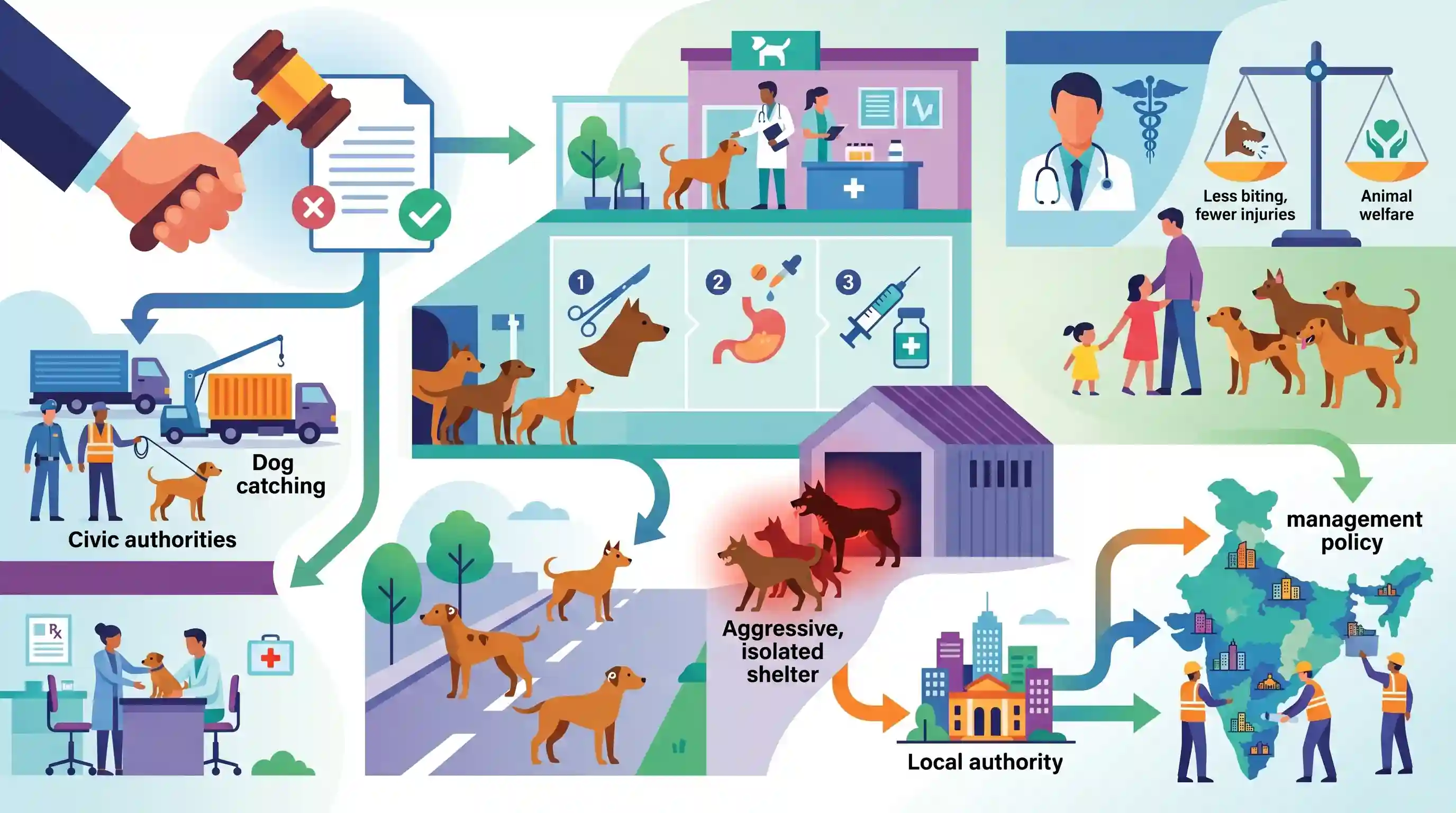
The Supreme Court has modified a controversial prior directive, now allowing civic authorities in Delhi to release stray dogs back onto the streets after they have undergone sterilisation, deworming, and immunisation. The Court noted that an absolute prohibition on releasing strays contradicts the Animal Birth Control (ABC) Rules, 2023, framed under the Prevention of Cruelty to Animals Act, 1960. The order mandates that rabid or highly aggressive dogs be isolated in separate shelters. Highlighting the public health dimension, the Solicitor General pointed out the rising fatalities from dog bites, particularly among children. Additionally, the Bench expanded the case's ambit to develop a national policy on stray dog management, bringing attention to the broader urban governance challenges faced by local bodies.
Key Points
- The Supreme Court modified its earlier suo motu directive that required Delhi civic authorities to capture and permanently confine all stray dogs in shelters.
- Under the revised order, strays must be released back into their territories after being sterilised, dewormed, and immunised, aligning with Rule 11(19) of the Animal Birth Control (ABC) Rules, 2023.
- Dogs infected with rabies or exhibiting unusually aggressive behaviour are exempted and must be kept in separate pounds or shelters.
- The Bench expanded the scope of the proceedings beyond Delhi-NCR to facilitate the formulation of a comprehensive national policy on stray dog management.
- The Solicitor General emphasised the severity of the stray dog menace as a public health crisis, noting that children are the primary victims of fatal dog bites and rabies.
Important Terms
Animal Birth Control (ABC) Rules, 2023

Notified under the PCA Act 1960, these rules mandate the 'Catch-Neuter-Vaccinate-Return' (CNVR) protocol for stray dogs, classifying them as 'community animals' to be managed without relocation or culling.
UPSC context
GS-II: Government policies; GS-III: Environment and Biodiversity. Tests knowledge of the regulatory framework for human-animal conflict management.
Prevention of Cruelty to Animals Act, 1960
A foundational Indian law enacted to prevent 'unnecessary pain or suffering' to animals. It provides the statutory basis for animal welfare and established the Animal Welfare Board of India.
UPSC context
GS-III: Environment. Core legislation frequently tested in the context of ethics and animal rights (GS-IV).
Animal Welfare Board of India (AWBI)
A statutory advisory body established in 1962 under the PCA Act. It advises the government on animal welfare laws, monitors compliance, and provides grants to animal welfare organizations.
UPSC context
GS-II: Statutory/regulatory bodies. Tests understanding of institutional mechanisms for animal protection.
Article 51A(g)
A Fundamental Duty in the Indian Constitution requiring citizens to protect and improve the natural environment and to 'have compassion for living creatures.'
UPSC context
GS-II: Constitution (Fundamental Duties). Often cited by the Supreme Court as the 'Magna Carta' of animal rights.
One Health Approach
A collaborative, multisectoral approach that recognizes the interconnection between the health of people, animals, and their shared environment, often applied to rabies control and zoonotic disease management.
UPSC context
GS-II: Public Health; GS-III: Science and Technology. Crucial for understanding global health governance and disease prevention.
Urban Local Bodies (ULBs)
Constitutional bodies (74th Amendment) responsible for implementing Animal Birth Control programs at the grassroots level, managing public health, and maintaining urban sanitation.
UPSC context
GS-II: Governance and Local Self-Government. Tests the practical execution of national policies by municipal authorities.
Prelims Trap
The Animal Welfare Board of India (AWBI) is a statutory body established under the Wildlife (Protection) Act, 1972.
The AWBI is a statutory body established under the Prevention of Cruelty to Animals (PCA) Act, 1960. It is often incorrectly conflated with the Wildlife Protection Act, 1972.
Static Concepts Connected
What is the statutory backing and mandate of the Animal Welfare Board of India (AWBI)?
- Statutory basis: Statutory advisory body established in 1962 under Section 4 of the Prevention of Cruelty to Animals (PCA) Act, 1960.
- Key pioneer: Rukmini Devi Arundale played a pivotal role in its inception and guided its early activities.
- Core function: Advises the central government on animal welfare laws, promotes animal welfare organizations, and oversees ABC rules implementation.
Where does stray animal management fall in the Constitutional scheme?
- 12th Schedule: Introduced by the 74th Amendment Act, 1992, it contains 18 functional items for Municipalities.
- Article 243W: Empowers state legislatures to endow Municipalities with powers over public health, sanitation, and urban amenities, which covers stray animal population control.
Cross-Topic Patterns
One Health approach to zoonotic diseases
Stray dog management directly links to the 'One Health' approach, which integrates human, animal, and environmental health. This is critical for India's NAPRE target to eliminate dog-mediated rabies by 2030.
Fundamental Duties vs Public Health (Article 21)
The Supreme Court frequently balances public health rights (Article 21) against the Fundamental Duty to have compassion for living creatures (Article 51A(g)) when adjudicating on animal culling or relocation.

Expect a multi-statement question interlinking AWBI's statutory roots, ABC Rules 2023, and the 'One Health' approach to rabies in 2026.
Linked PYQs · 3
Linked PYQs · 3
- 2024MainsGS2
Analyse the role of local bodies in providing good governance at local level and bring out the pros and cons merging the rural local bodies with the urban local bodies.
- 2023MainsGS2
“The states in India seem reluctant to empower urban local bodies both functionally as well as financially.” Comment.
- 2022PrelimsGS1
With reference to Indian laws about wildlife protection, consider the following statements : 1. Wild animals are the sole property of the government. 2. When a wild animal is declared protected, such animal is entitled for equal protection whether it is found in protected areas or outside. 3. Apprehension of a protected wild animal becoming a danger to human life is sufficient ground for its capture or killing. Which of the statements given above is/are correct?
