Supreme Court Ruling on Corruption Trials and Political Accountability
Source:Indian Express ↗
Why It Matters
This case serves as a critical example of structural loopholes within the criminal justice system being exploited for political expediency. It is highly relevant for GS-2 (Judiciary, Governance) and GS-4 (Ethics in Public Administration) as it illustrates challenges in maintaining probity, conducting speedy trials, and the conflict between holding public office while facing serious corruption and money laundering charges.
Summary
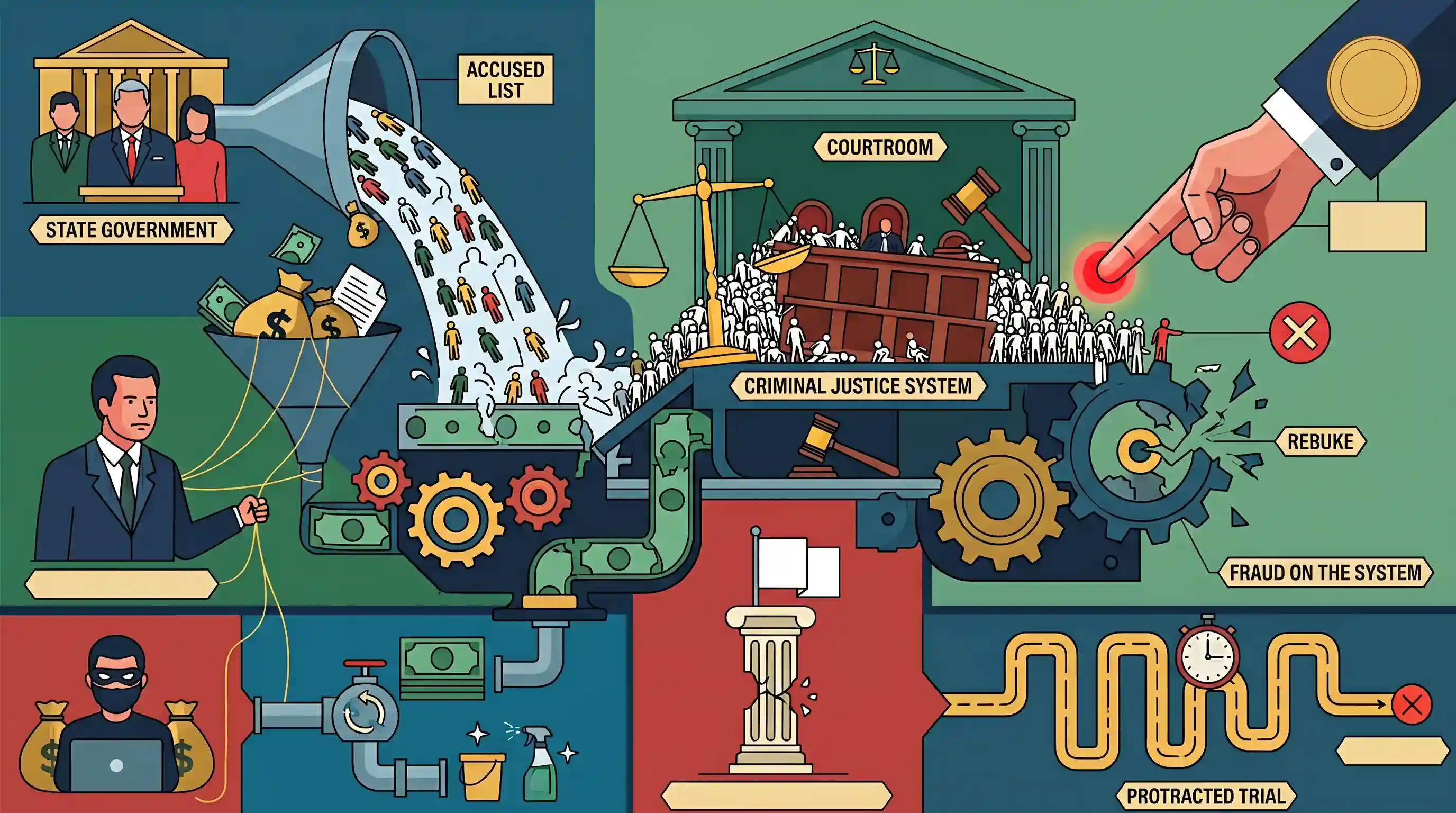
The Supreme Court has issued a scathing rebuke to the Tamil Nadu government, accusing it of deliberately attempting to derail the trial of former minister V Senthil Balaji in a cash-for-jobs scam. By naming roughly 2,000 alleged bribe givers as accused, the state administration effectively ensured the trial could never be completed, a tactic the Court described as a 'fraud on the system'. This development highlights significant concerns surrounding the criminal justice system's vulnerability to political manipulation, the protracted nature of corruption trials, and the broader implications for probity in public life. Balaji, who had previously been forced by the Supreme Court to resign his cabinet post to maintain bail in a parallel ED money laundering probe, remains at the center of this complex legal and political battle.
Key Points
- The Supreme Court severely criticized the Tamil Nadu government for allegedly stalling the trial of former state minister V Senthil Balaji in a cash-for-jobs scam by naming 2,000 individuals as accused.
- The bench, comprising Justices Surya Kant and Joymala Bagchi, termed the move a "fraud on the system," noting it would prevent the trial from ever concluding.
- Balaji is facing corruption and money laundering charges dating back to his tenure as transport minister in the AIADMK government (2011-2016).
- The former minister was recently forced by the Supreme Court to resign from the DMK state cabinet to retain his bail granted in the related money laundering case investigated by the Enforcement Directorate (ED).
Important Terms
Supreme Court of India

The highest judicial body in India under Article 124, serving as the final court of appeal and the ultimate protector and interpreter of the Constitution.
UPSC context
GS Paper II: Judiciary. Tests understanding of judicial activism, separation of powers, and the court's role in protecting fundamental rights.
Enforcement Directorate (ED)
A specialized financial investigation agency under the Ministry of Finance responsible for enforcing the Prevention of Money Laundering Act (PMLA) and the Foreign Exchange Management Act (FEMA).
UPSC context
GS Paper III: Security. Focuses on the role of statutory bodies in combating money laundering and economic offenses.
Prevention of Money Laundering Act (PMLA)
A 2002 legislation enacted to prevent the conversion of illegally obtained money into legal assets and to provide for the confiscation of proceeds from crime.
UPSC context
GS Paper III: Internal Security. Tests knowledge of legal frameworks for preventing financial crimes and related judicial interpretations.
Probity in Governance
An ethical standard in public life involving strict adherence to integrity, accountability, and transparency, ensuring public confidence in the governance process beyond mere absence of corruption.
UPSC context
GS Paper IV: Ethics. Essential for understanding administrative ethics and the moral duties of public officials in a democracy.
Right to a Speedy Trial
A fundamental right derived from Article 21, ensuring that criminal proceedings are completed without unreasonable delay to prevent administrative harassment of the accused.
UPSC context
GS Paper II: Fundamental Rights. Relevant for discussing judicial reforms, trial delays, and the principle of "justice delayed is justice denied."
Predicate Offence
The underlying crime (e.g., corruption or fraud) that generates illegal proceeds, which then serves as the basis for a subsequent money laundering investigation.
UPSC context
GS Paper III: Money Laundering. A technical term testing depth of understanding in how financial crimes are interlinked legally.
Prelims Trap
"The Right to a Speedy Trial is explicitly mentioned under Article 21 of the Indian Constitution."
It is an *implicit* fundamental right deduced by the Supreme Court (Hussainara Khatoon case), not explicitly written in the constitutional text.
Static Concepts Connected
How is the Right to Speedy Trial protected under the Indian Constitution?
- Implicit Right: It is not explicitly written in the Constitution but interpreted by the Supreme Court as an integral part of Article 21 (Protection of Life and Personal Liberty).
- Landmark Case: First established in Hussainara Khatoon v. State of Bihar (1979), which stated that a speedy trial is the essence of criminal justice.
- Bail Override: The Supreme Court has ruled that undue trial delays can override strict statutory bail restrictions to uphold the constitutional guarantee of Article 21.
What are the 'twin conditions' for bail under Section 45 of the PMLA?
- Stringent Test: Under the Prevention of Money Laundering Act, bail is a strict exception, reversing the general judicial principle of 'bail, not jail'.
- Prima Facie Innocence: The court must be satisfied that there are reasonable grounds to believe the accused is not guilty of the alleged money laundering offence.
- Non-Repetition: The judge must be convinced that the accused is not likely to commit any offence while out on bail.
Cross-Topic Patterns
PMLA Sec 45 vs Article 21
The Supreme Court increasingly uses the constitutional guarantee of a speedy trial (Article 21) to grant relief, overriding stringent statutory bail restrictions found in laws like PMLA and UAPA.
Institutional Probity & Procedural Loopholes
State tactics to indefinitely protract trials directly connect GS-2 criminal justice reforms with GS-4 probity, showing how procedural manipulation shields political executives from accountability.

Expect a 2026 GS-2 or GS-4 question analyzing how procedural loopholes delay corruption trials and undermine probity in governance.
Linked PYQs · 5
Linked PYQs · 5
- 2020MainsGS2
There is a need for simplification of procedure for disqualification of persons found guilty of corrupt practices under the Representation of Peoples Act". Comment.
- 2025MainsGS2
Discuss the 'corrupt practices' for the purpose of the Representation of the People Act, 1951. Analyze whether the increase in the assets of the legislators and/or their associates, disproportionate to their known sources of income, would constitute 'undue influence' and consequently a corrupt practice.
- 2021MainsGS3
Discuss how emerging technologies and globalisation contribute to money laundering. Elaborate measures to tackle the problem of money laundering both at national and international levels.
- 2013MainsGS3
Money laundering poses a serious security threat to a country's economic sovereignty. What is its significance for India and what steps are required to be taken to control this menace?
- 2019MainsGS4
What do you understand by probity in governance ? Based on your understanding of the term, suggest measures for ensuring probity in government.
