Aravalli Ecological Protection and Mining Regulation
Source:The Hindu ↗
Why It Matters
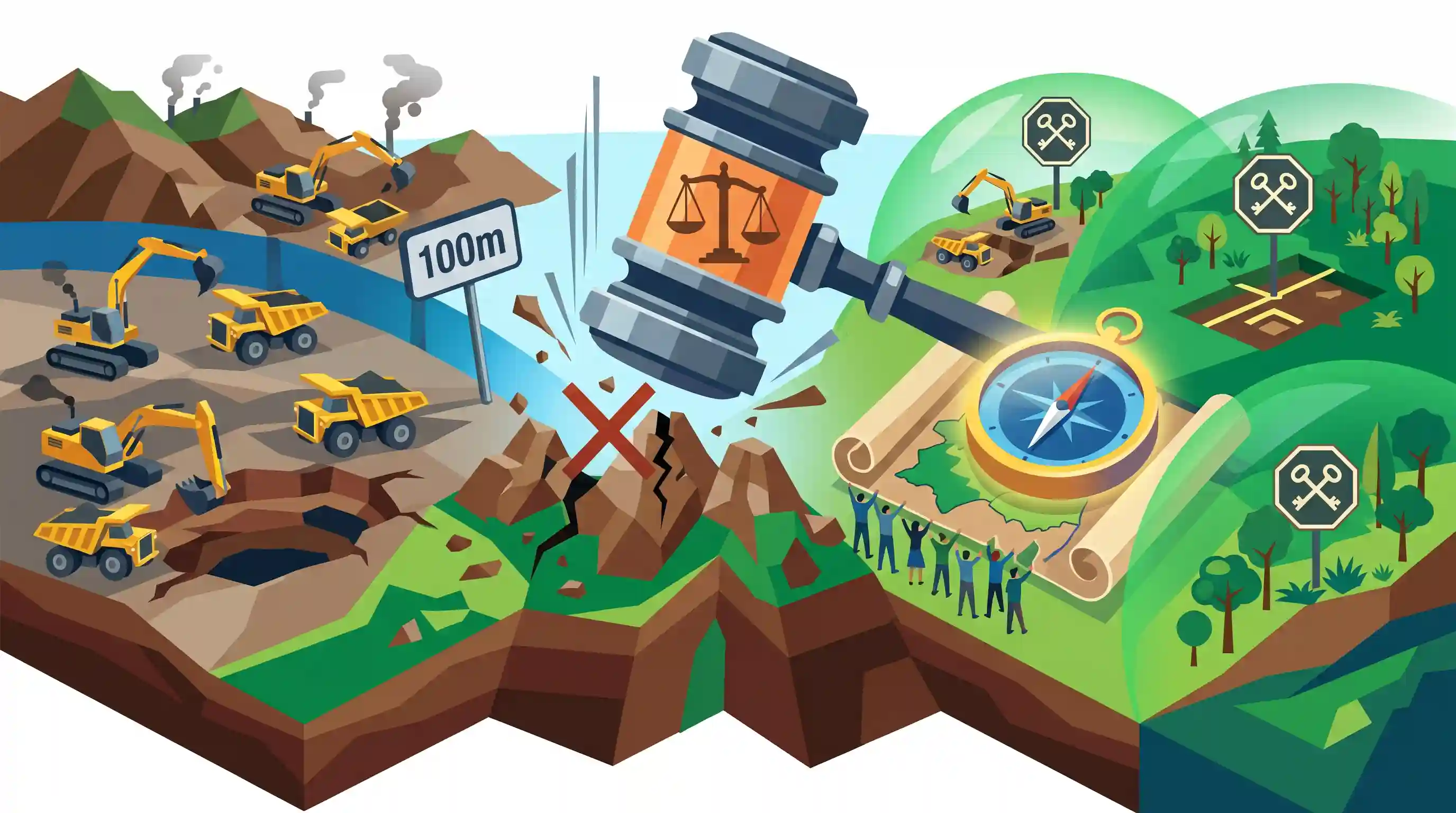
This issue exemplifies the critical balance between economic exploitation (mining) and ecological conservation, highlighting the Supreme Court's proactive role (constitutionalization of environmental problems) in protecting India's oldest mountain range from degradation. It provides a contemporary case study for GS3 (Environment/Mining) and GS2 (Judicial Activism/Governance).
Summary
The Supreme Court of India has registered a suo motu case to define the ecologically sensitive Aravalli hills and ranges and to regulate mining activities within the region across four states. The Court placed a controversial new definition—proposed by an Environment Ministry expert committee requiring a minimum elevation of 100 meters—in abeyance after environmentalists warned it would strip protections from vast areas. Reinforcing environmental safeguards, the apex court banned the granting of fresh mining leases and ordered that the Aravallis be identified based on a 2010 Forest Survey of India report, requiring prior permission for any mining operations.
Key Points
- The Supreme Court took suo motu cognizance to regulate mining and clearly define the Aravalli hills and ranges across Delhi, Haryana, Rajasthan, and Gujarat.
- An Environment Ministry expert committee proposed a definition classifying an 'Aravalli Hill' as having an elevation of 100 meters or more above local relief, which environmentalists argued would exclude and endanger large ecologically sensitive tracts.
- Responding to environmental concerns, the Supreme Court placed the committee's definition in abeyance.
- The Court imposed an interim ban on fresh mining leases in the Aravalli areas, mandating that the region be identified as per the 2010 Forest Survey of India (FSI) report and prohibiting mining without prior permission.
Important Terms
Aravalli Range

The world's oldest fold mountain system, stretching 670 km from Gujarat to Delhi, acting as a natural barrier against Thar Desert expansion and a critical groundwater recharge zone.
UPSC context
GS Paper I (Geography) and GS Paper III (Environment); vital for understanding India's physiography, climate regulation, and desertification control.
Suo Motu
A legal term meaning 'on its own motion,' where a court takes up a case without a formal petition from a party, often to protect public interest.
UPSC context
GS Paper II (Polity/Judiciary); reflects the proactive role of the higher judiciary in protecting fundamental and environmental rights.
Forest Survey of India (FSI)
A premier national organization under the MoEFCC responsible for forest resource assessment and monitoring; its 2010 report serves as a benchmark for defining the Aravallis.
UPSC context
GS Paper III (Environment/Governance); important for data-driven environmental policy and forest cover assessment in India.
Judicial Activism
The proactive role of the judiciary in ensuring the executive and legislature perform their duties, often used to safeguard the environment through innovative legal interpretations.
UPSC context
GS Paper II (Polity/Governance); tests knowledge of the separation of powers and the judiciary's role in socio-environmental issues.
Ecologically Sensitive Areas (ESA)
Ecologically fragile regions identified for protection where industrial activities like mining are restricted to preserve biodiversity and ecological balance.
UPSC context
GS Paper III (Environment); focuses on the 'Environmental Protection Act, 1986' and the trade-off between development and conservation.
Ministry of Environment, Forest and Climate Change (MoEFCC)
The nodal agency in the Union Government for the planning, promotion, and coordination of India’s environmental and forestry policies.
UPSC context
GS Paper II (Governance); primary body for environmental regulation, international treaties, and climate policy implementation.
Prelims Trap
The Aravallis are officially defined by the Environment Ministry's 100-meter elevation rule.
Aspirants might assume the Ministry's definition is law. However, the Supreme Court placed it in abeyance and mandated the 2010 FSI report parameters instead.
Static Concepts Connected
What is the geographical and ecological significance of the Aravalli Range?
- Geological Formation: One of the world's oldest fold mountain systems, highly denuded, stretching ~690km from southwest to northeast.
- Spatial Extent: Spans across Gujarat, Rajasthan, Haryana, and Delhi, terminating at the Delhi Ridge. Guru Shikhar is its highest peak.
- Ecological Role: Acts as a critical water divide between the Indus and Ganga basins, and a 'green barrier' checking the eastward spread of the Thar desert.
How does the Supreme Court exercise suo motu jurisdiction in environmental matters?
- Constitutional Basis: Derives from Article 32, Article 142 (doing complete justice), and the evolution of Public Interest Litigation (PIL) jurisprudence.
- Diluted Locus Standi: Allows the Court to proactively intervene without a formal petitioner to protect Article 21 (Right to a Clean Environment), often relying on expert committees.
Cross-Topic Patterns
Aravallis & Great Green Wall of India
The ecological protection of the Aravallis ties directly to India's UNCCD commitments and the proposed 'Great Green Wall of India' combating desertification from Porbandar to Panipat.
Executive vs Judiciary on Environment
Highlights a recurring theme where the MoEFCC relaxes environmental definitions for economic activity, prompting the Supreme Court to intervene using older, stricter ecological reports.

Expect a 2026 multi-statement question combining Aravalli geography (extent), the FSI definition, and its anti-desertification role.
Linked PYQs · 4
Linked PYQs · 4
- 2025MainsGS3
Mineral resources are fundamental to the country's economy and these are exploited by mining. Why is mining considered an environmental hazard? Explain the remedial measures required to reduce the environmental hazard due to mining.
- 2022MainsGS2
“The most significant achievement of modern law in India is the constitutionalization of environmental problems by the Supreme Court.” Discuss this statement with the help of relevant case laws.
- 2024MainsGS2
Explain the reasons for the growth of public interest litigation in India. As a result of it, has the Indian Supreme Court emerged as the world's most powerful judiciary ?
- 2020MainsGS2
Judicial Legislation is antithetical to the doctrine of separation of powers as envisaged in the Indian Constitution. In this context justify the filing of large number of public interest petitions praying for issuing guidelines to executive authorities.
