Supreme Court Warns States Against Impeding Investigative Processes
Source:Indian Express ↗
Why It Matters
This topic is vital for UPSC aspirants as it bridges two core areas of GS Paper 2: the friction in fiscal/investigative federalism between the Centre and States, and the administrative functioning of the Election Commission regarding electoral rolls. It also serves as a contemporary example of judicial intervention to uphold the rule of law against state resistance.
Summary
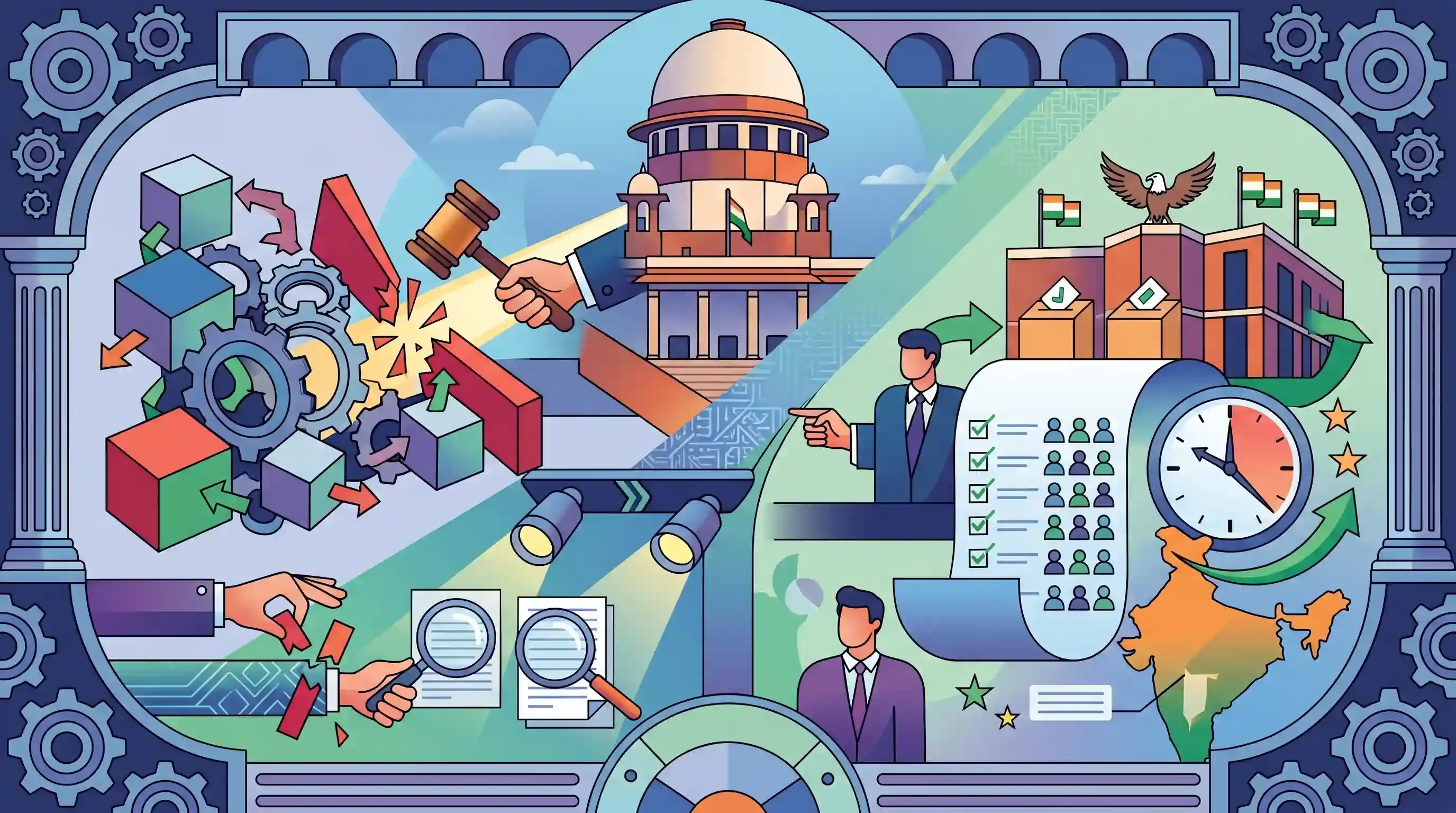
The Supreme Court of India has issued a firm directive to state governments, warning them against creating impediments to investigative processes—likely referring to Special Investigation Teams (SITs) or related central reports. This comes amid frequent federal friction where states push back against central agencies citing jurisdictional overreach. Simultaneously, the Election Commission of India has extended the deadline for finalizing the West Bengal voter list, ensuring the integrity of the electoral roll. The situations combinedly underscore the ongoing institutional efforts to mandate state compliance with constitutional duties and democratic prerequisites.
Key Points
- The Supreme Court issued a stern warning to states, affirming that it will not tolerate any impediments to court-mandated or central investigative processes (such as SITs).
- The intervention highlights the ongoing friction in federalism, where state governments often resist central agencies or court-appointed teams over jurisdictional disputes.
- Concurrently, the Election Commission extended the deadline for the preparation of the Bengal voter list, an essential step in ensuring accurate electoral rolls.
- The dual developments emphasize the critical role of the judiciary and constitutional bodies (like the ECI) in upholding democratic processes and the rule of law against state-level political hurdles.
Important Terms
Special Intensive Revision (SIR)

A detailed Election Commission process to verify and update electoral rolls, involving house-to-house enumeration and document scrutiny to ensure voter list integrity.
UPSC context
GS Paper II: Electoral reforms and constitutional bodies. Focuses on ensuring free and fair elections and preventing disenfranchisement.
Supreme Court of India
The apex judicial body in India, mandated to protect fundamental rights and resolve disputes between the Centre and States or between States.
UPSC context
GS Paper II: Functioning of the Judiciary. Relates to judicial activism and oversight in constitutional and administrative processes.
Election Commission of India (ECI)
An autonomous constitutional authority responsible for administering election processes in India at the national and state levels.
UPSC context
GS Paper II: Appointment to various Constitutional posts, powers, functions, and responsibilities of various Constitutional Bodies.
Federal Structure
A constitutional arrangement where power is shared between the central government and regional state governments, often leading to jurisdictional disputes.
UPSC context
GS Paper II: Issues and challenges pertaining to the federal structure; Centre-State relations and institutional friction.
Electoral Roll
A comprehensive list of all citizens eligible to vote in a particular jurisdiction, which must be regularly updated to maintain democratic legitimacy.
UPSC context
GS Paper II: Representation of People Act and the conduct of elections; vital for ensuring universal adult suffrage.
Prelims Trap
State governments can withhold administrative staff from the Election Commission if they are required for urgent state law and order duties.
Under Article 324(6), providing staff to the ECI is mandatory, not discretionary. During electoral exercises, deployed state officials operate exclusively under the ECI's 'deemed deputation'.
Static Concepts Connected
What are the statutory and constitutional backings for electoral roll revisions?
- Article 324(1): Vests the superintendence, direction, and control of electoral rolls exclusively with the Election Commission of India.
- Article 324(6): Mandates the President or Governor to provide necessary staff to the ECI for discharging its functions.
- RPA 1950: Section 21 empowers the ECI to order a special revision (like SIR) of the electoral roll at any time, overriding routine schedules.
Who handles the preparation of electoral rolls at the constituency level?
- Electoral Registration Officer (ERO): Designated under Section 13B of RPA 1950, the ERO holds the final statutory authority to pass orders on claims and objections regarding the electoral roll.
- Deemed Deputation: During revision periods, state government officers deployed as EROs or Booth Level Officers work under the ECI's discipline, making state interference unconstitutional.
Cross-Topic Patterns
Federalism vs. Deemed Deputation
The friction over electoral roll revisions mirrors conflicts involving CBI general consent and IAS/IPS cadre deputation rules, where states resist central or constitutional bodies commanding state administrative machinery.
Judicial backing of ECI autonomy
The SC's intervention to protect the ECI's mandate aligns with recent judicial scrutiny (like the Anoop Baranwal case on CEC appointments), reinforcing the ECI's insulation from state-level executive pushback.

Questions distinguishing RPA 1950 vs 1951 are staples. Expect a 2026 Prelims statement testing 'deemed deputation' of state staff to ECI.
Linked PYQs · 4
Linked PYQs · 4
- 2021MainsGS2
The jurisdiction of the Central Bureau of Investigation (CBI) regarding lodging an FIR and conducting probe within a particular State is being questioned by various States. However, the power of the States to withhold consent to the CBI is not absolute. Explain with special reference to the federal character of India.
- 2024MainsGS2
What changes has the Union Government recently introduced in the domain of Centre-State relations ? Suggest measures to be adopted to build the trust between the Centre and the States and for strengthening federalism.
- 2022MainsGS2
Discuss the role of the Election Commission of India in the light of the evolution of the Model Code of Conduct.
- 2017PrelimsGS1
Consider the following statements: 1. The Election Commission of India is a five-member body. 2. Union Ministry of Home Affairs decides the election schedule for the conduct of both general elections and bye-elections. 3. Election Commission resolves the disputes relating to splits/mergers of recognised political parties. Which of the statements given above is/are correct?
