Supreme Court rules ED raid obstruction is not Centre-State dispute
Source:Indian Express ↗
Why It Matters
The case brings critical clarity to the scope of Article 131 (original jurisdiction of the SC in federal disputes) and Article 32. It underscores the ongoing friction between central investigative agencies and state governments, a recurrent theme in Centre-State relations and cooperative federalism for UPSC GS Paper 2.
Summary
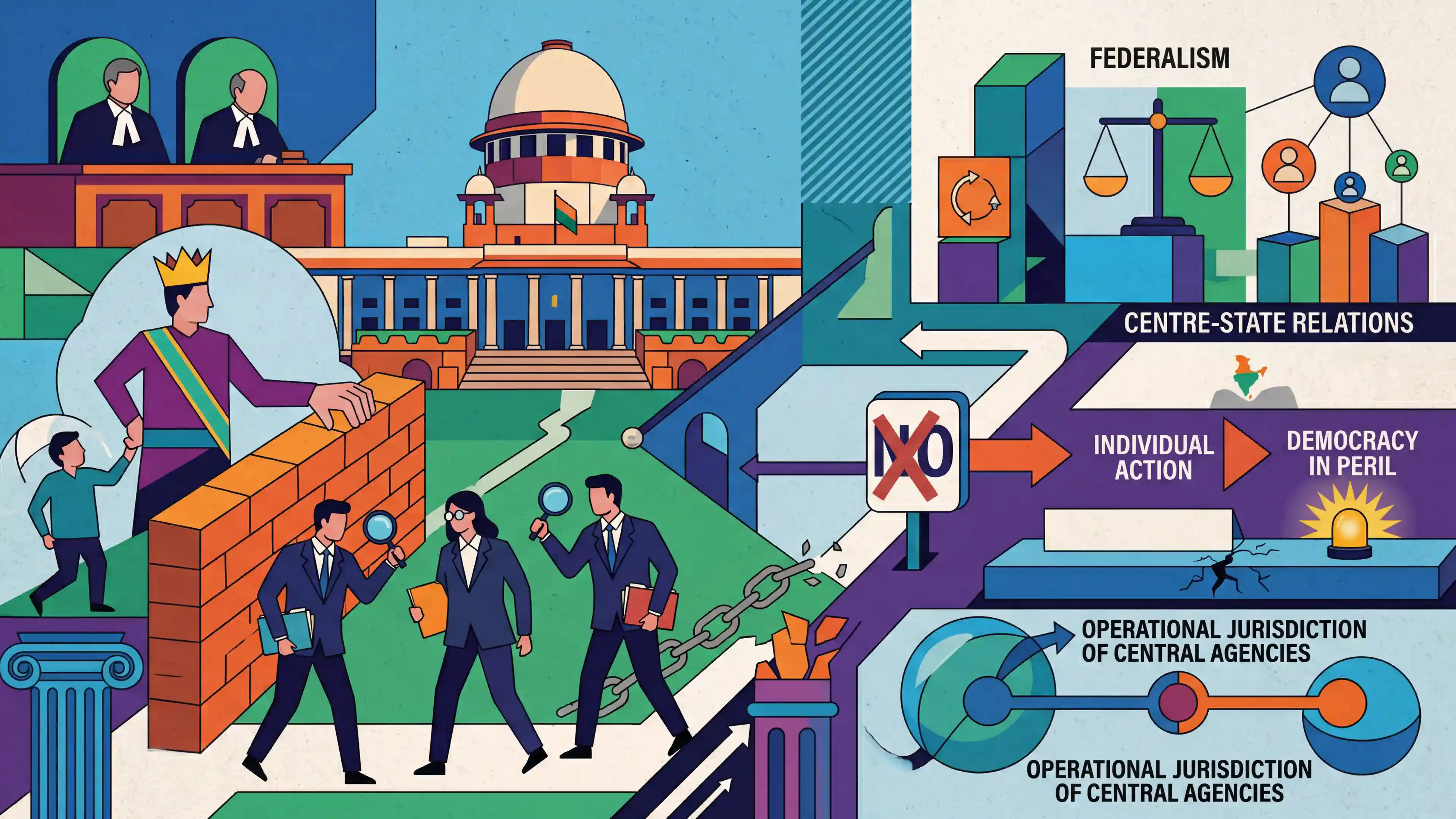
The Supreme Court has clarified that a Chief Minister's alleged obstruction of an Enforcement Directorate (ED) investigation does not qualify as a Centre-State dispute under Article 131 of the Constitution. Hearing an Article 32 petition filed by the ED seeking a CBI probe into West Bengal CM Mamata Banerjee's alleged interference during a raid on I-PAC, the two-judge bench noted that such actions by an individual in power put democracy and the rule of law in peril. The Court rejected arguments from state counsel that the matter was a federal dispute or should be relegated to lower courts, emphasizing that abstract constitutional arguments cannot mask the practical reality of investigative agencies and judicial officers being hindered. This case brings into sharp focus the intersection of federalism, the operational jurisdiction of central agencies, and the boundaries of constitutional safeguards.
Key Points
- The Supreme Court ruled that an alleged obstruction of an Enforcement Directorate (ED) raid by a Chief Minister does not constitute a Centre-State dispute under Article 131.
- The ED filed an Article 32 petition seeking a CBI probe into West Bengal CM Mamata Banerjee's alleged interference during searches at the I-PAC office.
- Counsels for state officials argued that the matter involved a federal dispute (Article 131) and questioned the ED bypassing the High Court/Magistrate to approach the SC directly under Article 32.
- The Supreme Court emphasized that individual obstruction of justice by a sitting CM puts democracy in peril and cannot be shielded as a dispute between the State and the Union.
- The bench noted that courts must consider practical socio-political realities—such as judicial and investigative officers being held hostage—rather than relying solely on abstract constitutional principles.
Important Terms
Article 131 of the Constitution

Grants the Supreme Court exclusive original jurisdiction over disputes between the Union and States or between States themselves, provided the dispute involves a legal right.
UPSC context
GS II: Judiciary/Federalism. Tests understanding of SC's role as a federal court and mechanisms for resolving Centre-State conflicts.
Article 32 of the Constitution
Guarantees the right to move the Supreme Court for the enforcement of Fundamental Rights through writs like Habeas Corpus and Mandamus.
UPSC context
GS II: Fundamental Rights. Tests knowledge of constitutional remedies and the SC’s mandatory jurisdiction in protecting liberties.
Enforcement Directorate (ED)
A specialized financial investigation agency under the Ministry of Finance, mandated to enforce the PMLA, FEMA, and Fugitive Economic Offenders Act.
UPSC context
GS II: Statutory Bodies. Tests awareness of central agencies' powers, jurisdictional conflicts, and money laundering laws.
Original Jurisdiction
The authority of a court to hear and decide a case in the first instance, rather than on appeal from a lower court.
UPSC context
GS II: Judiciary. Tests conceptual clarity on judicial powers and their application in federal disputes.
Central Bureau of Investigation (CBI)
India's premier investigative agency, deriving powers from the DSPE Act, 1946, to probe corruption, economic offenses, and special crimes.
UPSC context
GS II: Governance/Statutory Bodies. Tests understanding of federal friction and state consent requirements for central probes.
Rule of Law
A constitutional principle where everyone, including government officials, is subject to the law, ensuring equality and the absence of arbitrary power.
UPSC context
GS II: Constitution. Tests knowledge of the Basic Structure doctrine and the judiciary's role in checking executive overreach.
Prelims Trap
Disputes between a Central agency like the ED and a State fall under the Supreme Court's exclusive original jurisdiction (Article 131).
Article 131 strictly covers disputes between the Government of India and States involving legal rights. It excludes individual functionaries' actions or statutory bodies like the ED.
Static Concepts Connected
What are the essential conditions for invoking the Supreme Court's Original Jurisdiction under Article 131?
- Parties involved: Must be strictly between the Government of India and State(s), or between two or more States.
- Legal right: The dispute must involve a question of law or fact on which the existence or extent of a legal right depends.
- Exclusions: Does not cover political disputes, inter-state water disputes, or cases involving private citizens and statutory bodies.
Can statutory bodies or government departments invoke Article 32 to enforce Fundamental Rights?
- State under Art 12: Agencies like the ED are considered 'State' under Article 12. Fundamental Rights are typically protections against the State, not for the State.
- Article 32 scope: Article 32 is exclusively for enforcing Part III Fundamental Rights, unlike Article 226 which covers 'other purposes' including ordinary statutory rights.
Cross-Topic Patterns
CBI general consent & federalism
This friction mirrors the frequent withdrawal of 'general consent' for the CBI under the DSPE Act, a recurring Mains theme highlighting the tension between state police autonomy and central investigative powers.
Rule of Law vs Constitutional Machinery
The Court noting that blocking agencies puts democracy in peril links directly to Article 355/356, where the breakdown of constitutional machinery and rule of law justifies central intervention.

Expect a 2026 Prelims statement testing if central statutory agencies (like ED/CBI) qualify as 'Government of India' under Article 131.
Linked PYQs · 4
Linked PYQs · 4
- 2012PrelimsGS1
Which of the following are included in the original jurisdiction of the Supreme Court? 1. A dispute between the Government of India and one or more States 2. A dispute regarding elections to either House of the Parliament or that of Legislature of a State 3. A dispute between the Government of India and a Union Territory 4. A dispute between two or more States Select the correct answer using the codes given below:
- 2014PrelimsGS1
The power of the Supreme Court of India to decide disputes between the Centre and the States falls under its
- 2021MainsGS2
The jurisdiction of the Central Bureau of Investigation (CBI) regarding lodging an FIR and conducting probe within a particular State is being questioned by various States. However, the power of the States to withhold consent to the CBI is not absolute. Explain with special reference to the federal character of India.
- 2024MainsGS2
What changes has the Union Government recently introduced in the domain of Centre-State relations ? Suggest measures to be adopted to build the trust between the Centre and the States and for strengthening federalism.
