Supreme Court Hears Maharashtra Local Body Election Reservation Case
Source:livelaw ↗
Why It Matters
Crucial for understanding the legal and constitutional dynamics of local self-government elections, OBC reservations, and judicial oversight in Maharashtra.
Summary
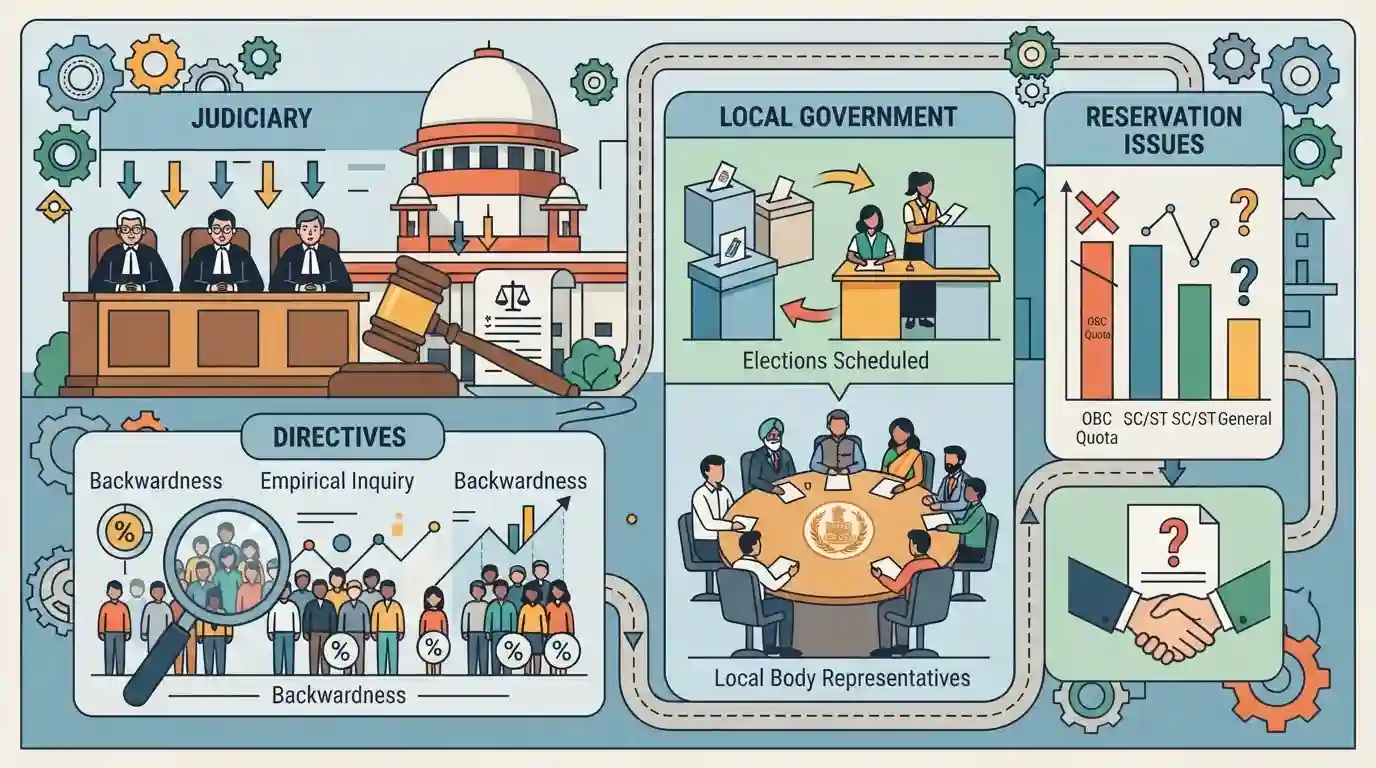
The article covers ongoing Supreme Court proceedings concerning local body elections in Maharashtra, focusing on political reservations and compliance with judicial directives for conducting empirical inquiry into backwardness.
Key Points
- The Supreme Court of India is hearing matters regarding local body elections and OBC reservations in Maharashtra.
- Local body elections in Maharashtra have faced delays due to legal contentions surrounding political reservations and the triple-test requirement for OBCs.
- Constitutional provisions governing Panchayats and Municipalities (Parts IX and IX-A) outline reservation frameworks for local governance.
Important Terms
Supreme Court of India

The highest judicial tribunal and ultimate court of appeal in India, established under Article 124, exercising original, appellate, and advisory jurisdictions over federal and constitutional disputes.
UPSC context
Core topic in GS Paper II (Indian Constitution—Structure, Organization, and Functioning of the Judiciary). Tests understanding of constitutional interpretation and judicial review.
Maharashtra State Election Commission
An autonomous constitutional authority established under Articles 243K and 243ZA responsible for conducting free and fair elections to rural and urban local bodies in Maharashtra.
UPSC context
Important for MPSC and GS Paper II (Polity and Governance—Local Government and Constitutional Bodies). Tests awareness of decentralized governance and SEC powers.
Prelims Trap
OBC political reservations can be provided up to 50% in local body elections independently of SC/ST quotas.
The 50% reservation ceiling applies strictly to the aggregate of all reservations (SC, ST, and OBC) in local bodies, not separately to OBCs alone.
Static Concepts Connected
What is the triple-test requirement laid down by the Supreme Court for OBC reservations in local bodies?
- Empirical Inquiry: Establish a dedicated commission to conduct a rigorous empirical inquiry into the nature and implications of backwardness in local bodies.
- Proportional Quota: Specify the proportion of reservation required for each local body based on the commission's recommendations.
- 50% Ceiling: Ensure that aggregate reservations for SCs, STs, and OBCs taken together do not exceed the aggregate 50 percent ceiling limit.
Cross-Topic Patterns
Local Body Reservations & Judicial Review
Judicial enforcement of the 50% cap in local body reservations directly intersects with cooperative federalism and judicial review under Article 13/142.
Empirical Inquiry & Backward Classes Commissions
The triple-test requirement for empirical inquiry into backwardness links judicial oversight with executive data collection mechanisms like backward classes commissions.

Supreme Court's triple-test criteria for OBC reservations in local bodies frequently appears in MPSC polity statements.
Linked PYQs · 2
Linked PYQs · 2
- 2023MPSC_PRELIMSGS1
Match the pairs correctly. | Column A | Column B | |---|---| | A. Part - I | i. Fundamental Rights | | B. Part - III | ii. Panchayat Raj | | C. Part - IX | iii. Citizenship | | D. Part - II | iv. The Union and its territory | Code: A B C D
- 2019MPSC_PRELIMSGS1
Which one of the following statements about the Governor of Maharashtra is true ?
