Supreme Court acquits Sri Lankan man in wrong identity UAPA case
Source:Indian Express ↗
Why It Matters
This case is directly relevant to the internal security and governance syllabus, illustrating the challenges of counter-terrorism investigations and the potential for human rights violations under stringent laws like the UAPA. It underscores the critical role of the judiciary in acting as a check on investigating agencies.
Summary
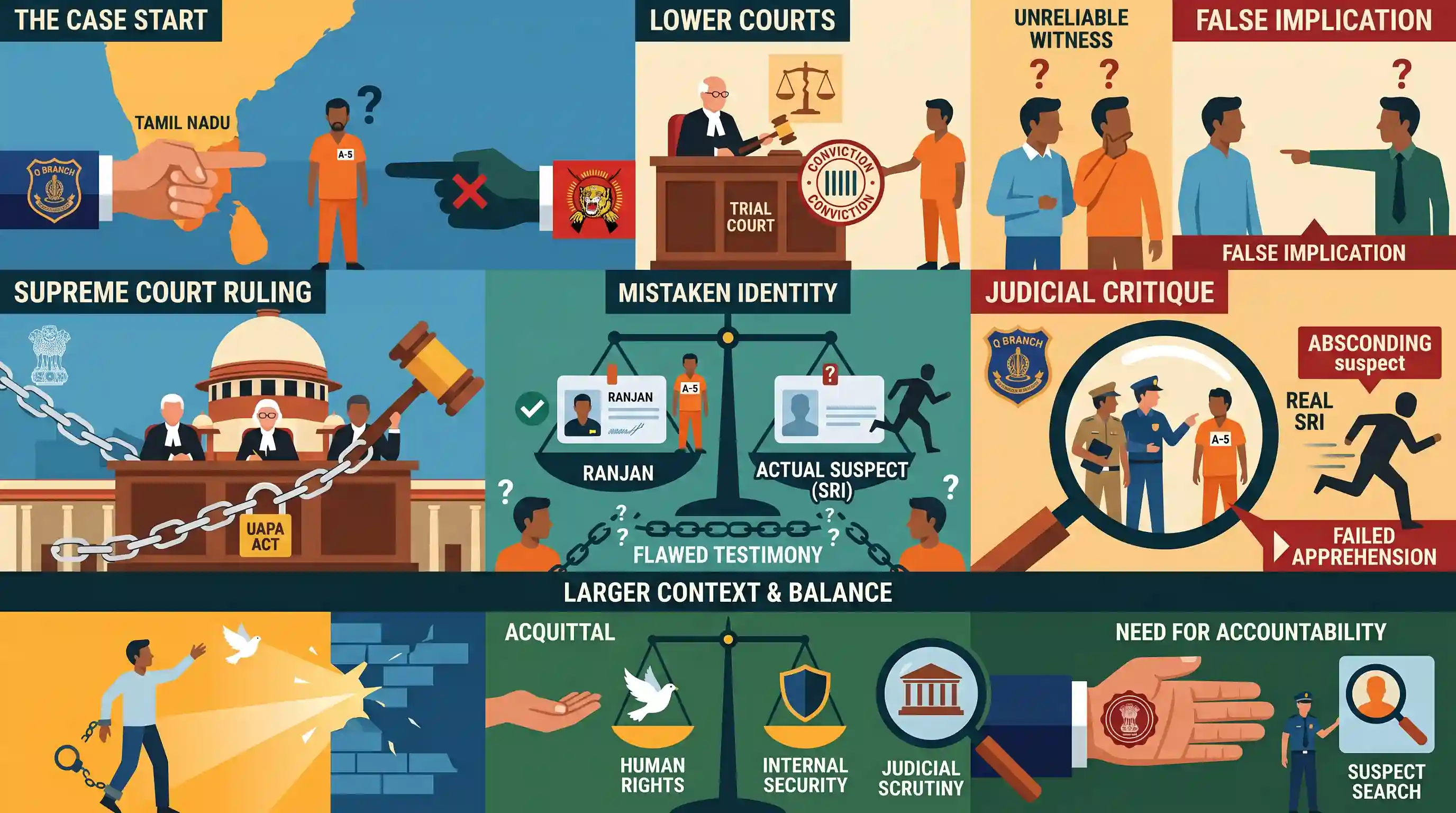
The Supreme Court of India acquitted a Sri Lankan man who had been jailed under the Unlawful Activities Prevention Act (UAPA) for alleged ties to the Liberation Tigers of Tamil Eelam (LTTE). Overturning previous convictions by lower courts, the Supreme Court ruled the case one of mistaken identity, noting that the prosecution relied on unreliable oral testimony. The bench strongly criticized the investigating agency for falsely implicating the accused while failing to take adequate steps to apprehend the actual suspect, bringing into focus the critical need for judicial scrutiny over investigations conducted under stringent anti-terror laws.
Key Points
- The Supreme Court acquitted a Sri Lankan national convicted under the UAPA for allegedly being an LTTE operative, citing a clear case of mistaken identity.
- The police had claimed the accused was 'Sri', a former security detail member for late LTTE chief Veluppillai Prabhakaran, tasked with reviving the terror outfit using cyanide and GPS-4 chemicals.
- The Court found the prosecution's case rested solely on 'completely unreliable' oral testimonies from two witnesses who had their own motives to falsely implicate the accused.
- The judgment criticized the investigating agency for its 'inaction and indolence' in failing to trace the actual absconding accused, casting doubt on the bona fides of the investigation.
- The case highlights persistent concerns surrounding the potential misuse of stringent anti-terror laws like UAPA and the necessity for rigorous evidentiary standards to prevent human rights violations.
Important Terms
Unlawful Activities Prevention Act (UAPA)

India’s primary anti-terror law enacted in 1967, allowing the government to designate individuals and organizations as terrorists. It features stringent bail conditions and extended detention periods (up to 180 days).
UPSC context
GS Paper III: Internal Security. Tests knowledge of anti-terror legislation, its amendments (2019), and the balance between security and civil liberties.
Liberation Tigers of Tamil Eelam (LTTE)
A separatist militant organization founded in 1976 that sought an independent Tamil state in Sri Lanka. It remains a banned organization in India under the UAPA.
UPSC context
GS Paper III: Terrorism and International Relations. Relevant for India-Sri Lanka ties and the history of regional ethnic conflicts.
Q Branch (Tamil Nadu Police)
A specialized intelligence and investigation wing of the Tamil Nadu Police, primarily tasked with monitoring and investigating cases related to extremism, terrorism, and banned organizations like the LTTE.
UPSC context
GS Paper III: Role of state-level specialized agencies in managing internal security threats and intelligence gathering.
Judicial Scrutiny
The power of the judiciary to examine the actions of the legislative, executive, and administrative arms of the government to ensure they conform to the Constitution.
UPSC context
GS Paper II: Separation of Powers and Judiciary. Critical for evaluating the courts' role in preventing executive overreach in UAPA cases.
Internal Security
The state’s act of maintaining law and order and peace within its borders. It includes countering terrorism, insurgency, and organized crime.
UPSC context
GS Paper III: Primary syllabus head. Tests understanding of various threats to the nation's integrity and the institutional response.
Prelims Trap
"Under UAPA, the burden of proof completely shifts to the accused for trial conviction."
The 'reverse burden' under UAPA Section 43D(5) applies to denying bail. For a final trial conviction, the prosecution must still prove guilt beyond a reasonable doubt.
Static Concepts Connected
How is an organization officially banned under the UAPA?
- Centre's Notification: The Central Government issues a notification declaring an entity an "unlawful association" or "terrorist organization".
- Tribunal Confirmation: A UAPA Tribunal headed by a sitting High Court judge must adjudicate and confirm the ban within 6 months.
- Validity Period: Once confirmed, the ban is typically valid for 5 years, after which it requires periodic review and extension.
What are the restrictive bail and custody provisions under UAPA?
- Section 43D(5): Courts must deny bail if the police report or case diary suggests the accusations are 'prima facie' true.
- No Anticipatory Bail: Section 438 of the CrPC, which provides for anticipatory bail, does not apply to offenses under the UAPA.
- Extended Custody: Allows for extended police custody (up to 30 days) and judicial custody (up to 180 days without a chargesheet).
Cross-Topic Patterns
UAPA Bail vs. Article 21
SC increasingly invokes Article 21 (Right to Speedy Trial) to grant bail in UAPA cases despite statutory restrictions, showing a trend of constitutional courts mitigating harsh procedural hurdles.
Low convictions in stringent laws
Like PMLA, UAPA faces scrutiny for high undertrial incarceration but abysmally low conviction rates (2-4%), linking internal security laws directly to investigative capacity and police reform issues.

Expect a multi-statement prelims question on UAPA: distinguishing unlawful associations vs terrorist orgs, and UAPA Tribunal validations.
Linked PYQs · 2
Linked PYQs · 2
- 2019MainsGS3
Indian Government has recently strengthened the anti-terrorism laws by amending the Unlawful Activities (Prevention) Act (UAPA), 1967 and the NIA Act. Analyze the changes in the context of prevailing security environment while discussing the scope and reasons for opposing the UAPA by human rights organizations.
- 2023MainsGS3
What are the internal security challenges being faced by India? Give out the role of Central Intelligence and Investigative Agencies tasked to counter such threats.
