JK Statehood Restoration Plea Scheduled for Supreme Court Hearing
Source:The Hindu ↗
Why It Matters
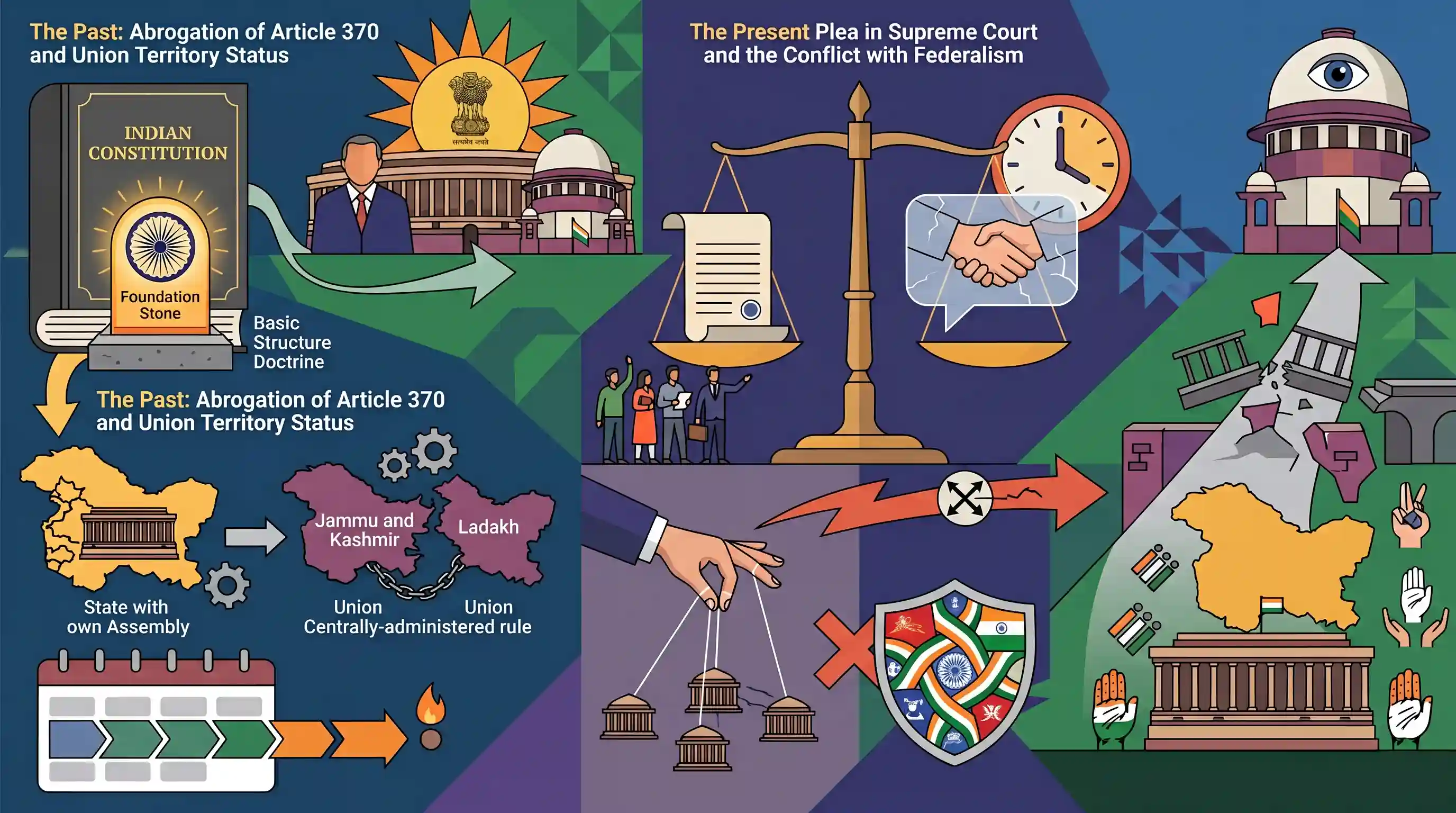
The issue goes to the heart of India's federal structure and the Basic Structure Doctrine. It demonstrates the judicial expectations placed on executive assurances (restoring statehood) and the constitutional implications of reducing a State to a Union Territory indefinitely, which is highly relevant for GS2 Polity and Governance questions.
Summary
The Supreme Court of India has scheduled a hearing for a plea demanding the immediate restoration of statehood to Jammu and Kashmir. Filed on the sixth anniversary of the abrogation of Article 370, the petition argues that the Centre's failure to restore statehood—despite holding peaceful Assembly elections—violates the principle of federalism, a core component of the Basic Structure Doctrine. The applicants note that while the Court's 2023 judgment upheld the abrogation of Article 370, it relied on the Centre's assurance to restore statehood 'at the earliest'. The delay, they argue, continuously diminishes the democratic and constitutional rights of the people of J&K by keeping it a Union Territory.
Key Points
- The Supreme Court of India will hear a plea on August 8 seeking the time-bound restoration of statehood to Jammu and Kashmir.
- The applicants argue that the continued status of J&K as a Union Territory, especially after peaceful Assembly elections, violates federalism, which is part of the Constitution's Basic Structure.
- In 2023, the Supreme Court upheld the abrogation of Article 370 but accepted the Centre's assurance that statehood would be restored 'at the earliest' without setting a firm deadline.
- The petition asserts that delaying statehood diminishes the democratic rights of J&K citizens and contradicts the constitutional mandate of representative government.
Important Terms
Article 370

A temporary constitutional provision (Part XXI) that granted special autonomous status to Jammu and Kashmir, limiting Parliament's legislative powers over the region until its abrogation in August 2019.
UPSC context
GS Paper-II (Polity); tests understanding of J&K’s historical special status, its abrogation, and implications for Indian integration.
Basic Structure Doctrine
A judicial principle from the 1973 Kesavananda Bharati case stating that Parliament cannot amend the Constitution's essential features, such as democracy and federalism, which form its core identity.
UPSC context
GS Paper-II (Constitution); tests knowledge of judicial limits on amending powers (Article 368) and landmark Supreme Court judgments.
Federalism
A system of government where power is shared between the Union and States. In India, it is characterized by a 'unitary bias' and recognized as part of the Basic Structure.
UPSC context
GS Paper-II (Polity); tests knowledge of Centre-State relations and the distribution of powers in India’s quasi-federal structure.
Union Territory
Administrative units governed directly by the Union Government. Some, like Jammu and Kashmir, possess a Legislative Assembly but remain under the overriding authority of a Lieutenant Governor.
UPSC context
GS Paper-II (Polity); tests understanding of India's administrative divisions and differences between States and Union Territories.
Judicial Review
The power of the judiciary to examine the constitutionality of legislative acts and executive actions, ensuring they conform to the Constitution and the Basic Structure Doctrine.
UPSC context
GS Paper-II (Polity/Judiciary); tests understanding of the judiciary's role as the guardian of the Constitution.
Prelims Trap
"The Supreme Court in 2023 set a binding, time-bound deadline for the Centre to restore Jammu & Kashmir's statehood."
The SC set a strict deadline (Sept 30, 2024) for Assembly elections but only directed that statehood be restored "at the earliest," leaving the exact timeline open.
Static Concepts Connected
What are the legislative constraints on the J&K UT Assembly?
- Article 239A framework: Operates under Article 239A (similar to Puducherry), providing a legislative assembly but keeping ultimate executive control with the Union.
- Excluded subjects: The Assembly can legislate on State/Concurrent lists, but 'Public Order' and 'Police' are explicitly reserved for the Union Government.
- LG's primacy: The Lieutenant Governor retains significant discretionary powers, acting as the Centre's administrator rather than a mere titular head.
How is Federalism protected under the Basic Structure Doctrine?
- S.R. Bommai (1994): In the landmark S.R. Bommai case (1994), the SC explicitly cemented federalism as part of the Basic Structure, ruling states are not mere appendages of the Union.
- Parliamentary limits: While Article 3 allows Parliament to alter state boundaries or names, the permanent conversion of a State into a UT theoretically challenges the basic federal balance.
Cross-Topic Patterns
J&K UT vs Delhi's GNCTD Act disputes
The friction over Lieutenant Governor discretionary powers links J&K's current UT status directly to ongoing Delhi Government vs Centre constitutional battles over administrative control.
Article 3 and the 'downgrade' precedent
The 2019 Reorganisation marked the first time a full state was downgraded to a UT, testing the unwritten limits of Article 3 and cooperative federalism.

Expect a comparative Prelims question testing the legislative exceptions of Art 239A (J&K, Puducherry) versus Art 239AA (Delhi) in 2026.
Linked PYQs · 4
Linked PYQs · 4
- 2014MainsGS2
Though the federal principle is dominant in our Constitution and that principle is one of its basic features, but it is equally true that federalism under the Indian Constitution leans in favour of a strong Centre, a feature that militates against the concept of strong federalism. Discuss.
- 2016MainsGS2
To what extent is Article 370 of the Indian Constitution, bearing marginal note "Temporary provision with respect to the State of Jammu and Kashmir", temporary? Discuss the future prospects of this provision in the context of Indian polity.
- 2025MainsGS2
Discuss the nature of Jammu and Kashmir Legislative Assembly after the Jammu and Kashmir Reorganization Act, 2019. Briefly describe the powers and functions of the Assembly of the Union Territory of Jammu and Kashmir.
- 2020PrelimsGS1
Consider the following statements: 1. The Constitution of India defines its 'basic structure' in terms of federalism, secularism, fundamental rights and democracy. 2. The Constitution of India provides for 'judicial review' to safeguard the citizens' liberties and to preserve the ideals on which the Constitution is based. Which of the statements given above is/are correct?
