Supreme Court to Review Constitutional Validity of Online Gaming Act
Source:Indian Express ↗
Why It Matters
The case is a prime example of the intersection between emerging digital economies and constitutional law. It highlights crucial debates around the Seventh Schedule (Centre-State legislative competence), the doctrine of reasonable classification (games of skill vs. chance), and the proportionality test under Article 21, making it highly relevant for GS Paper 2.
Summary
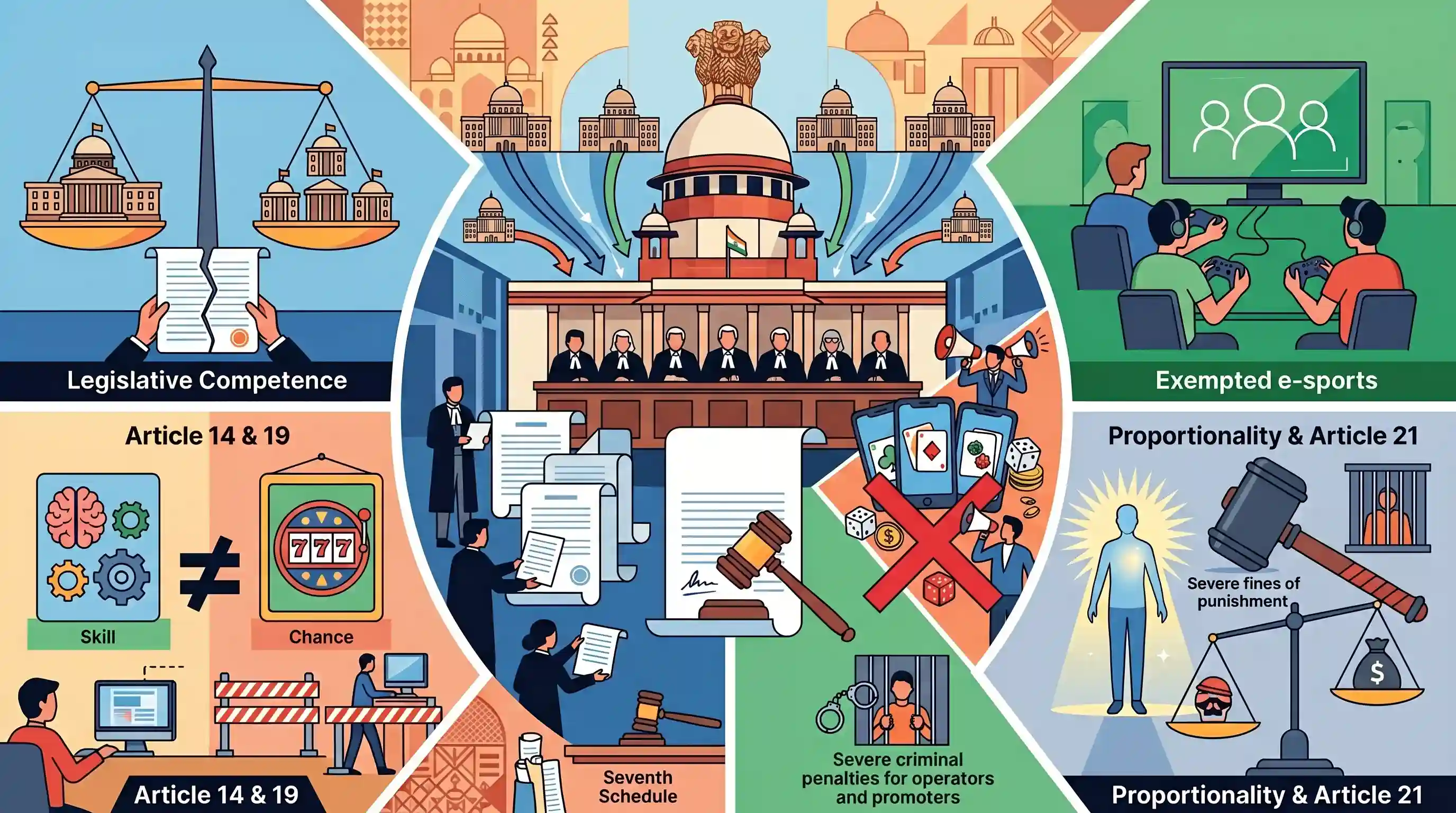
The Supreme Court is set to hear consolidated petitions challenging the newly enacted Promotion and Regulation of Online Gaming Act, 2025. The Centre moved to transfer similar cases from various High Courts to the Supreme Court to avoid conflicting rulings. The Act institutes a blanket ban on offering, operating, and advertising online money games, imposing severe criminal penalties on both operators and promoters, while exempting organized e-sports. The apex court will evaluate four broad constitutional issues: Parliament's legislative competence to legislate on a state subject, the lack of distinction between games of skill and chance (implicating Articles 14 and 19), and whether the harsh criminal sanctions adhere to the proportionality doctrine under Article 21.
Key Points
- The Supreme Court will hear petitions challenging the Promotion and Regulation of Online Gaming Act, 2025, which imposes a blanket ban on online money games.
- The Centre sought the consolidation of cases from the Delhi, Karnataka, and Madhya Pradesh High Courts to the Supreme Court for a single authoritative judgment.
- The Act carries severe penalties, including up to three years of imprisonment and a Rs 1 crore fine for operators, and two years jail time for influencers promoting such platforms.
- The law explicitly exempts 'e-sports' involving organized competitive multi-sport events from the ban.
- The Court will examine Parliament's legislative competence to enact the law, as 'gaming' falls under the State list in the Seventh Schedule.
- Additional constitutional issues include whether treating games of skill and games of chance equally violates Articles 14 and 19, and if the severe penalties satisfy the proportionality test under Article 21.
Important Terms
Promotion and Regulation of Online Gaming Act, 2025

A central law enacted in August 2025 that prohibits real-money online games while promoting e-sports and social games, establishing a national regulatory framework to address addiction and financial crimes.
UPSC context
GS II (Government Policies/Interventions). Tests knowledge of new regulatory frameworks for the digital economy and emerging social challenges.
Game of Skill vs. Game of Chance
The 'predominance test' used by Indian courts to distinguish between protected legitimate businesses (skill-based) and prohibited gambling (chance-based) under Article 19(1)(g).
UPSC context
GS II (Judiciary/Fundamental Rights). Tests understanding of judicial doctrines and the legal boundaries of commercial activity.
Legislative Competence
The constitutional authority of a legislature to enact laws, often contested when a central law overlaps with subjects in the State List (like Betting and Gambling).
UPSC context
GS II (Seventh Schedule/Federalism). Critical for questions on Centre-State relations and the distribution of legislative powers.
Article 19(1)(g)
A fundamental right guaranteeing Indian citizens the freedom to practice any profession or carry on any occupation, trade, or business, subject to reasonable restrictions.
UPSC context
GS II (Fundamental Rights). Frequently tested in the context of state bans on specific industries or services.
Doctrine of Proportionality
A judicial principle ensuring that state-imposed restrictions or penalties are not excessive and maintain a fair balance between the objective and the means employed.
UPSC context
GS II (Judiciary/Article 21). Tests ability to analyze the reasonableness of state actions and criminal sanctions.
Transfer Petition (Article 139A)
Under Article 139A, the Supreme Court's power to withdraw cases involving substantially the same questions of law from High Courts to itself for uniform adjudication.
UPSC context
GS II (Judiciary). Relevant for questions on the Supreme Court's jurisdiction and its role in ensuring legal consistency.
Prelims Trap
Since the Centre passed the Online Gaming Act, betting and online gaming fall under the Concurrent List.
Betting and gambling explicitly fall under Entry 34 of the State List. The crux of the Supreme Court challenge is precisely Parliament's legislative competence.
Static Concepts Connected
What is the Supreme Court's power to transfer cases under Article 139A?
- Substantial law question: Cases pending before the SC and HCs, or multiple HCs, must involve the same or substantially the same constitutional or legal question.
- General importance: The Supreme Court must be satisfied that the legal question is of general public importance, necessitating a single authoritative ruling to avoid conflicting judgments.
- Trigger mechanism: The Supreme Court can initiate the transfer suo motu, or upon an application filed by the Attorney General of India or a party to the case.
How does constitutional jurisprudence distinguish games of skill from games of chance?
- Predominance test: Indian courts use this doctrine; if the element of skill predominates over the element of chance in a game's outcome, it is not considered gambling.
- Article 19 protection: Games of skill are recognized as legitimate commercial activities and enjoy fundamental right protection under Article 19(1)(g) to practice any profession or carry on trade.
- Article 14 implication: Legislation that groups skill-based games with pure gambling under a blanket ban is often challenged as treating unequals equally, violating the Right to Equality.
Cross-Topic Patterns
Federalism in the Digital Age
Technology blurs geographical boundaries, leading the Centre to legislate on digital spaces using IT powers. This increasingly conflicts with State List subjects like public order or gambling.
Proportionality in Regulatory Penalties
Applying the Puttaswamy proportionality test beyond privacy to assess whether severe criminal sanctions in new regulatory or economic laws arbitrarily violate Article 21 liberty.

Digital federalism: legislative competence conflicts over borderless digital subjects (State List vs Union tech powers) is highly probable for GS2 Mains.
Linked PYQs · 3
Linked PYQs · 3
- 2024MainsGS2
What changes has the Union Government recently introduced in the domain of Centre-State relations ? Suggest measures to be adopted to build the trust between the Centre and the States and for strengthening federalism.
- 2023MainsGS2
“The Constitution of India is a living instrument with capabilities of enormous dynamism. It is a constitution made for a progressive society.” Illustrate with special reference to the expanding horizons of the right to life and personal liberty.
- 2024MainsGS2
Right to privacy is intrinsic to life and personal liberty and is inherently protected under Article 21 of the constitution. Explain. In this reference discuss the law relating to D.N.A. testing of child in the womb to establish its paternity.
